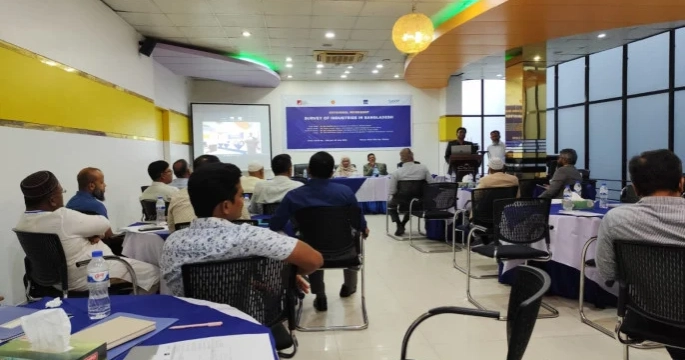
The Bangladesh Investment Development Authority (BIDA), in partnership with the Asian Development Bank (ADB) and the South Asian Network on Economic Modeling (SANEM), held a divisional workshop in Khulna on Thursday to introduce the "Survey of Industries in Bangladesh."
The event, held at a hotel in Khulna, brought together government officials, private sector representatives, and local business leaders to discuss promising regional sectors, identify barriers to investment, and seek stakeholder cooperation in verifying industrial data.
The survey led by BIDA, funded by ADB, and technically supported by SANEM—aims to identify investor grievances, resolve systemic bottlenecks, and establish a unified investment database to assist the government in evidence-based policymaking.
Addressing the workshop as the chief guest, Ms. Sifat Mehnaz, Additional Divisional Commissioner of Khulna Division, emphasized the need for efficient land use and the adoption of modern agricultural technologies to boost the economy.
She pointed out that approximately 30 percent of export-potential fruits are currently lost to post-harvest damage, and suggested the establishment of cold storage facilities to safeguard foreign earnings.
BIDA Director General Gazi AKM Fazlul Haque, who chaired the session, highlighted that the survey would replace scattered and redundant records with a clearer, unified database to help the government frame effective industrial policies.
"We must first make our domestic investment environment strong and keep local investors satisfied, which will naturally attract foreign investors," he said, noting that local business leaders have urgently requested a centralized portal for investment-related information.
Tasnim Alam, Public Sector Economist at ADB Bangladesh, who joined the session online, noted that with Bangladesh set to graduate from Least Developed Country (LDC) status in about three years, the private sector must step up to lead economic growth.
He stressed the importance of easing investor burdens through initiatives like BIDA's One-Stop Service (OSS).
Md. Tariqul Islam Zaheer, Managing Director of Achia Sea Foods Limited and guest of honour, discussed Khulna’s industrial potential in jute, sugar, shipbuilding, and cold storage sectors.
He advocated for establishing eco-friendly industries near the Sundarbans and integrating modern technologies into local enterprises. He also welcomed the survey, warning that the country’s growing debt is a heavy load being passed to future generations.
Dr. Selim Raihan, Executive Director of SANEM and Economics Professor at Dhaka University, explained that Bangladesh is simultaneously navigating three major structural shifts: energy, technology, and economic composition. He stated that building a unified investment database integrated with BIDA’s OSS portal is critical to overcoming the country's weak evidence base and fragmented records.
The industrial study is being executed through five work streams: collecting investment data, verifying it, building a standardized database, producing analytical reports, and preparing a national investment compendium.
SANEM Programme Director Zubayer Hossen highlighted that the survey covers all major economic sectors and ownership models across all eight administrative divisions of Bangladesh.