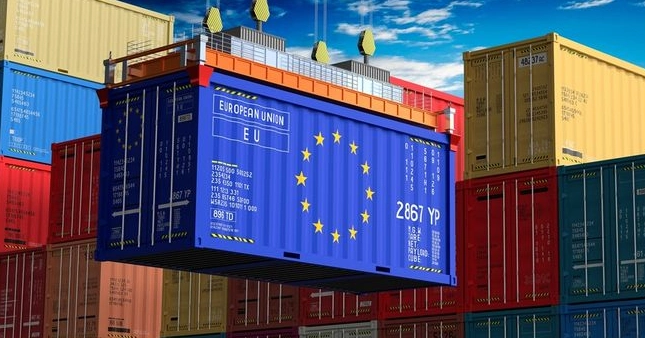
The European Union's apparel imports experienced an 11.27 percent negative growth during the January-February period of 2026, totaling €13.83 billion, according to the latest data from Eurostat.
The contraction in the EU fashion retail market was driven by a 6.23 percent decline in import volume and a 5.38 percent decrease in average unit prices compared to the same period last year.
Bangladesh, one of the primary apparel suppliers to the EU, took a significant hit as its garment exports to the bloc fell to €2.89 billion during the first two months of 2026, dropping sharply from €3.57 billion recorded in the corresponding period of 2025.
EU delegation visits Apex factory, praises sustainability efforts
The country registered a substantial 19.26 percent negative growth in export value to the EU, compounded by an 11.14 percent decrease in shipment volume and a 9.13 percent drop in unit prices.
A month-on-month comparison reveals that in February 2026 alone, Bangladesh's apparel exports to the EU declined by 12.39 percent in value, 3.30 percent in volume, and 9.39 percent in unit prices compared to February 2025.
"Exporters are grappling with severe margin compression, losing revenue on both ends due to fewer work orders and lowered per-unit prices amid global demand softness," said Mohiuddin Rubel, Former Director of the Bangladesh Garment Manufacturers and Exporters Association (BGMEA) and Additional Managing Director of Denim Expert Ltd.
A broad-based downward trend was visible across almost all major manufacturing hubs supplying the European market.
China, the largest apparel exporter to the EU, managed to increase its export volume by 1.34 percent, but still registered a 4.01 percent decline in total value, reaching €4.20 billion, due to a 5.27 percent drop in its unit prices.
Among other major competitors, Turkey faced a massive 22.91 percent decline in its apparel exports to the EU, falling to €1.20 billion. Vietnam also remained in negative territory with a 2.06 percent decline in export value, totaling €711.73 million, despite recording a 6.56 percent increase in its unit prices.
Other key supplying nations, including India, Pakistan, and Cambodia, similarly mirrored the negative growth trend, reflecting persistent cost-of-living pressures and cautious consumer spending across the Eurozone.