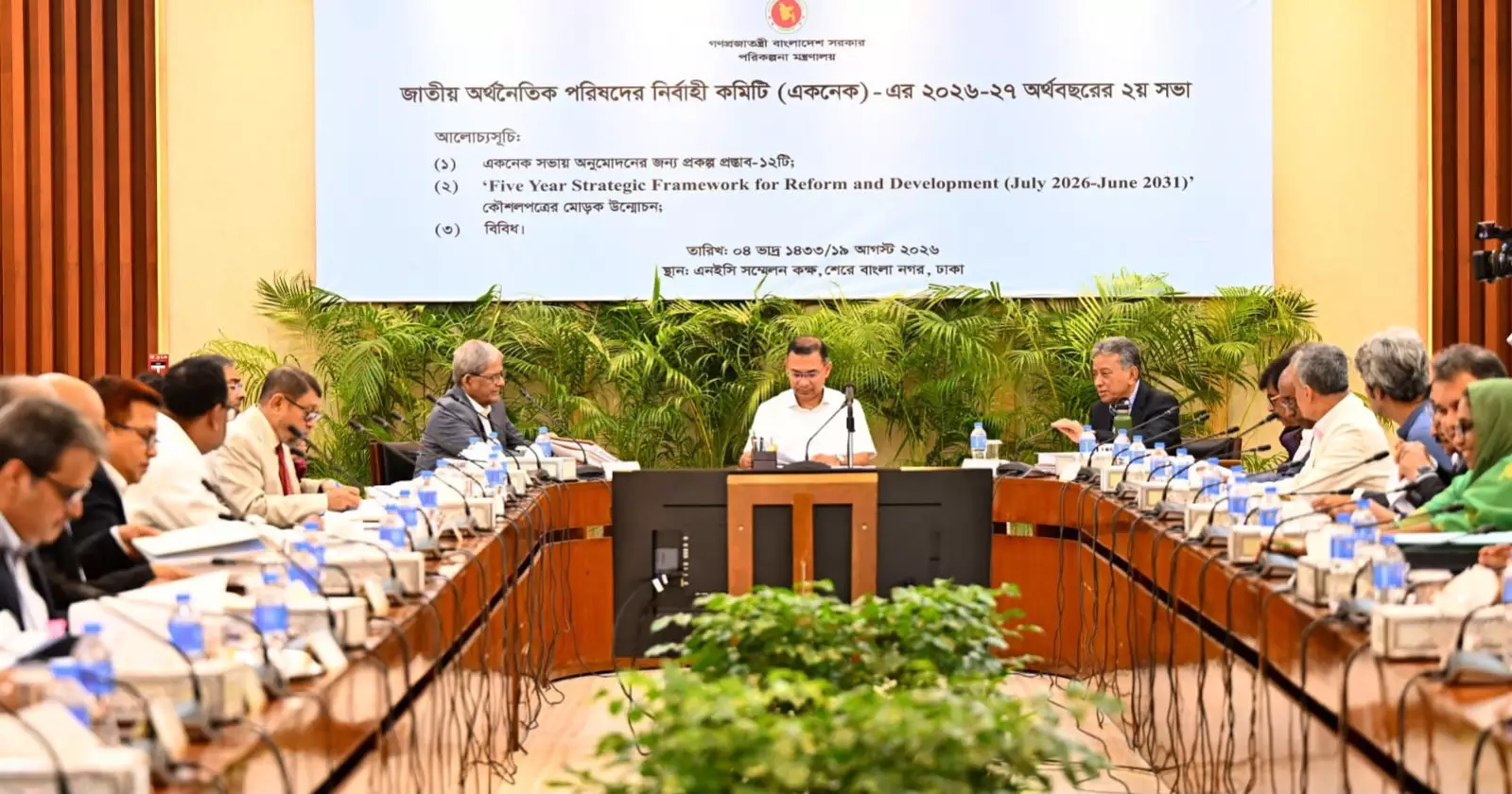
The government on Wednesday unveiled its Five-Year Strategic Framework for Reform and Development (July 2026 to June 2031), along with a Strategic Action Matrix, outlining a roadmap for economic recovery, restoration and accelerated development.
Prime Minister Tarique Rahman formally unveiled the covers of the two documents at a meeting of the Executive Committee of the National Economic Council (ECNEC) at the NEC Conference Room in Sher-e-Bangla Nagar.
The documents were prepared under the initiative of the General Economics Division (GED) of the Planning Commission.
Speaking to reporters after the meeting, GED Member Dr Monzur Hossain said the initiative to formulate the framework was taken soon after the present government assumed office.
The draft received policy approval at a National Economic Council (NEC) meeting on May 18 and was later finalised after incorporating opinions from different ministries.
Dr Monzur said the framework differs from conventional planning documents in both its title and contents.
The framework has been organised around five broad pillars in line with the government’s political manifesto, with 11 economic clusters identified to group related issues and priorities.
It identifies strategic priorities for different sectors and assigns responsibilities to relevant ministries, lead agencies and collaborating agencies to establish a clear implementation framework.
The framework proposes a four-tier institutional mechanism to monitor implementation. An advisory council comprising economists and experts will periodically assess progress. A coordination committee will review implementation every three months, while a steering committee led by the Finance Minister will conduct reviews every six months with senior secretaries concerned.
A governing council led by the Prime Minister will review the reports and oversee overall implementation.
Dr Monzur said such a monitoring mechanism was necessary as previous planning documents often underwent mid-term evaluations but lacked an effective system for regularly checking and reporting progress.
The framework also highlights reforms in areas including land use, Bangladesh Bureau of Statistics (BBS) data and public investment management to improve planning and implementation.
The second volume, titled Strategic Action Matrix, consolidates commitments made by different ministries after the government assumed office.
The ministries initially submitted proposed activities for six months, one year and five years, collectively running to around 2,200 pages. The GED consolidated them into a document of about 300 pages.
“This document contains the commitments made by the ministries regarding the work they will undertake. In the future, everyone will be able to see how much of that work has been completed and how much has not,” Dr Monzur said.
He said the framework aims to achieve higher economic growth and move Bangladesh towards a US$1 trillion economy, alongside broader socio-economic development.
The priorities have been divided into three phases: recovery, restoration and acceleration. The first year will focus on recovery, the following two to three years on restoration, and the three-to-five-year period on rebuilding and accelerating development, including poverty reduction.
Dr Monzur described the framework as a “living document” that can be reviewed and updated periodically.
The two documents are expected to be made available online through the Planning Ministry and GED websites.