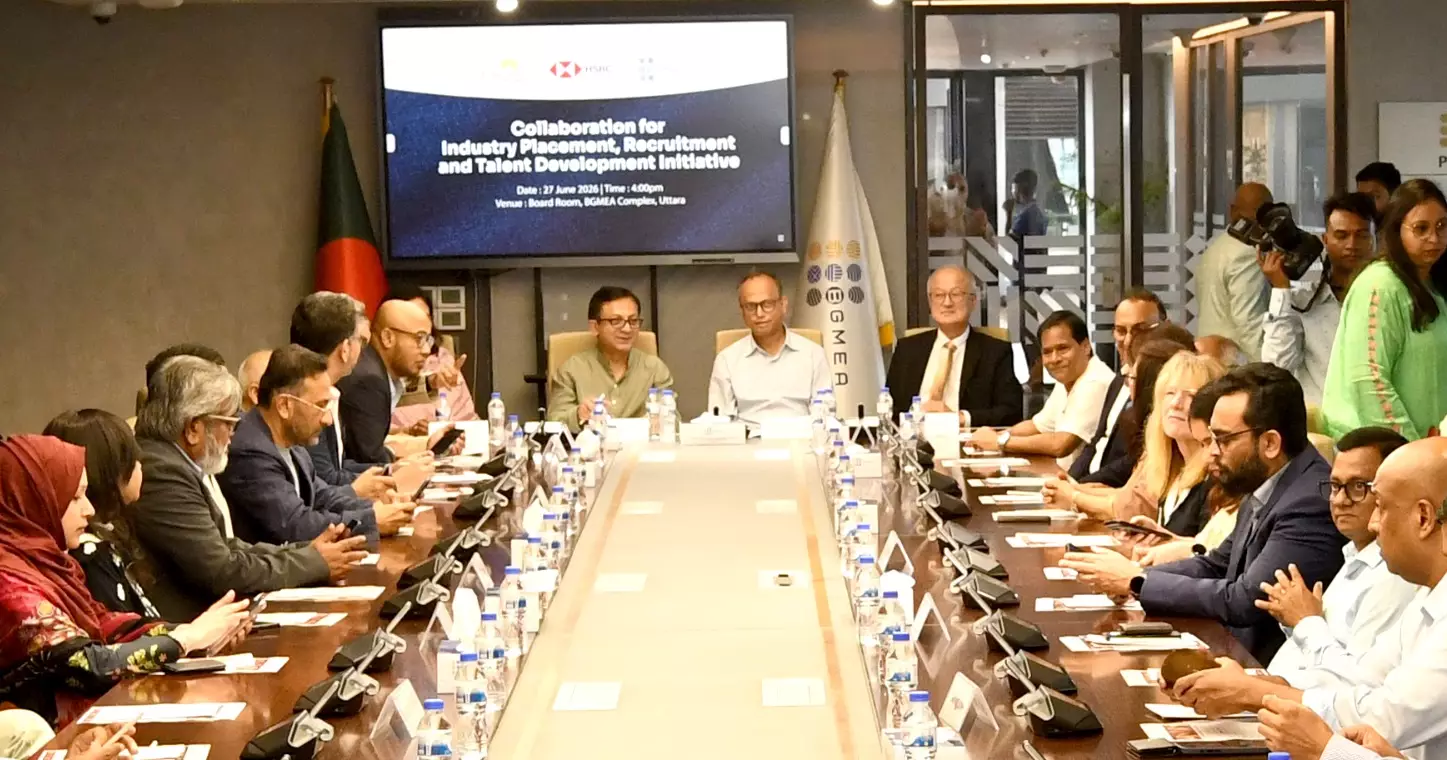
Commerce Minister Khandaker Abdul Muktadir on Saturday said the government is implementing fast-track reforms in business registration, licensing, port management and the energy sector to boost investment, expand industrialisation, create employment and strengthen the country's export capacity.
Speaking as the chief guest at a discussion titled "Collaboration on Employment Generation and Skill Development Initiatives in the Industrial Sector" at the BGMEA Complex in Uttara, the minister said the government is committed to creating a modern and investment-friendly business environment.
He noted that nearly 85 percent of Bangladesh's export earnings come from the readymade garment (RMG) sector and described the Bangladesh Garment Manufacturers and Exporters Association (BGMEA) as one of the country's strongest and most organised business bodies.
Although sectors such as leather, jute, light engineering and shipbuilding hold considerable potential, none of them are likely to match the scale of the RMG industry in the short term, he said, underscoring the sector's critical role in the national economy.
The minister said the government has been working since assuming office to transform Bangladesh into an attractive global investment destination. At present, it takes an average of 355 days to start a business and obtain the required licences, but the government is taking steps to significantly reduce that timeframe.
Under the planned reforms, entrepreneurs will be able to obtain Import Registration Certificates (IRC) and other primary approvals within 14 days of company registration, enabling them to import machinery and set up industries more quickly.
Muqtadir also announced plans to introduce an integrated inspection system in place of separate inspections by multiple agencies, which would reduce harassment and shorten the time required to establish industries.
In addition, all services, including trade licences, company registration, share transfers and company dissolution, will be made available online through a one-stop service platform, following successful models adopted by Singapore and Malaysia.
On port management, the minister said the involvement of international operators would improve cargo handling efficiency, reduce vessel waiting times and lower transportation costs, making Bangladeshi exporters and importers more competitive in the global market.
Addressing challenges in the energy sector, he said the government plans to install another Floating Storage and Regasification Unit (FSRU), which is expected to add an additional 550 to 600 million cubic feet of gas to the national grid.
He said many industrial units have been unable to begin production due to the gas crisis, making uninterrupted energy supply one of the government's top priorities to support industrial output, employment and export growth.
The commerce minister reiterated the government's commitment to working in partnership with business leaders and industrial entrepreneurs to build an efficient and investment-friendly environment and position Bangladesh as one of the world's most attractive destinations for investment and trade.
The event was chaired by BGMEA President Mahmud Hasan Khan, while Asian University for Women Vice-Chancellor Dr Rubana Huq delivered the welcome speech.
Among others, Asian University for Women founder Kamal Ahmad, Youngone Corporation Chairman Kihak Sung and HSBC Bank Head of Sustainability Syeda Afzalun Nessa also spoke at the event.
Former BGMEA President Engineer Kutubuddin Ahmed and former BGMEA Vice-President and Urmi Group Managing Director Asif Ashraf were also present.