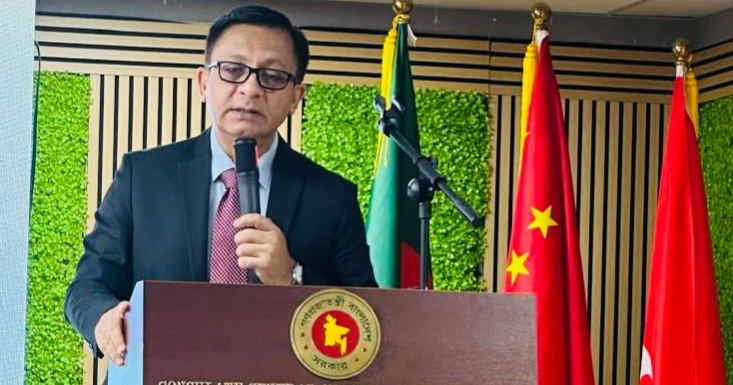
Commerce Minister Khandaker Abdul Muktadir has stressed the need to make Bangladesh's economy internationally competitive to attract global investment.
Speaking at a seminar titled "Trade Expansion and Investment Potential in Bangladesh," organised by the Bangladesh Consulate General in Hong Kong on Thursday, Muktadir underscored ensuring policy stability, reducing logistics costs, automating the customs system and simplifying business start-up procedures to improve the investment climate.
Govt working to accelerate economic growth, boost investment: Muktadir
The minister said that thanks to information technology, investors can now easily assess the business and investment environment of any country in the world.
To stay ahead in the competition for investment, he said, Bangladesh must build a business environment, policy framework and capacity comparable to other countries.
He said Bangladesh is signing trade agreements with various countries to retain its trade benefits after graduating from the Least Developed Country (LDC) category in 2029. “Economic partnership agreements have already been signed with Japan and South Korea, giving Bangladesh duty-free access for about 97 percent of its products to the South Korean market. Free trade agreement talks are underway with around 13 more countries.”
Free trade negotiations with the European Union will also begin soon, the minister said, adding that Bangladesh hopes to reach an understanding before its LDC graduation.
If that is not possible, he said, efforts will continue to retain existing market access through preferential trade arrangements.
Highlighting high logistics costs as a major challenge to the investment climate, Muktadir said supply chain costs in Bangladesh stand at around 16 percent of GDP, compared to a global average of about 10 percent.
He said this gap must be narrowed by cutting transport, production and import-export costs.
He also spoke of efforts to boost the capacity of Chattogram Port through the involvement of international operators, along with the construction of the Matarbari deep-sea port, saying these infrastructure projects are expected to reduce cargo transport and port management costs.
On easing business start-up procedures, the minister said it currently takes several hundred days for a business to reach the letter-of-credit stage.
The entire process is being digitised, he said, which will allow new enterprises to reach that stage within a maximum of 14 days in the future.
Efforts are also underway to digitise trade licences, share transfers and other business processes, he said, which will significantly reduce the need for entrepreneurs to visit government offices in person.
On customs reforms, the minister said automation will cut clearance time and costs for importers. “A risk-based customs management system is being introduced to reduce unnecessary physical inspections for established, trusted businesses, adding that unnecessary customs restrictions and procedures are expected to ease considerably within the next six months to a year.”
Emphasising policy continuity to build investor confidence, the commerce minister said investment is a long-term decision, and frequent policy changes shortly after their introduction create uncertainty among investors.
Any necessary policy changes, he said, should apply prospectively to new investments so that investors have a clear picture of the situation when making decisions.
At the seminar, the minister also identified ship recycling as a promising sector for new investment in Bangladesh, noting that Bangladesh and India together account for about 90 percent of global ship recycling, and that there is scope for further investment in the sector in the country's coastal regions.
Muktadir said making Bangladesh more competitive for investment by addressing weaknesses in the business environment remains one of the government's top priorities, and continuous reforms are being carried out in infrastructure, policy, customs and business processes to that end.