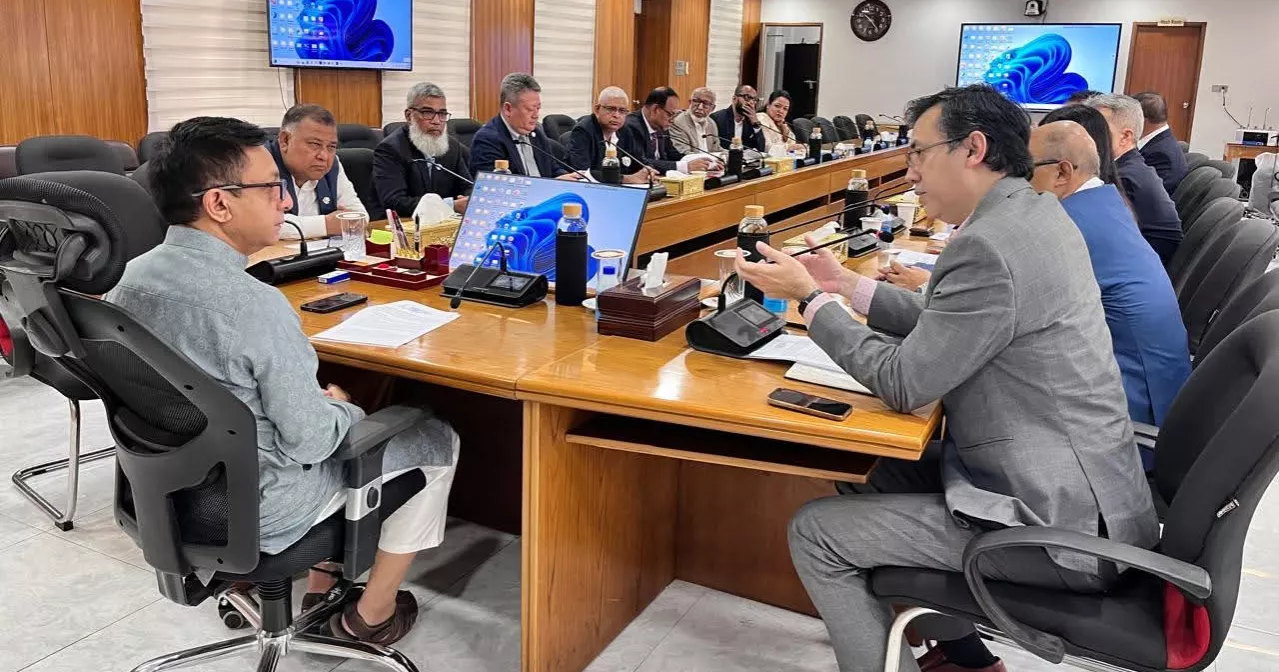
Japan Bangladesh Chamber of commerce and Industry (JBCCI) on Sunday reaffirmed its commitment to working closely with the Ministry of Commerce and relevant government agencies to create a more investment-friendly, predictable, and competitive business environment in Bangladesh, further strengthening the longstanding economic partnership between Japan and Bangladesh.
Board of Directors of the JBCCI held a courtesy meeting with Commerce Minister Khandakar Abdul Muktadir and discussed issues of mutual interest.
The JBCCI delegation was led by Mr. Tareq Rafi Bhuiyan (Jun), President of JBCCI.
The discussion was focused on JBCCI role in promoting Japan-Bangladesh trade, investment, and economic cooperation, with emphasis on effective implementation of the Japan-Bangladesh EPA.
It marks a highly important junction in Japan and Bangladesh bilateral relations, therefore JBCCI has proposed to undertake or participate in measures to accelerate the implementation of this lucrative agreement.
JBCCI raised the need to simplify visa, work permit, and security clearance procedures, ease financial regulations, and ensure policy consistency to attract and retain Japanese investment in Bangladesh.
JBCCI also proposed authorization to issue Certificates of Origin for eligible member exporters, particularly those operating in BSEZ, EPZs, and other economic zones.
During the meeting, Tareq Rafi Bhuiyan (Jun), President of JBCCI, briefed the Minister on JBCCI’s activities, objectives, and role in strengthening Japan-Bangladesh trade and investment relations.
He mentioned that JBCCI, established in 2004 as a unique bilateral chamber with equal representation of Bangladeshi and Japanese nationals on its Board.
He reaffirmed JBCCI’s commitment to promoting trade and investment, exploring new business opportunities, encouraging joint ventures, and addressing investment challenges through policy advocacy and public-private dialogue.
He also highlighted the importance of effective implementation of the Japan-Bangladesh Economic Partnership Agreement (EPA), signed on February 6, 2026, in Tokyo, describing it as a historic milestone for bilateral economic cooperation.
He expressed JBCCI’s readiness to work closely with the Ministry of Commerce through awareness programs, seminars, market access guides, SME support, and regular consultation mechanisms.
He proposed that JBCCI be authorized to issue Certificates of Origin to eligible exporters who are registered members of JBCCI, particularly companies operating in the Bangladesh Special Economic Zone (BSEZ), Export Processing Zones (EPZs), and other relevant industrial zones which would assist its members doing business in Bangladesh.
Maria Howlader, Secretary General of JBCCI, highlighted the Bangladesh–Japan EPA as a long-term (50-year) strategic framework to boost investment, industrial growth, and bilateral cooperation the importance of timely and effective implementation of the Japan-Bangladesh Economic Partnership Agreement (EPA).
She noted that although the EPA has already been signed, JBCCI members are seeking clearer information regarding the list of products that will receive duty-free market access under the agreement.
She requested the support of the Ministry of Commerce in sharing the detailed product list and relevant implementation guidelines with the business community.
Japan has been a long regarded one of Bangladesh’s closest and most reliable partners in trade, investment, and the economic development of the country.
She emphasized deepening the bilateral relationship with Japan as much as possible.
She also requested the Ministry’s consideration to include a JBCCI representative in EPA-related implementation discussions and mechanisms, so that the Chamber can contribute effectively from the private sector perspective.
She reaffirmed JBCCI’s readiness to work closely with the Ministry of Commerce through awareness programs, joint seminars and workshops, product-wise market access guides, identification of new export sectors, SME support, and regular public-private consultation mechanisms to ensure successful implementation of the EPA.
Abdul Haque, Past President of JBCCI, emphasized the need to create a more investable and investor-friendly business environment in Bangladesh, noting that attracting Japanese investors would also encourage investors from other countries. Referring to international best practices, he proposed the establishment of a professional single-window investment facilitation agency to provide comprehensive support to investors from one platform.
Manabu Sugawara, Director of JBCCI, emphasized the importance of early ratification and implementation of the Japan-Bangladesh Economic Partnership Agreement (EPA).
He noted that although the agreement has already been signed, it is yet to come into effect pending approval by both governments. He expressed hope that the ratification process would be completed at the earliest so that businesses of both countries can start benefiting from the agreement.
He also highlighted the need for clear information on the EPA’s implementation timeline, duration of benefits, and review mechanisms, which would help businesses plan effectively and support Bangladesh in expanding and diversifying its export basket in the Japanese market.
Hiroaki Oura, Vice President of JBCCI, appreciated the Government of Bangladesh’s recent efforts to improve visa support and security clearance procedures for foreign investors and expatriates.
He noted that Japanese companies still face challenges in obtaining timely support for investment visas and related clearances, while also expressing concern over financial regulatory issues and frequent policy changes affecting long-term investment confidence.
He emphasized the need for simplified investment procedures, a stronger financial framework, and a stable, predictable, and sustainable policy environment to make Bangladesh a more attractive and competitive destination for Japanese investors.
Md. Moniruzzaman, DGM, Mitsui & Co. (Asia Pacific), highlighted the need for simplifying visa and work permit procedures for expatriate professionals, who play an important role in supporting business operations, technology transfer, and investment implementation in Bangladesh.
He also emphasized the importance of modernizing the Registrar of Joint Stock Companies and Firms (RJSC), particularly in relation to record-keeping, document management, entry-level procedures, acquisition, buy-out, and investment-related processes.
He requested the kind attention of the Minister to ensure a more efficient, transparent, and investor-friendly corporate regulatory environment for Japanese investors in Bangladesh.
Kenji Kimura, Treasurer of JBCCI, highlighted key financial challenges faced by Japanese investors in Bangladesh, particularly regarding import-export settlement and overseas borrowing.
He noted that Bangladesh’s strict LC-based transaction requirements and complex approval procedures for overseas borrowing remain challenging compared to other investment destinations such as India and Vietnam.
He requested consideration for relaxing LC-related regulations and simplifying overseas borrowing procedures, especially for loans from parent companies or shareholders to local subsidiaries, to help foreign investors access funds more efficiently and operate with greater confidence in Bangladesh.
Mohammed Sohel, Director of JBCCI expressed hope regarding the future development of the RMG sector which would be highly benefited from alignment with the provisions for the sector in the EPA.
Khandakar Abdul Muktadir responded positively to the issues raised by the JBCCI delegation on visa and work permit-related issues, the Minister noted that the revision of the visa issuance process is currently under consideration by the Cabinet and requested JBCCI to submit specific recommendations in writing for review.
He also highlighted the Government’s ongoing initiatives to simplify business processes, reduce licensing and clearance timelines, and introduce a more efficient one-stop service mechanism through BIDA.
Regarding the issue of Certificates of Origin, he assured that the Ministry would examine the proposals with due importance. Regarding JBCCI’s proposal to issue Certificates of Origin, he stated that the matter would be reviewed carefully, as such authority has traditionally been entrusted to sectoral associations and chambers.
The Minister assured that the Ministry would work on a roadmap for effective implementation of the Japan-Bangladesh Economic Partnership Agreement (EPA) and form a committee where JBCCI representatives would be included.
He also acknowledged issues related to financial structure, policy predictability, RJSC modernization, IRC/ERC digitization, import-export flexibility, and long-term foreign currency loans, assuring that relevant reforms are being considered to create a more predictable, efficient, and investor-friendly business environment in Bangladesh.