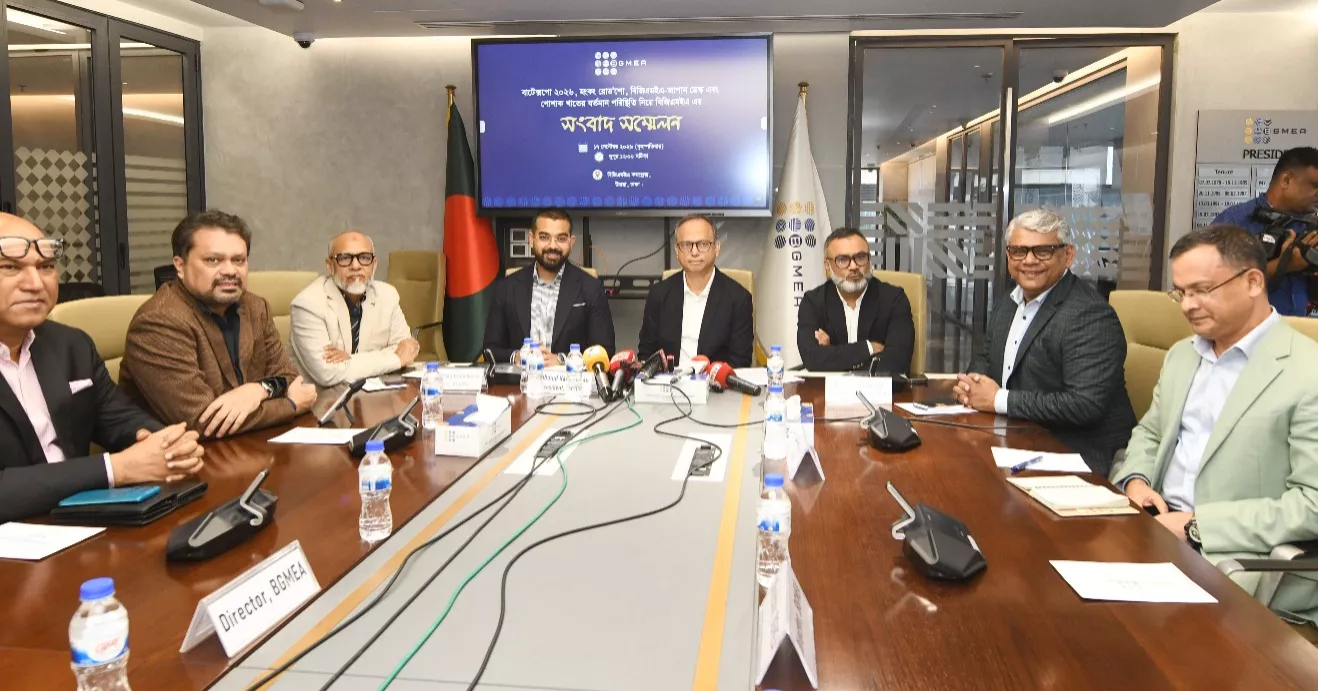
Gas supply in the country has improved and no garment factory has shut down so far due to the recent energy crisis, said Mahmud Hasan Khan, President of Bangladesh Garments Manufacturers and Exporters Association (BGMEA) on Thursday.
Speaking at a press conference at the BGMEA Complex in Uttara, he said while immediate closures have been avoided the true economic impact of the energy crunch will become clear in three to four months.
The press conference was organised to brief the media on 'BATEXPO 2026', an upcoming Hong Kong roadshow, and the current state of the RMG sector.
He explained that impact on the garment sector is never instantaneous, as shuttering a factory requires roughly six months of planning to finish existing orders in the pipeline, clear legal compensations for workers, and settle outstanding banking liabilities.
Therefore, any factory closure occurring today due to incidents from six months or a year ago should not be attributed to the current energy crisis.
The BGMEA President said low gas pressure severely disrupted backward linkage sectors, particularly dyeing and washing units.
However, following a recent meeting between the business community and the Prime Minister, the government announced the restoration of industrial gas supply to previous levels, which has already taken effect.
During normal times, garment factories operate for 8 to 10 hours daily and due to the gas shortage, many units had to spend nearly five additional hours and rely on alternative fuels to maintain operations, driving up the cost of doing business to meet shipment deadlines.
To maintain a stable gas supply, BGMEA has submitted a presentation to the Ministry of Energy outlining short-, medium-, and long-term plans, which it believes could resolve major energy issues within two years if implemented.
To ensure long-term energy security, BGMEA pressed for two additional Floating Storage Regasification Units (FSRUs), while emphasising a transition toward land-based LNG storage terminals.
Noting that an agreement has already been reached to bring one FSRU from China on a G2G basis, Mahmud Hasan Khan said rather than adding multiple FSRUs, BGMEA favours land-based storage.
He stressed that simply adding FSRUs without upgrading the gas distribution network will not deliver expected benefits, calling for simultaneous modernisation of distribution pipelines.
BGMEA’s additional demands include top priority for gas connections and rationing for SME factories, low-interest "green loans" to promote renewable energy adoption and accelerated offshore and onshore gas exploration in coastal areas.
On LDC graduation, the BGMEA President expressed optimism that the United Nations General Assembly will approve the government’s initiative to extend Bangladesh’s transition period by three years later this month.
He noted that an extra three years would provide crucial preparation time to tackle post-LDC challenges. The private sector is actively engaged in the process through regular progress reviews led by the Economic Relations Division (ERD) under the Ministry of Finance.
Regarding post-LDC market access, Mahmud Hasan Khan underscored that securing a Free Trade Agreement (FTA) with the European Union—rather than GSP Plus—is the sector's top priority.
BGMEA also called for modernising company and customs laws to improve the ease of doing business, expediting FTAs and Economic Partnership Agreements (EPAs), and ensuring at least five years of special policy support and tariff continuity post-LDC graduation.
In its efforts to diversify export destinations, BGMEA highlighted that non-traditional markets now generate around $8 billion out of Bangladesh’s total $40 billion RMG export basket outside the US, EU, and Canada.
To attract new global brands, BGMEA will participate in a roadshow organised by HSBC in Hong Kong. Additionally, BGMEA is launching a dedicated "Japan Desk" staffed with Japanese-speaking officers to ease communication with buyers.
The organization aims to scale exports to Japan from the current $500 million to $2–2.5 billion in the coming years.
BGMEA also announced a strategic agreement with the Bangladesh Brand Forum to showcase Bangladesh’s apparel industry on the global stage as an innovation-driven, modern sector rather than merely a low-cost manufacturing hub.