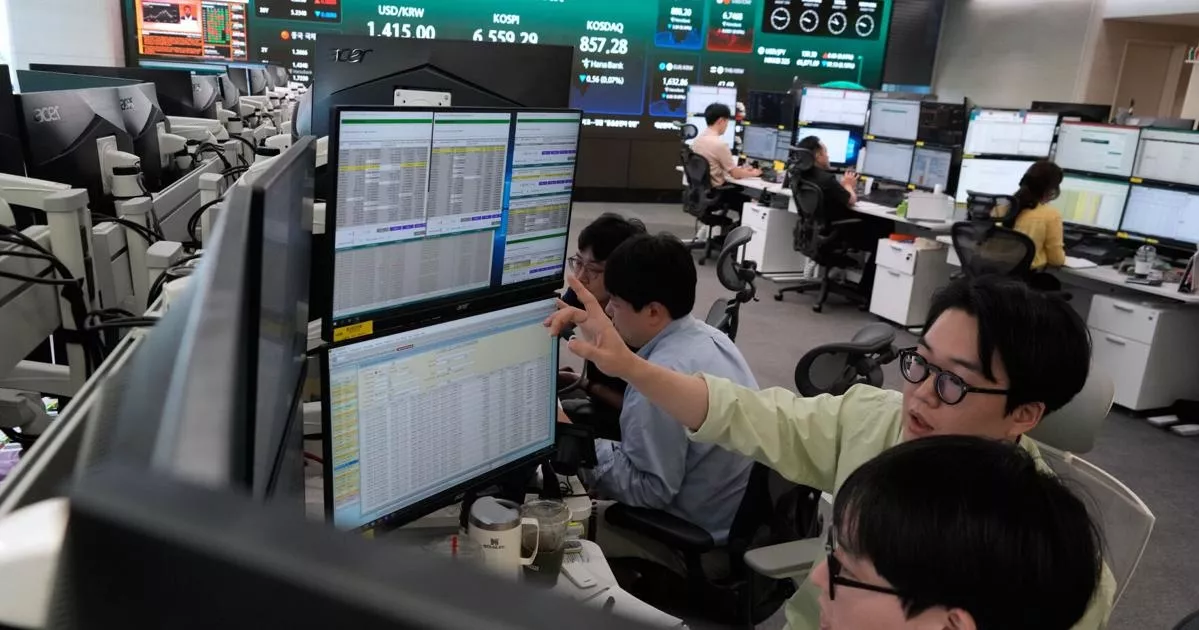
Asian and European shares traded mixed on Wednesday as investors awaited the latest US inflation data, while oil prices rose amid uncertainty over when crude supplies disrupted by the war with Iran will return to normal.
US stock futures were slightly higher. Futures for the S&P 500 rose 0.2%, while Dow Jones Industrial Average futures were almost unchanged.
In early European trading, Germany's DAX gained 0.3% to 26,480.04, while France's CAC 40 fell 0.2% to 8,698.79. Britain's FTSE 100 slipped 0.1%.
Asian markets were mixed. Japan's Nikkei 225 rose 0.8% to 67,524.06, while South Korea's Kospi jumped 3.7% to 6,579.04 as investors bought computer chip stocks. Samsung Electronics rose 6.7% and SK Hynix gained 5.5%.
Taiwan's Taiex advanced 0.9%. China's Shanghai Composite rose 0.3% to 3,946.68, while Hong Kong's Hang Seng fell 0.8% to 25,440.17. Australia's S&P/ASX 200 dropped 0.5% to 9,209.40.
Brent crude, the international benchmark, rose 1% to $89.79 a barrel in early trading. US benchmark crude also gained 1% to $84.07.
Oil prices have risen as uncertainty continues over the impact of the war with Iran on global supplies and shipping routes.
Iran has rejected US President Donald Trump's remarks that Tehran's demand for compensation in any negotiations to end the war would lead Washington to make a similar demand.
The United States and Israel attacked Iran in late February, leading to the closure of the Strait of Hormuz and disrupting the movement of a significant amount of oil from the Middle East. Brent crude prices fluctuated between $72 and $102 a barrel last month.
Concerns about regional shipping also increased after Iran-backed Houthi rebels attacked a vessel in the Bab el-Mandeb strait near Yemen.
Ben May, director of global macro research at Oxford Economics, said renewed fighting between the United States and Iran could result in a prolonged reduction in shipping through the Strait of Hormuz.
Oxford Economics expects Brent crude to average around $85 a barrel for the rest of this year before falling gradually to about $65 by late 2027.
Higher oil prices can add to inflationary pressure. The average price of regular gasoline in the United States has risen to $4.01 a gallon, according to AAA, up from less than $3.14 a year ago.
Investors are now closely watching the US government's latest inflation report, due Wednesday. Economists expect annual inflation to ease slightly to 3.4% in July from 3.5% in June.
On Wall Street on Tuesday, the S&P 500 fell 0.3%, extending its second modest decline since reaching a record high on Friday. The Dow dropped 184 points, or 0.3%, while the Nasdaq composite fell 0.6%.
A weaker-than-expected inflation reading could reduce pressure on the Federal Reserve to raise interest rates. While higher rates can help control inflation, they also make borrowing more expensive for households and businesses and can weigh on economic growth and investment prices.
US Treasury yields have risen since the war with Iran began, driven by higher oil prices and inflation concerns. The increase has pushed long-term mortgage rates to their highest level in a year.
In early currency trading, the US dollar slipped to 159.22 Japanese yen from 159.30 yen. The euro was unchanged at $1.1544.