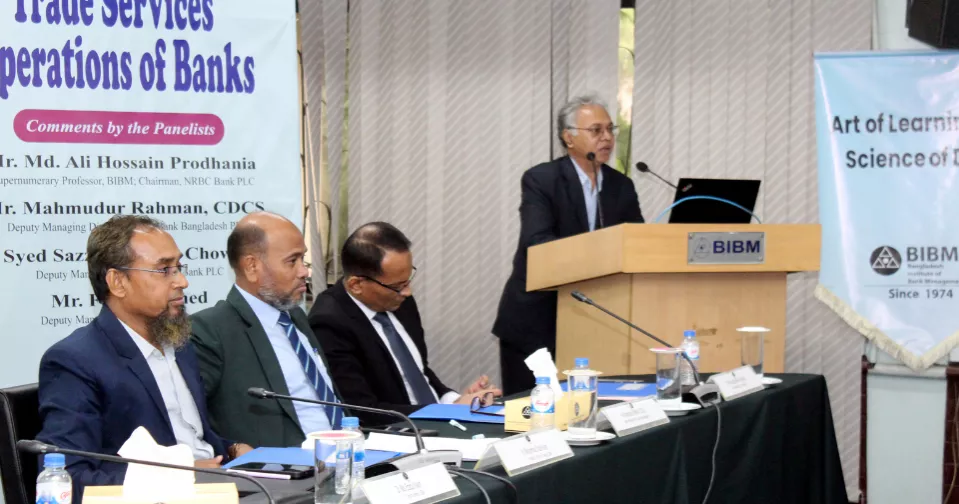
Modernizing trade finance operations and improving asset quality are essential to ensuring sustainable banking in Bangladesh, experts said at a workshop held at Bangladesh Institute of Bank Management (BIBM) on Wednesday.
According to the BIBM study, the NPL rate specifically related to trade finance in troubled banks currently hovers between 40 and 50 percent. More alarmingly, in banks that already suffer from high overall NPLs alongside substantial trade exposure, the trade-specific default loan rate exceeds 80 percent.
Islami Bank customer forum announces fresh protests demanding restoration of previous ownership
Senior bankers, policymakers, regulatory officials, and researchers noted that trade finance portfolios face visible asset-quality pressures, with specific segments experiencing alarmingly high non-performing loans (NPLs).
The observations were made during a review workshop titled "Trade Services Operations of Banks" organized by the BIBM at its campus in Mirpur, Dhaka.
Presenting the keynote paper on behalf of the research team, Dr. Shah Md. Ahsan Habib, Professor (Selection Grade) at BIBM, revealed that the pressure on asset quality in trade-related loan portfolios is now starkly visible, particularly among banks with significant trade exposures.
The study highlighted that the forced conversion of non-funded liabilities into funded loans is a primary driver behind this spike in trade defaults. This trend is most prominent in import finances involving capital machinery, raw materials like cotton, essential commodities such as sugar and fertilizer, fuel, and scrap vessel imports.
The research paper also identified critical structural vulnerabilities in export financing. A survey conducted among industry professionals showed an overwhelming consensus among bankers that the misuse of back-to-back Letters of Credit (LCs) without legally enforceable sales contracts is directly fueling default loans in export finance.
"Back-to-back LCs are meant to secure raw materials against confirmed export orders," the study noted.
"However, if the underlying contract is weak, disputed, or legally unenforceable, the entire financing process falls into jeopardy. When export proceeds are delayed or unrealized, the self-liquidating nature of trade finance breaks down, turning these exposures into forced loans and multi-folding the credit risk for banks."
Presiding over the workshop, BIBM Director General Dr. Md. Ezazul Islam stressed the urgent need to establish a modern legal and digital infrastructure for electronic trade documents to facilitate faster, secure, and paperless international trade.
He also called for more stringent measures to combat trade-based money laundering (TBML) and terrorism financing without compromising the quality of customer service.
"We need to expand trade finance opportunities for small and medium enterprises (SMEs) through innovative financial products and risk-sharing mechanisms," Dr. Islam said.
He further emphasized the need to strengthen product-specific data collection, risk management, and rigorous asset-quality monitoring through closer coordination among Bangladesh Bank, scheduled banks, customs authorities, and all relevant stakeholders.
The comprehensive research paper was jointly prepared by a team comprising BIBM faculty members Dr. Shah Md. Ahsan Habib, Tofayel Ahmed, Rahat Banu, and Rajib Kumar Das, alongside Mohammad Arafat Ali, Additional Director of the Foreign Exchange Policy Department-1 at Bangladesh Bank, and ATM Nesarul Hoque, Executive Vice President of Mutual Trust Bank PLC.
The workshop also featured expert discussions from Md. Ali Hossain Pradhania, Supernumerary Professor at BIBM and Chairman of NRBC Bank PLC; Mahmudur Rahman, Deputy Managing Director of Islamic Bank Bangladesh PLC; Syed Sajjad Haider Chowdhury, Deputy Managing Director of Prime Bank PLC; and Faruk Ahmed, Deputy Managing Director of City Bank PLC.