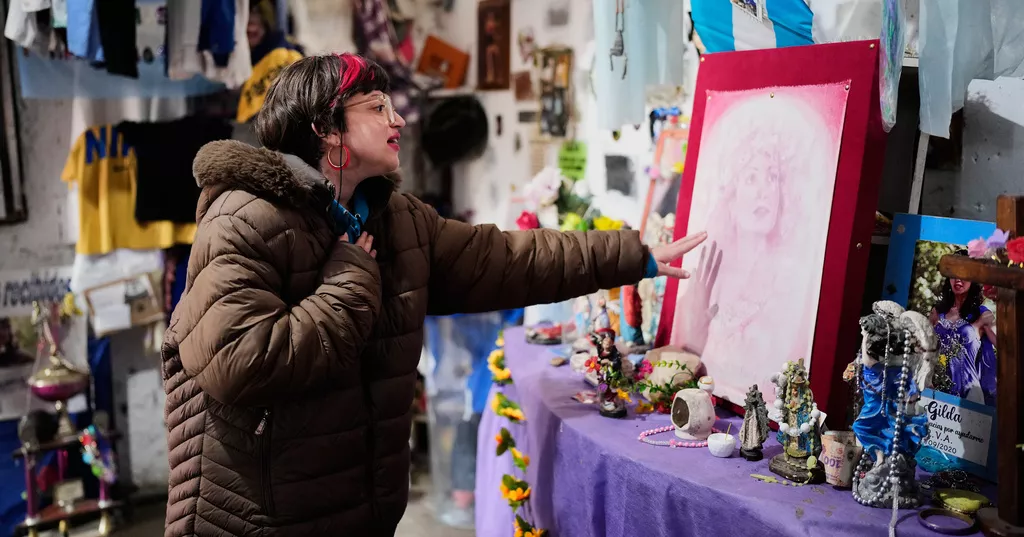
Thirty years after cumbia singer Gilda died in a road accident, thousands of her admirers continue to visit the site of her death, seeking miracles, healing and protection from the beloved Argentine performer.
Born Miriam Alejandra Bianchi, Gilda was 34 when the tour bus carrying her and her band collided with a truck. She died on Sept 7, 1996, but her popularity grew after her death as fans began to regard her as a miracle-working folk saint.
At a shrine near the crash site, devotees gathered Monday to mark the 30th anniversary of her death. Some prayed quietly while others sang and danced to her best-known songs.
Gilda became a nationally popular figure during her lifetime through her cumbia music, a style of Latin dance music deeply rooted in Argentine popular culture.
Her posthumous album went double platinum, while several of her songs became widely recognized anthems. Fans began travelling annually to the site where she died, sharing accounts of dreams in which Gilda appeared and stories of prayers they believe she answered.
Although she has not been formally recognized as a saint by the Catholic Church, devotees invoke Gilda in much the same way Catholics pray to officially recognized saints, asking for healing, protection and assistance during difficult times.
The wreckage of the tour bus has been preserved as a memorial near a national highway beside Argentina's Paranacito River. It is now covered with flowers, stuffed toys, candles and handwritten messages seeking help.
A nearby chapel contains wedding dresses from women who say their prayers to Gilda helped them marry, along with sports trophies and jerseys, discarded crutches and police uniforms left by devotees who attribute personal achievements or recoveries to her intercession.
“For me, it’s about faith — putting everything in God’s hands and asking Gilda to intercede,” said Julia Domínguez, 63, who credits Gilda with helping cure growths on her vocal cords nearly two decades ago.
Folk saints remain popular
Gilda's shrine, roughly a two-hour drive from Buenos Aires, reflects Argentina's long-standing tradition of popular religious devotion outside formal Catholic institutions.
Unofficial figures such as Gauchito Gil, a 19th-century outlaw often compared to Robin Hood, and Difunta Correa, a woman from Argentine folklore believed to have miraculously breastfed her baby after death, have large followings across the country.
Former Argentine football star Diego Maradona has also attracted a form of quasi-religious devotion from some fans.
Cleopatra Barrios, a researcher of popular religion at Argentina's national scientific research body Conicet, said devotees commonly describe folk saints as companions who remain present in their daily lives.
“Miracles aren’t understood as they are from the institutional Catholic point of view, as something extraordinary. Here, they’re things that happen every day,” she said.
Gilda's connection with ordinary people has also contributed to her enduring popularity. During her career, she performed in prisons and maintained personal contact with fans through handwritten letters.
Paola Martini, 46, who arranges pilgrimages to Gilda's shrine from different parts of Argentina, said she regularly asks the singer to accompany her through difficult moments.
Church keeps distance but embraces devotees
Catholic authorities have not directly opposed devotion to Gilda and other folk saints but have encouraged worshippers to keep God at the centre of their faith.
Two priests celebrated Mass at the shrine on Monday but did not refer to Gilda as a saint.
The enduring popularity of folk saints comes as the Catholic Church faces declining influence and competition from other Christian denominations in Latin America.
Pope Leo XIV is scheduled to visit Argentina, Uruguay and Peru in November on his first trip to South America as pope. Argentine church officials told local media that he is expected to visit a Buenos Aires prison and a centre serving people with disabilities, although the Vatican had not immediately confirmed the itinerary.
At Gilda's shrine, however, devotees see no conflict between their Catholic faith and their devotion to the singer.
“In the end, sainthood isn’t always decided by the church. Sometimes, the people recognize it first,” Domínguez said.