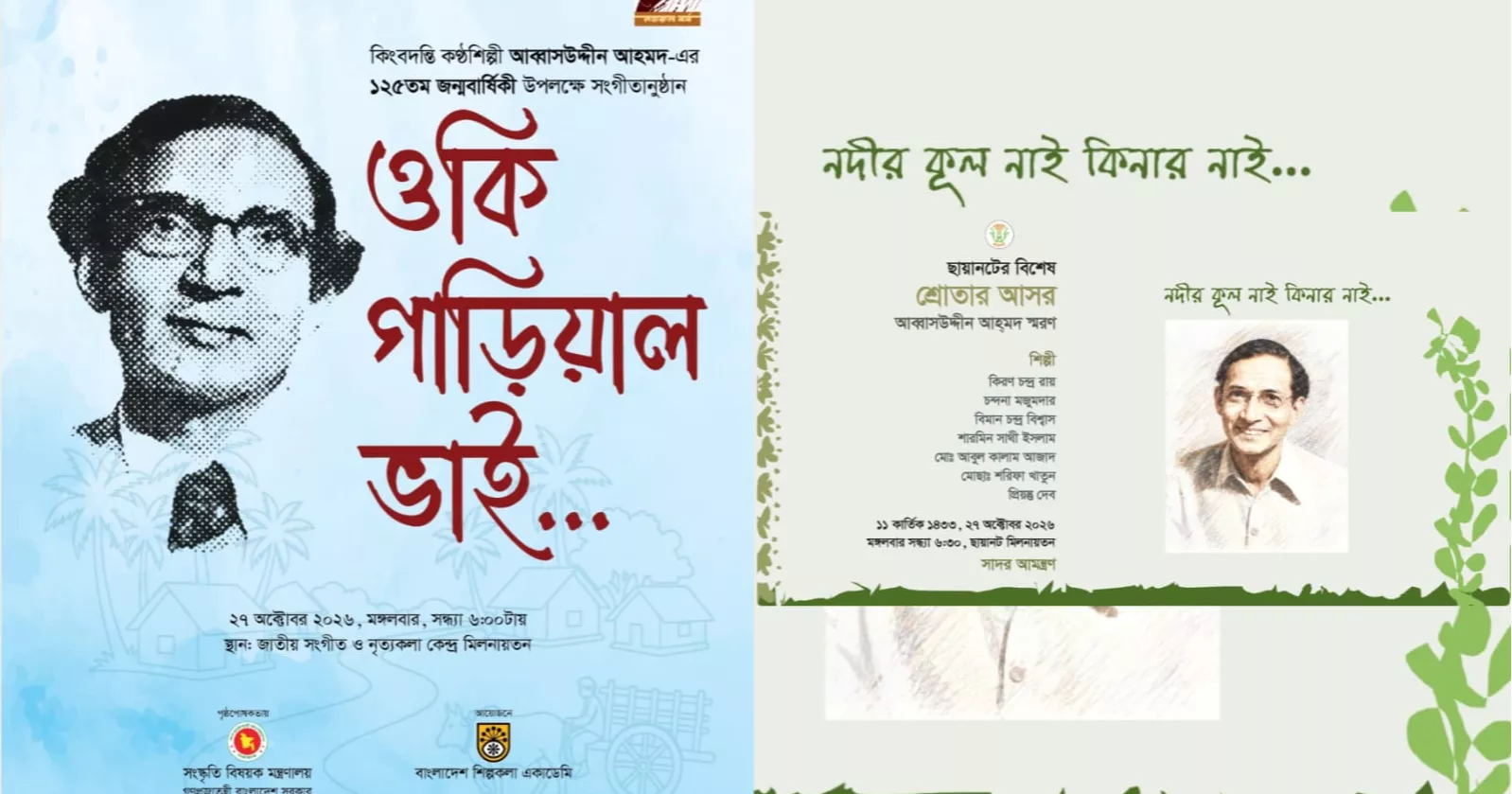
Legendary folk singer Abbasuddin Ahmed will be remembered on his 125th birth anniversary on Tuesday, celebrating his enduring contribution to Bengali music and the preservation of the region’s rich folk traditions.
Bangladesh Shilpakala Academy (BSA) and cultural institution Chhayanaut have arranged separate programmes featuring discussions and musical performances to pay tribute to the iconic artiste, renowned for popularising Bhawaiya and other forms of Bengali folk music.
Bangladesh Shilpakala Academy will organise a programme titled ‘Oki Gariyal Bhai’ at 6 pm on Tuesday at its National Music and Dance Centre auditorium.
Organised under the patronage of the Ministry of Cultural Affairs, the programme will feature discussions and musical performances in remembrance of the legendary singer.
Culture Affairs Minister Nitai Roy Chowdhury is scheduled to attend as the chief guest, while Professor Dr Nashid Kamal will deliver the keynote address.
Cultural Affairs Secretary Yasmin Begum will attend as a special guest, and Mohammad Harun-or-Rashid, who is serving as the academy’s acting director general, will preside over the programme.
Chhayanaut will hold a special edition of its ‘Shrotar Ashor’ from 6:30 pm to 8 pm at its auditorium, bringing together seven artistes to perform in tribute to Abbasuddin and his musical legacy.
The participating artistes are Kiran Chandra Roy, Chandana Majumdar, Biman Chandra Biswas, Sharmin Sathi Islam, Md Abul Kalam Azad, Mosa Sharifa Khatun and Priyantu Deb.
Admission to the programme is open to all, and the event will also be streamed live on Chhayanaut’s Facebook page and YouTube channel.
Born on October 27, 1901, at Balarampur village in Tufanganj subdivision of Cooch Behar, now in West Bengal, India, Abbasuddin became one of the most influential voices in the history of Bengali music.
His distinctive voice and emotive delivery helped bring the musical traditions of Bengal’s rural communities to a wider audience.
His repertoire encompassed Bhawaiya, Palli Geeti, Bhatiyali, Jari, Sari, Murshidi, Bichchhedi, Marsiya and Pala Gaan, alongside modern, patriotic and Islamic songs.
Although he received brief training from music maestros, he was largely self-taught.
Abbasuddin played a significant role in popularising folk songs through gramophone recordings, helping preserve musical traditions that had long been passed down through oral performance.
His interpretations captured the joys, sorrows and everyday experiences of rural Bengal, securing him a lasting place in the region’s musical heritage.
His association with Kazi Nazrul Islam, the National Poet of Bangladesh, also marked an important chapter in his career.
Abbasuddin was the first singer to record Nazrul’s iconic Islamic song ‘O Mon Romjaner Oi Rozar Sheshe Elo Khushir Eid’, which has since become a cherished part of Eid-ul-Fitr celebrations among Bengali-speaking Muslims.
He recorded numerous other songs written by Nazrul, contributing to the wider popularity of Bengali Islamic music. His musical legacy also reflects the diverse cultural traditions of Bengal, encompassing folk, devotional and contemporary forms.
Following the Partition of India in 1947, Abbasuddin moved to Dhaka and joined the Department of Information and Broadcasting as an additional song organiser. Alongside his official responsibilities, he continued to contribute to the development and promotion of Bengali music.
He represented the region at several international cultural gatherings, including the International Folk Music Conference in Germany in 1956. His autobiography, ‘Amar Shilpi Jiboner Kotha’, published posthumously in 1960, remains an important account of his life and musical journey.
In recognition of his contributions, he received the Pride of Performance Award in 1960, the Shilpakala Academy Award in 1979 and the Independence Day Award in 1981, all posthumously.
Abbasuddin passed away on December 30, 1959, but his recordings continue to connect generations of listeners with the musical heritage of Bengal.