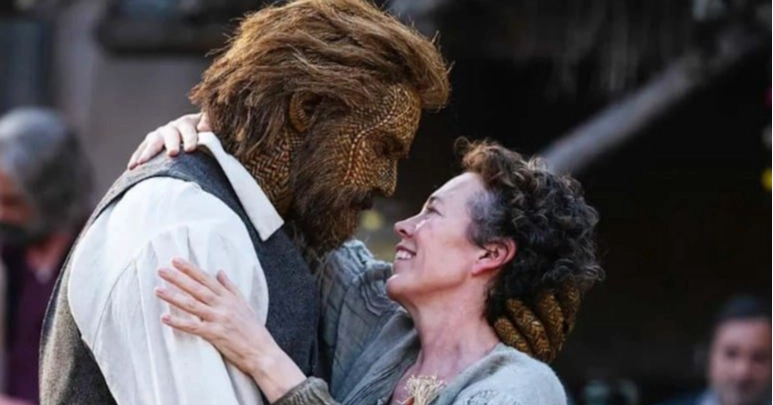
Wicker is an unusual yet engaging fairy tale that blends romance, dark comedy and social satire to explore marriage, jealousy, gender expectations and the human desire for genuine companionship.
Two seemingly opposite elements mischievous humour and emotional darkness come together remarkably well in Wicker, creating a film where fantasy meets sharp social commentary.
Adapted from British writer Ursula Wills' short story The Wicker Husband, the film is directed and written by Alex Huston Fischer and Eleanor Wilson. It explores the destructive power of envy and the importance of meaningful relationships, even when they come with unexpected consequences.
Olivia Colman and Alexander Skarsgard deliver impressive performances, building a convincing connection between their characters. Their chemistry gives the film an emotional depth that balances its fantastical setting, playful sensuality and eccentric humour.
Although some events stretch the limits of believability, the film's emotional appeal and carefully maintained darkly comic atmosphere make its unusual storyline work.
The characters are identified by their occupations or marital status rather than personal names. At the centre of the story is the Fisherwoman, played brilliantly by Colman, who faces ridicule and social exclusion because she is unmarried and smells of fish.
In the original short story, the character is described as an unattractive woman with an unusual physical appearance. Although Colman does not entirely match that description, her portrayal includes a noticeable limp.
Colman's powerful screen presence makes the character's transformation particularly convincing. After spending years as an isolated spinster with little hope of finding a partner, the Fisherwoman eventually experiences romance and physical intimacy.
When the Bottlewasher gets married, the Fisherwoman decides that she, too, wants a husband. However, no man in the village is willing to marry her.
She eventually approaches the Basket-Maker, portrayed by Peter Dinklage, a man who shares her resentment towards the judgmental villagers. She asks him to create a husband for her.
The Basket-Maker fulfils her request by crafting a handsome man, played by Skarsgard, from wicker and plant-based materials. Named Mr Wicker, the artificial husband is created from natural elements associated with nourishment and growth.
Unlike the other men in the village, Mr Wicker treats his wife with kindness, respect and genuine affection. In a society where marriage is symbolised by a collar around a man's neck and women are expected to follow restrictive gender roles, he represents an entirely different kind of husband.
He pays attention to the Fisherwoman's needs and takes an active interest in improving her home. From repairing the roof and cleaning the garden to fixing a crooked door, he performs everyday household tasks with remarkable dedication.
For the Fisherwoman, life changes dramatically. She finally has a caring, attentive and loving partner who combines masculinity with tenderness without displaying the toxic behaviour common among the village's other husbands.
Their physical relationship is equally passionate. Mr Wicker approaches intimacy with spontaneous enthusiasm, sometimes causing furniture to break during their encounters before carefully putting everything back together.
His declaration that he lives and breathes because of her reflects the depth of his affection. Through their relationship, the film challenges a patriarchal social order in which women are often treated merely as objects of desire and domestic labour.
As the Fisherwoman becomes happier and more confident, her transformation attracts growing resentment among the villagers. Both men and women become jealous because she possesses something they lack — genuine love, fulfilment and happiness.
At the Butcher's wedding, played by Phil Daniels, the Fisherwoman and Mr Wicker share a graceful dance. Their natural chemistry and visible affection draw attention, further fuelling the villagers' jealousy.
Among those particularly disturbed by the couple's happiness is the Tailor's Wife, portrayed by Elizabeth Debicki. She joins forces with her sister, the Bottlewasher's Wife, played by Marli Siu, to create trouble in their relationship.
Their attempts to undermine the marriage lead to a series of bizarre developments involving a wicker baby presented as an illegitimate child, suspicions of infidelity and an act of violence.
The situation becomes even more tragic when a villager attempts to imitate Mr Wicker's thoughtful behaviour by repairing his own home's roof. The structure collapses, causing a fatal accident.
Although the Fisherwoman has no involvement in the incident, the tragedy disrupts her previously peaceful life and sends the village into turmoil.
The filmmakers retain the central spirit of Wills' original story while making several changes that give the film a lighter and more energetic feel than its 26-page literary source.
The result is a production that combines unapologetic sensuality with sharp humour and emotional storytelling without becoming unnecessarily explicit.
The directors use the unusual romance to examine social prejudice, human weaknesses and a culture of hatred and jealousy that thrives on other people's suffering.
Cinematographer Lol Crawley, who won an Oscar for The Brutalist, captures the atmosphere and visual contrasts of the film's setting in Hungary, adding considerable depth and visual appeal to its scenes.
Ultimately, Wicker is more than a conventional romantic fairy tale. Its eccentric narrative, sarcastic humour and absurd situations create a thoughtful satire of marriage, social expectations and human relationships.
With outstanding performances from Colman and Skarsgard, the film offers an entertaining mixture of fantasy, romance and social criticism.
Wicker is a delightful collection of cinematic surprises — a strange, wicked and wonderfully imaginative film worth experiencing.
Source: NDTV