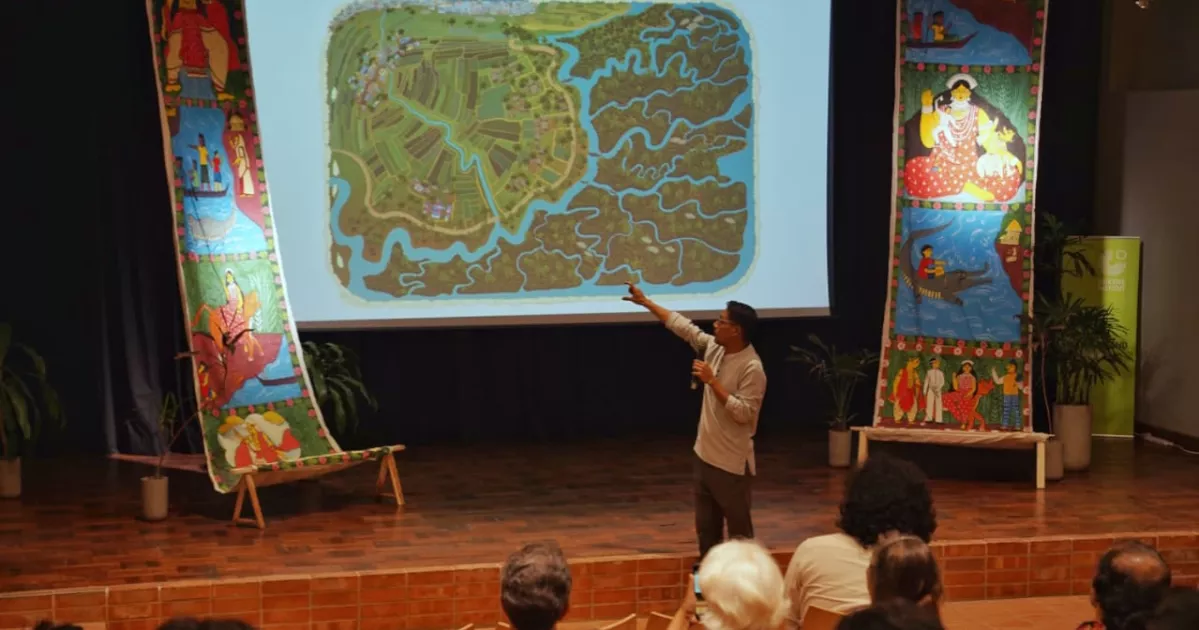
The cultural connections, shared heritage and resilience of communities living across the Sundarbans of Bangladesh and Kolkata were highlighted at the closing event of an EUNIC-supported project held at the Goethe-Institut Bangladesh on Monday night.
The EUNIC Cluster Bangladesh and EU Delegation to Bangladesh, in collaboration with HERITEiNCE DoA-BUET, Riverine People and Team Platform, organised the event to mark the conclusion of the project titled 'Sundarbans Across Borders: The Spirit of Cultural Resilience'.
The event brought together project partners, artists, researchers, cultural practitioners and guests to reflect on the project’s activities and explore the cultural and ecological connections shared by communities across the Sundarbans.
The programme began with a welcome note by Goethe-Institut Bangladesh Director Frank Werner, followed by an introduction to the project by Hasib Zuberi Shihan of Team Platform.
Two documentary films produced by EUNIC Clusters Bangladesh and Kolkata were screened during the event, offering perspectives on the people, landscapes, cultural practices and ecological realities of the world’s largest mangrove forest.
A Q&A session followed the screenings, with Mohammad Tahajibul Hossain of HERITEiNCE and Hasib Zuberi Shihan responding to questions from the audience.
The discussion focused on life and livelihoods in the Sundarbans, its rich biodiversity and the complex relationship between local communities and the fragile ecosystem, highlighting both the challenges faced by residents and their resilience.
As part of the closing programme, "The Hive and the Hymn", an interdisciplinary exhibition exploring the tangible and intangible cultural practices of the Moual, the honey-collecting communities living along the fringes of the Sundarbans, was also presented.
The exhibition features four bodies of Patachitra scroll work, including a traditional Gazir Pat, a contemporary depiction of the honey-collection cycle, a vertical retelling of the Bonobibi myth and a co-created scroll painted by community women and children.
Alongside the artworks, architectural and cultural research by BUET’s Heritage and Technology Integration Cell and Riverine People documents livelihood practices, settlement patterns, ecological adaptations and spiritual traditions of the region.
Through art and research, the exhibition explores the interconnectedness of cultural heritage, livelihood, ecology and resilience, while highlighting the role of women and younger generations in preserving cultural memory and ecological knowledge.
The 'Sundarbans Across Borders' project sought to deepen understanding of the intersections between culture, living heritage and climate resilience on both sides of the Bangladesh-India border.
Through workshops, field studies, collaborative art production, documentary filmmaking and performances, the project brought together communities and cultural practitioners to explore the shared heritage and contemporary challenges of the Sundarbans.
The initiative was co-financed under the EUNIC Cluster Fund 2024, which supports sustainable, collaborative and culturally grounded projects across the region.
The closing event marked the culmination of the project while reaffirming the importance of continued cross-border dialogue and collaboration around the Sundarbans, a shared ecosystem shaped by intertwined histories, belief systems, cultural practices, artistic traditions and biodiversity.
'The Hive and the Hymn' exhibition will remain open to visitors daily from 3 pm to 9 pm through Sept 12 at the Goethe-Institut Bangladesh Auditorium, House 10, Road 9, Dhanmondi R/A, Dhaka-1205.
Visitors can experience the exhibition and explore the stories, traditions, artistic expressions and ecological knowledge connecting communities of the Sundarbans across borders.