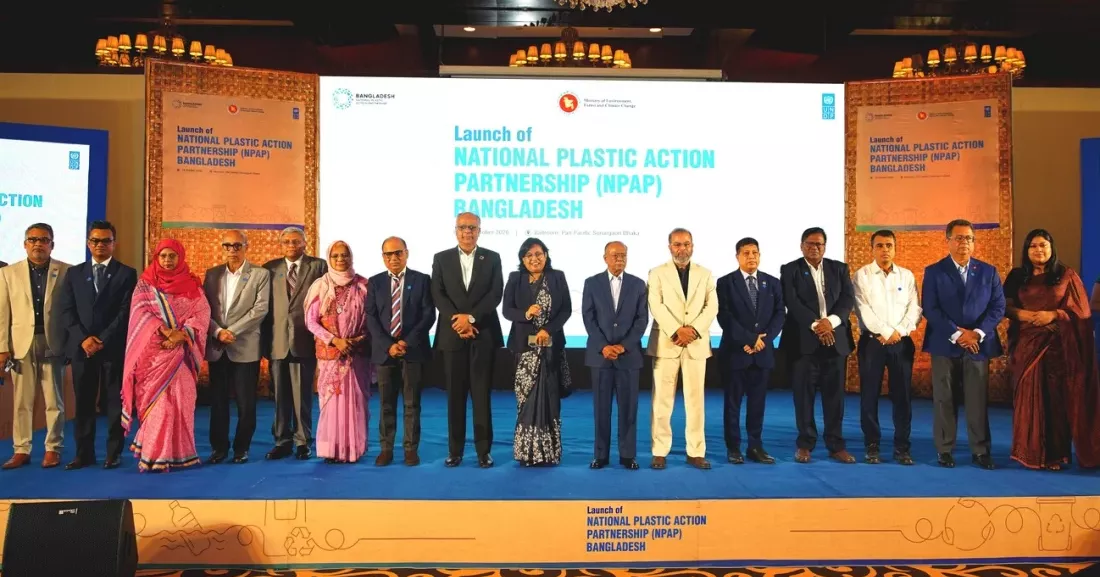
The Government of Bangladesh, in partnership with the United Nations Development Programme (UNDP) and the World Economic Forum’s Global Plastic Action Partnership (GPAP), officially launched the National Plastic Action Partnership (NPAP) Bangladesh on Tuesday at a hotel in Dhaka to strengthen coordinated action against plastic pollution and accelerate the transition towards a circular economy.
Led by the Ministry of Environment, Forest and Climate Change (MoEFCC), NPAP Bangladesh brought together government institutions, businesses, development partners, academia, civil society and waste-sector actors to align policies, investments and practical solutions.
UNDP Bangladesh will host the NPAP Secretariat, supporting coordination and collaboration among stakeholders.
The launch comes as Bangladesh faces growing challenges from plastic pollution.
A World Bank report published in 2024, drawing on earlier national data, estimated nearly one million tonnes of plastic waste annually, with almost 70 percent dumped, littered or openly burned, contributing to environmental pollution, flooding and public health risks.
Speaking as the chief guest, Environment Minister Abdul Awal Mintoo called for collective action.
“Instead of producing, consuming and discarding materials, we must find ways to reduce unnecessary use, improve design, increase reuse, strengthen collection and recycling and keep valuable resources within the economy for longer.”
Shaikh Faridul Islam, State Minister of Environment, Forest and Climate Change stated “A circular economy is not simply about managing waste differently. It is about using our resources more responsibly, protecting our environment and creating a system in which everyone has a role and everyone can benefit”.
Stephen Rodriques, Resident Representative of UNDP Bangladesh, added “When we meet again in 2027, we should not simply be holding another conference on plastics. We should be able to show which measures have been introduced, how much unnecessary plastic use has been reduced, how much more plastic is being collected and recycled, and what difference this is making to our rivers, cities and communities.”
Clémence Schmid, Director of GPAP at the World Economic Forum, stressed the importance of evidence-based collaboration. “The opportunity now is to build on those strengths and translate them into more coordinated, evidence-based action.”
Through collective action, NPAP Bangladesh aims to strengthen resource efficiency, encourage innovation and advance a cleaner, more inclusive and sustainable circular economy.