Experts on Thursday stressed that cutting buildings’ electricity use alone is not enough; embodied carbon from construction materials must also be addressed and greater use of low-carbon and bio-based construction materials as the country seeks to make its rapidly expanding infrastructure sector more sustainable and climate-friendly.
Bangladesh needs to look beyond energy efficiency in buildings and account for the carbon emissions generated throughout the lifecycle of construction materials, including their production, transportation and use, experts said at a seminar in Dhaka on Thursday.
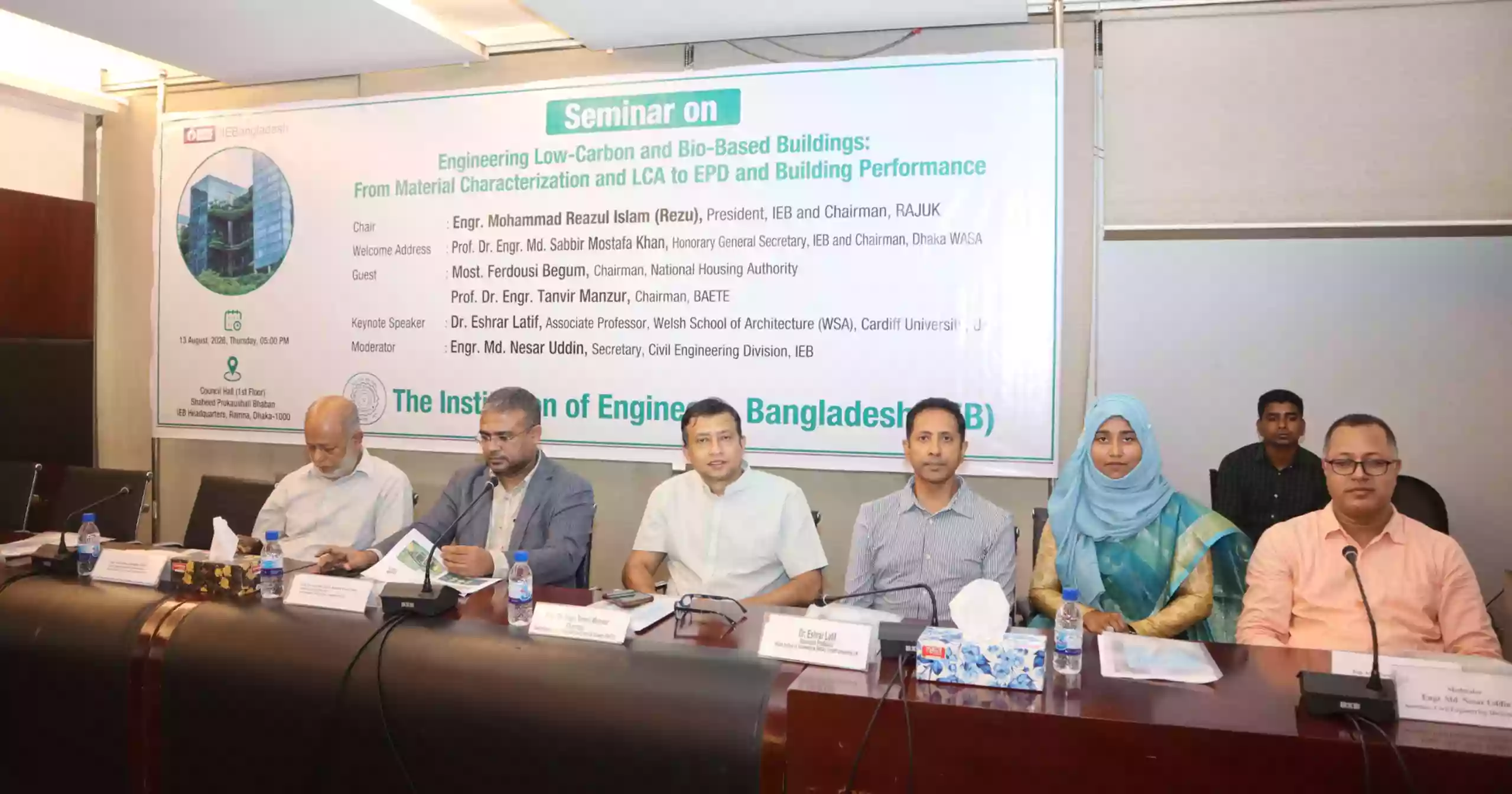
The remarks came at a seminar titled “Engineering Low-Carbon and Bio-Based Buildings: From Material Characterization and LCA to EPD and Building Performance”, organised by the Institution of Engineers, Bangladesh (IEB) at the Shaheed Engineer Bhaban at IEB headquarters in Ramna, Dhaka.
Engineer Khan Manjur Morshed, IEB vice-president (Academic and International), chaired the seminar.
Technology must serve humanity
In his opening remarks, Khan Manjur Morshed said scientific research and technological innovation have significantly improved human life, but the benefits of any invention depend largely on how and for what purpose it is used.
Citing the example of dynamite, he said the technology once brought major changes to mining, road, railway and infrastructure construction, but was later also used in warfare and destruction.
He also highlighted the social consequences of excessive and uncontrolled use of information technology.
“Technology has made our lives easier, but excessive dependence on it can weaken social interaction, family bonds and direct human relationships,” he said.
IEB Honorary General Secretary and Dhaka WASA Chairman Prof Dr Engineer Md Sabbir Mostafa Khan delivered the welcome address.
He said construction materials and material engineering would become increasingly important in the future practice of civil engineering.
He said concrete, steel, bricks and cement remain the dominant materials used in permanent buildings in Bangladesh, while lightweight houses made of tin, bamboo, timber and other locally available materials remain common in rural areas.
“Against the backdrop of climate change and the global need to reduce carbon emissions, we need to rethink our conventional construction practices,” he said.
Tanvir Manjur pointed out that significant carbon dioxide emissions are generated during cement production, particularly through limestone calcination and the high-temperature kiln process involved in clinker production.
The cement industry is associated with around 7–8% of global greenhouse gas emissions, he said.
National Housing Authority Chairman Mosa Ferdous Begum was also present at the seminar.
Carbon assessment should begin at design stage
Dr Eshrar Latif, associate professor at the Welsh School of Architecture, Cardiff University, UK, presented the keynote paper.
He said buildings consume substantial amounts of energy and raw materials not only during construction but throughout their operational lifecycle.
“Assessing only electricity consumption during the operational stage does not provide the full picture of a building’s carbon footprint,” he said.
The seminar was moderated by Engineer Nesar Uddin, secretary of IEB’s Civil Engineering Division.
Engineer Muhammad Ahsanul Russell, IEB honorary assistant general secretary (Administration and Finance), members of the IEB Central Council, leaders of engineering divisions and engineers from various government agencies and departments also attended the event.