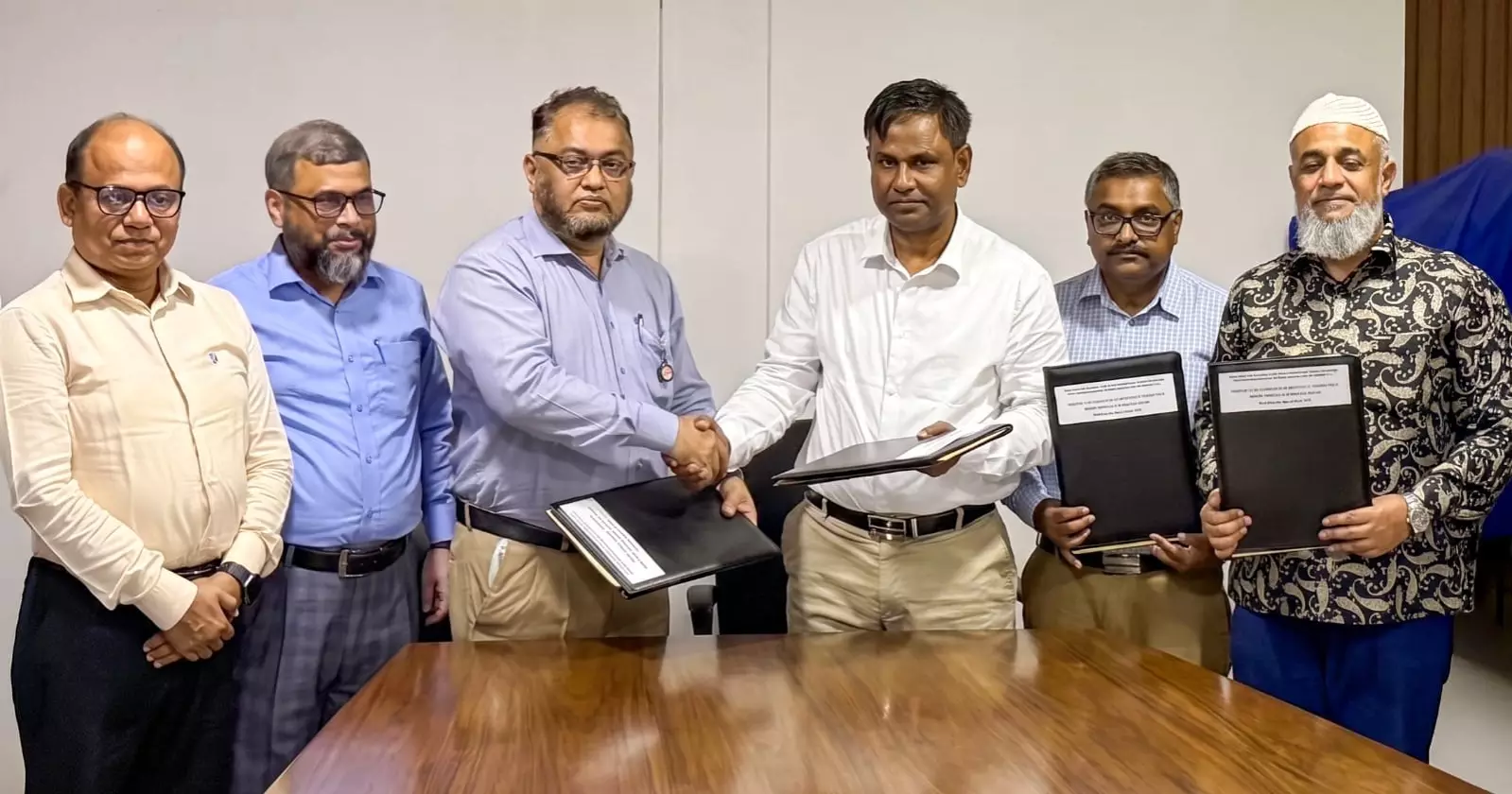
The Department of Environment (DoE) on Thursday signed two Memorandums of Understanding (MoUs) with the Forest Department and the Barind Multipurpose Development Authority (BMDA) to expand locally led climate adaptation initiatives in the climate-vulnerable Chittagong Hill Tracts and Barind region.
The agreements were signed at the DoE office in Dhaka with technical support from the United Nations Development Programme (UNDP), said a press release from the UNDP.
The MoUs were signed under the Integrating Climate Change Adaptation into Sustainable Development Pathways of Bangladesh (SD Pathways) project, funded by the Global Environment Facility-Least Developed Countries Fund (GEF-LDCF) and implemented by the DoE with technical support from UNDP.
Doe Director General Dr Md Lutfar Rahman, while signing the agreements, said, “Signing these agreements represents a commitment to concrete action for our most climate-vulnerable communities. By combining DoE's oversight with the specialised expertise of the Forest Department and BMDA, we are ensuring that climate adaptation reaches the grassroots level effectively, transparently and sustainably.”
Chief Conservator of Forests Md Amir Hosain Chowdhury highlighted the importance of ecosystem restoration in the Chittagong Hill Tracts.
“The ecosystem of the Chittagong Hill Tracts requires targeted conservation. Through this MoU, the Forest Department will leverage its technical expertise and field presence to restore natural watersheds and Village Common Forests, placing local indigenous communities at the heart of forest stewardship,” he said.
BMDA Executive Director Jahangir Alam Khan said, “With over four decades of experience in the Barind region, BMDA is uniquely positioned to deliver sustainable water management solutions. This collaboration will provide local farmers with climate-smart irrigation, combat soil degradation and protect agricultural livelihoods against severe drought.”
Reaffirming UNDP’s support, Assistant Resident Representative of UNDP Bangladesh Sarder M Asaduzzaman said, “This partnership directly advances the government’s priority agenda on sustainable afforestation and water resource management. By combining community action with institutional expertise, we are not only addressing immediate climate vulnerabilities in the hills and Barind region, but also creating a scalable adaptation model that can be replicated across Bangladesh.”
Under the two partnerships, climate adaptation efforts will focus on Rangamati and Naogaon districts. In Kaptai and Barkal, the Forest Department will restore 90 hectares of Village Common Forests and 115 hectares of agroforestry under a Tk 2.52 crore initiative running from August 2026 to May 2028.
In drought-prone Sapahar and Mohadevpur, BMDA will strengthen water security through climate-smart irrigation, waterbody restoration and 85 hectares of afforestation, with a Tk 10.44 crore programme running from August 2026 to June 2028.