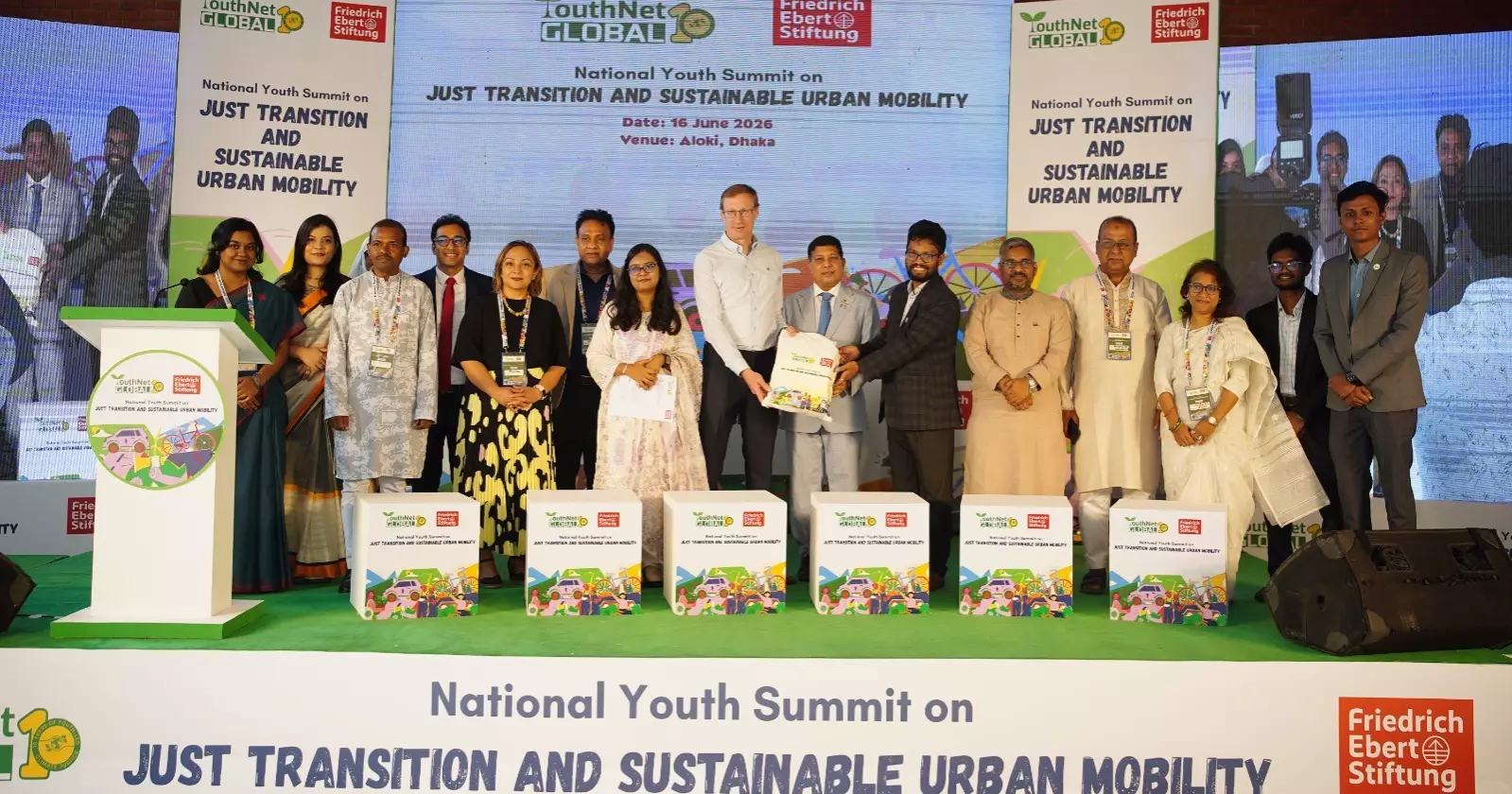
Bangladesh’s transition to greener transport systems must ensure protection for workers, vulnerable communities, and informal operators so that no one is left behind, said Additional Secretary (Climate Change Wing) of the Ministry of Environment, Forest and Climate Change, Mohammad Navid Safiullah.
He made the remarks while addressing the National Youth Summit on Just Transition and Sustainable Urban Mobility in Bangladesh, organised by YouthNet Global in partnership with Friedrich-Ebert-Stiftung (FES) Bangladesh on Tuesday at Aloki Convention Centre in Dhaka, according to a press release issued on Wednesday.
The summit brought together around 150 participants, including youth leaders, policymakers, climate experts, diplomats, academics, and trade union representatives.
European Union (EU) Ambassador to Bangladesh Michael Miller joined the concluding session to underline the EU's commitment to Bangladesh.
"The European Union, together with the European Investment Bank and EU member states, is a strong and reliable partner for Bangladesh in helping shape a just, efficient, and clean transition," he said.
Executive Coordinator of YouthNet Global Sohanur Rahman stressed the need to place young people at the centre of climate and transport governance.
Speaking as the chief guest, Safiullah said Bangladesh is at a critical crossroads, as rapid urbanisation, rising traffic congestion, deteriorating air quality, and unequal access to transport continue to challenge sustainable development.
Reflecting on the challenges of conventional transport systems, he highlighted the need to accelerate the transition towards cleaner mobility solutions while ensuring social protection for affected communities.
Highlighting the progress of green mobility, Safiullah said millions of electric three-wheelers are already operating across Bangladesh. However, he stressed that the transition must be supported by clean energy generation, stronger charging infrastructure, and environmentally safe battery management systems.
“A transition is only truly green if it is both safe and clean,” he said, warning that unsafe battery recycling continues to create serious environmental and public health risks.
Speakers linked transport reform directly to public health, noting that air pollution has become one of Bangladesh’s most urgent urban challenges, affecting children, workers, and vulnerable communities.
“For the Ministry of Environment, Forest and Climate Change, sustainable urban mobility is more than a transport issue. It is also about public health, equity, and social justice,” Safiullah said.
“When a low-income worker, a woman, or a person with a disability cannot access safe and affordable transport, they are denied opportunity and dignity.”
He stressed that an equitable transition must include reskilling opportunities for transport workers, recognition of informal operators, and improved access to safe and affordable mobility services for all citizens.
Youth engagement and collaboration across society, he added, will be essential for implementing NDC 3.0 and advancing Bangladesh’s climate ambitions ahead of COP31.
Opening the summit, Dr Felix Gerdes, Resident Representative of FES Bangladesh, underscored the importance of inclusive dialogue and cooperation among stakeholders to address urban mobility and environmental challenges.
Participants adopted a set of youth-led policy recommendations calling for cleaner public transport, stronger labour protections, expanded green jobs, improved air quality, and greater youth participation in decision-making as Bangladesh advances towards a low-carbon and climate-resilient future.