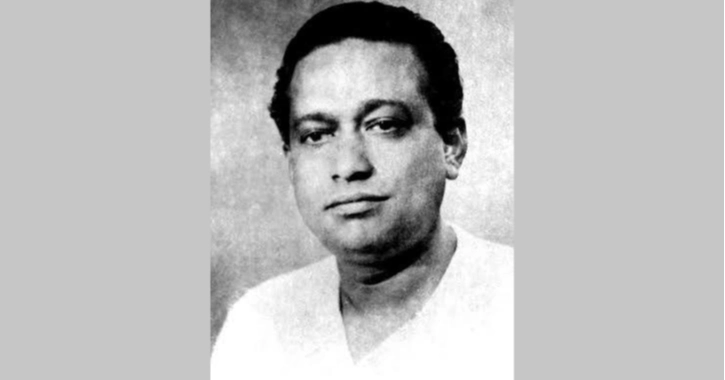
Few voices in the region's folk music have carried the soul of rural Bengal quite like Abdul Alim, whose deeply moving songs turned the experiences of ordinary people into an enduring musical legacy.
The legendary folk singer died on this day 52 years ago (September 5, 1974) at the erstwhile PG Hospital in Dhaka, aged 43. He has been dead longer than he lived, yet songs including 'Naiya Rey Nayer Badaam Tuila', 'Holudia Pakhi Shonar Boron', 'Porer Jaiga Porer Jomi' and 'Shorbonasha Padma Nodi' continue to resonate across generations.
Born on July 27, 1931, in Talibpur village of Murshidabad, Alim developed an interest in music during childhood. His first two recorded songs, 'Tor Mostafa-ke De Na Mago' and 'Aftab Ai Baslo Pate', were recorded in 1943, when he was only 12.
After Partition, he settled in Dhaka, where he became associated with radio and television while continuing his training under noted musicians including Ustad Mohammad Hossain Khasru and Momtaz Ali Khan.
Alim recorded more than 300 gramophone records and lent his voice to over 100 films. He was also among the singers associated with Mukh O Mukhosh, the first feature film produced in the then East Pakistan.
His repertoire covered diverse folk traditions, including bhatiali, murshidi, marfati, jari and sari. His distinctive voice and emotional delivery brought songs of love, separation, devotion, rivers and rural life to a much wider audience.
His reputation extended beyond Bengal. At the All Pakistan Music Conference in Lahore, he received five gold medals for his performances and contribution to music.
He received the Ekushey Padak posthumously in 1977 and the Independence Award in 1997. He also received the National Film Award for Best Male Playback Singer posthumously for his performance in Khan Ataur Rahman’s Sujan Sakhi.
Yet preserving his musical legacy remains a concern. His family has said that of more than 500 songs associated with him, only around 250 to 300 have been documented, while some recordings held in archives outside Bangladesh remain difficult to recover.
The preservation challenge makes Alim’s legacy more than a story of remembering a legendary singer. Every lost recording potentially means the loss of a unique musical interpretation and performance tradition.
Despite the gaps, his voice continues to live through younger performers, his children and cultural organisations working to preserve his repertoire.
More than five decades after his final journey, Abdul Alim’s songs are still travelling, keeping his unmistakable voice alive in Bangladesh’s musical heritage.