Music once echoed through Kabul's streets, filling cafes, restaurants and homes across the Afghan capital. But under Taliban rule, those sounds have largely disappeared, forcing musicians to abandon their professions and practise their art in secrecy.
Since 2022, the Taliban authorities, who returned to power in 2021, have enforced a nationwide ban on playing and listening to music. Only religious vocal chants without instrumental accompaniment are permitted. The restrictions are enforced by the morality police under the Ministry for the Propagation of Virtue and Prevention of Vice.
"Music is forbidden in Islam," ministry spokesperson Saif ul Islam Khyber said, arguing that it encourages sinful behaviour. He added that people were not allowed to listen to music or record songs and musical compositions.
Following the Taliban takeover, many musicians fled Afghanistan, while others sent their instruments abroad or concealed them to prevent their destruction.
Kucha-e-Kharabat, a historic neighbourhood in Kabul known for its musical heritage, has also lost much of its identity. Former music shops now sell groceries, clothing and household products instead of musical instruments.
Despite the restrictions, some musicians remain determined to preserve Afghanistan's musical heritage. Occasionally, they bring out their hidden instruments and perform privately, despite the risk of arrest.
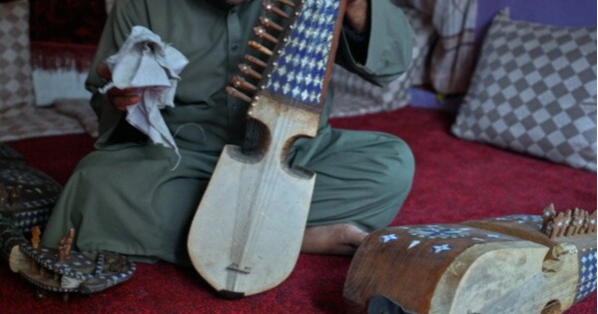
In a small house in Kabul, one musician keeps three hand-carved rubabs, a traditional Afghan string instrument. He occasionally takes one out and plays it, determined not to let the instrument or the country's musical traditions disappear.
"As long as I am alive, I will continue to play," he said, adding that even if he has to perform secretly, he will not allow the rubab to fall silent.
A Kabul-based singer shares the same determination, saying that music remains alive in people's hearts even when public performances are prohibited.
Both musicians spoke anonymously because of fears of arrest.
Before the Taliban takeover, the singer regularly performed at concerts and celebrations. He has since hidden his rubab, harmonium, flute, tabla and keyboard.
He described covering his instruments with a tarp as an emotionally devastating experience, saying music had given him purpose, recognition and a livelihood.
Sometimes, he stands beside his concealed instruments and cries, asking their forgiveness because he can no longer play them.
Musicians face financial hardship
The restrictions have also pushed musicians into severe economic difficulties.
The rubab player previously taught at a music school and operated a traditional instrument shop inherited through his family. After the Taliban returned to power, he sent many instruments abroad, hid the rest and closed his business.
He said his family had earned around 10,000 afghanis ($150) daily through music teaching and instrument sales. Today, he earns barely 100 afghanis ($1.50) a day working as a labourer.
The closure also deeply affected his father, who died of a heart attack shortly afterwards. The musician believes his father never recovered emotionally from losing the family business.
Meanwhile, the singer remained unemployed for two years before friends helped him establish a small business.
Secret performances become increasingly risky
Initially, some musicians continued performing at underground gatherings despite the ban. However, growing surveillance and the threat of arrest have made such events increasingly dangerous.
The singer said government agents were actively searching for musicians involved in secret performances. He has not attended any underground musical gathering for four years, fearing imprisonment and worrying about his young children.
The rubab player also stopped performing secretly after authorities raided a gathering where he had played. The morality police reportedly learned about the event after an attendee took photographs and sent them to officials. Several participants were arrested, although he managed to escape.
Musicians fear loss of cultural heritage
Beyond the financial consequences, musicians fear that Afghanistan's traditional music could gradually disappear if younger generations cannot learn and practise it.
The rubab player learned the instrument from his father and now hopes to pass the skill on to his eldest son.
He said preserving the family tradition was essential, describing it as a legacy passed down from his grandfather to his father and then to him.
The singer, however, believes Afghanistan's musical identity cannot be erased despite the restrictions.
"No one can ever truly separate music from Afghan society," he said, comparing their connection to that between a fingernail and flesh.