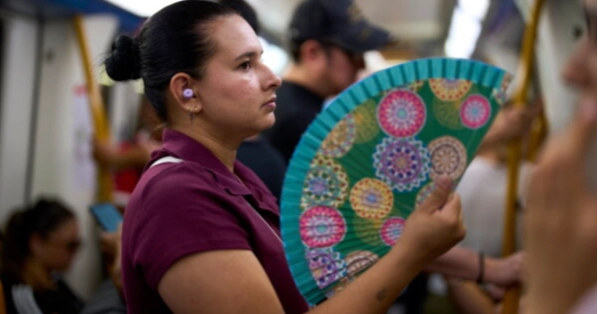
As Spain endures another scorching summer, an age-old accessory has returned to prominence, offering a simple and effective way to beat the heat.
The traditional Spanish folding hand fan, known as an abanico, is once again a common sight in packed metro trains, busy squares, concerts and outdoor festivals. Compact enough to carry in a handbag, the fan opens into a half-circle and produces a refreshing breeze with a quick movement of the wrist.
With a series of heat waves sending temperatures across Western Europe soaring this summer, the humble fan has become almost indispensable. People of all ages, including an increasing number of men, are now using them to stay cool. During Madrid’s Pride celebrations in July, brightly colored rainbow fans were particularly visible among the crowds.
On a hot August day, 20-year-old Ana Feliu used a paper fan she had received at a festival in Valencia to shield herself from the sun. She said she takes it with her whenever temperatures rise.
“This one is my favorite because it’s the biggest, but I have many more,” Feliu told The Associated Press near Madrid’s Puerta del Sol. Temperatures in the Spanish capital were forecast to climb to 39 degrees Celsius (102 Fahrenheit) later that week.
Nearby, 53-year-old David González was also cooling himself with an abanico decorated in shades of pink, purple and red.
González said he initially felt somewhat awkward carrying the traditionally feminine accessory, but eventually embraced its practicality.
“At first, I felt a little self-conscious, because it’s something that’s mainly associated with women, but I have to admit it serves a purpose — and it brightens my day,” he said.
A tradition with Asian origins
Although closely associated with Spanish culture today, the folding fan has roots far beyond Europe.
Historians believe it arrived in Europe through Portuguese maritime trade with Asia during the 15th and 16th centuries. The accessory soon found its way into European art. Spanish master Diego Velázquez depicted a woman holding what appears to be a delicate folding fan in his 17th-century painting The Lady with a Fan.
As fans became fashionable among European royalty and aristocrats, Spain developed its own manufacturing tradition. Madrid became a major production centre, while Valencia emerged as the country’s leading fan-making hub during the 18th century.
Mary Kitson, a curatorial consultant at London’s Fan Museum, said advances in printing helped make fans more affordable during that period.
The fan eventually became deeply embedded in Spanish social life. By the 19th century, women in aristocratic circles could supposedly communicate romantic interest, flirtation or disapproval through carefully choreographed movements of the fan — a practice popularly known as the “language of the fan.”
The accessory later crossed the Atlantic and became popular in Latin America. In the 19th century, flamenco performers adopted the abanico as a dramatic prop, incorporating it into dance movements influenced in part by Cuban music and dance traditions.
Over time, its role in flamenco helped establish the hand fan as one of the enduring visual symbols of Spain.
For flamenco dancer Carmen Torres, 44, the fan remains both practical and expressive.
“The fan is a perfect element because, on the one hand, it evokes the heat and humidity of Cuba — that heavy, oppressive feeling,” she said. “And at the same time, it gives us a way to bring out the seductive, coquettish quality.”
From historic stores to tourist stalls
At Casa de Diego, a traditional wood-panelled shop in Madrid, the Llerandi family has been selling abanicos for more than 150 years.
“We live from the heat,” said Javier Llerandi, whose family business has benefited from the latest bout of extreme temperatures.
The shop sells fans made in Spain, ranging from relatively simple wooden designs to elaborate, hand-painted creations made from mother-of-pearl and decorated with intricate floral motifs.
Prices start at around 30 euros ($35), while more elaborate pieces can cost between 200 and 500 euros (up to $580). The most exclusive fans can command prices of as much as 6,000 euros (nearly $7,000).
According to Llerandi, the cost reflects not only the materials but also, more importantly, the skill and time required to make each piece.
Madrid’s popularity as an international tourist destination has also brought foreign buyers into the shop. Llerandi said many customers appreciate the traditional fans as a practical alternative to battery-powered portable devices.
“Battery-run items eventually run out of power, and always at the worst possible moment,” he said with a smile. “Without a doubt, heat waves are good for this business.”
For tourists looking for a cheaper souvenir, plastic fans decorated with printed designs are widely available at kiosks across the city, often for just a few euros. Vendors say sales have been strong during this summer’s heat.
Near one of Madrid’s large bullrings, Juani Duran sells wooden fans featuring traditional floral patterns for about five euros each.
Because bullfights are held in open-air arenas and spectators traditionally dress formally for the occasion, the elegant hand fan remains a natural accessory.
“You’ll usually find a hand fan in any woman’s pocket — and in some men’s, too,” Duran said before a bullfight in late August.
She acknowledged that the inexpensive fans she sells are not particularly durable.
“They’re not the best quality,” she said, “but they’ll get you through the summer.”