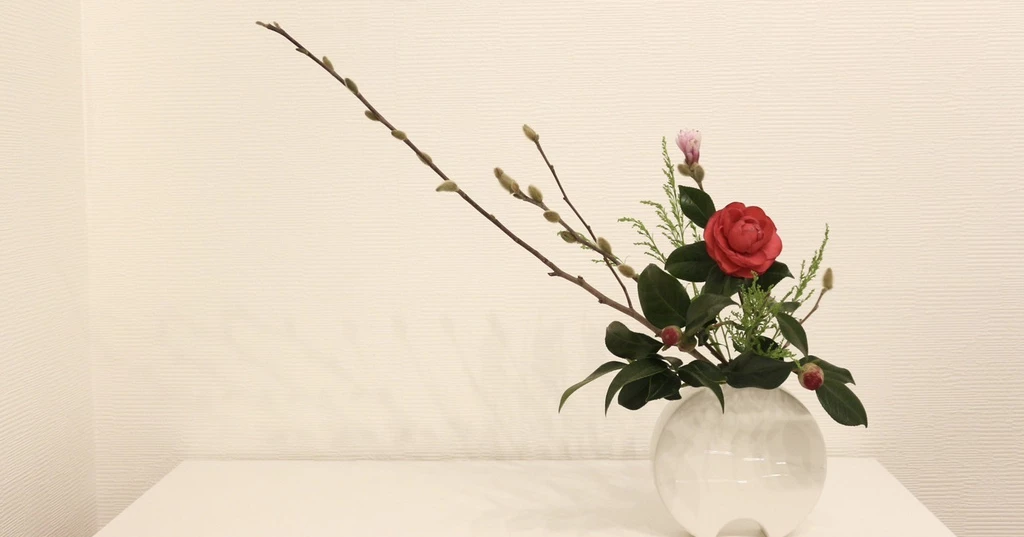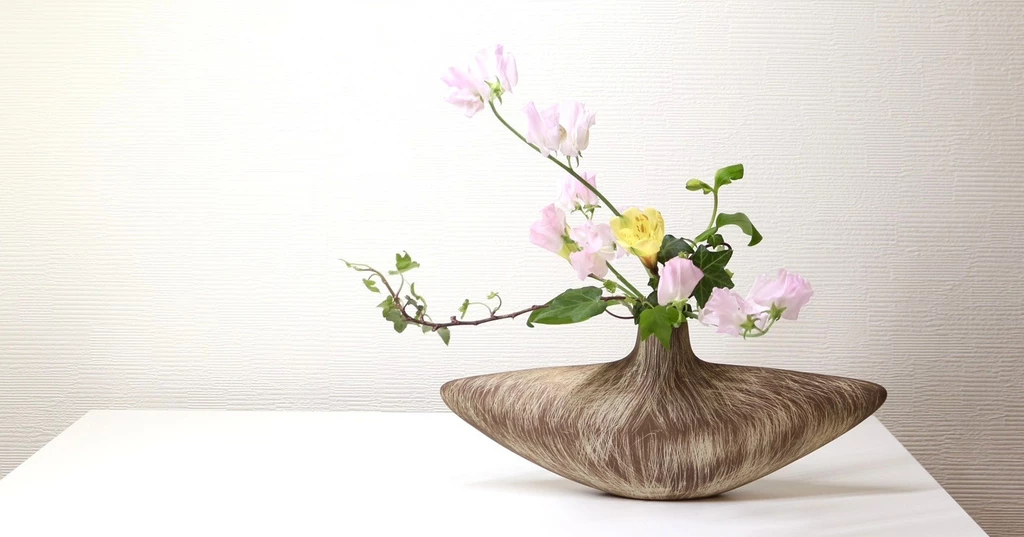
Ikebana, the traditional Japanese art of flower arrangement, has been practiced for more than 500 years and continues to attract both traditionalists and newcomers seeking creativity, mindfulness and a sense of calm.
Ikebana can resemble solving a puzzle, but unlike a conventional puzzle, it has no single correct solution. Since every flower and every person is different, there can be many ways to create an arrangement.
"There's a 'detox' purifying factor, and a healing," said Hiroyuki Okada, 40, who began studying ikebana about seven years ago and now teaches Ikenobo, the oldest of the three major ikebana schools.
Okada also teaches backflips to those interested. He normally wears silver chains and jeans, but puts on a formal kimono when demonstrating his flower arrangements.
He sees himself as representative of many people who are drawn to ikebana today — those searching for joy, purpose or relief from the pressures and difficulties of modern life.
"In arranging (flowers), you are dealing with the life that is there, the beauty, of course, but you find what's in your heart," Okada said. "You come face to face with yourself."
The Kyoto-based Ikenobo school has roots in Buddhism and now has chapters in various parts of the world.
Okada previously worked for a nonprofit organization, where he interacted with people from different countries and came to appreciate both their differences and similarities.
After moving to his current job at a flower shop, he decided to pursue an activity that would allow him to explore something distinctly Japanese and that he could continue doing on his own for many years.
Observing nature is part of ikebana
Ikebana involves an interaction with nature, although usually on a small scale, often centered around a small vase.
"It is about the relationship of the creator with the flowers," said Senko Ikenobo, the headmaster-designate of the Ikenobo school.
Her family has maintained a connection to the art for generations, dating back to its origins. Her father is the current headmaster.
Jeannette Haviland-Jones, a professor of social psychology at Rutgers University, said studies have found that flowers and even their scents can promote happiness.
"We suggested a coevolutionary theory for this in which flowers became the 'pets' of the plant world," she said.
For Okada, the experience involves more than a flower's appearance and fragrance. The texture of petals and leaves is also important, much like touching or petting a kitten or puppy.