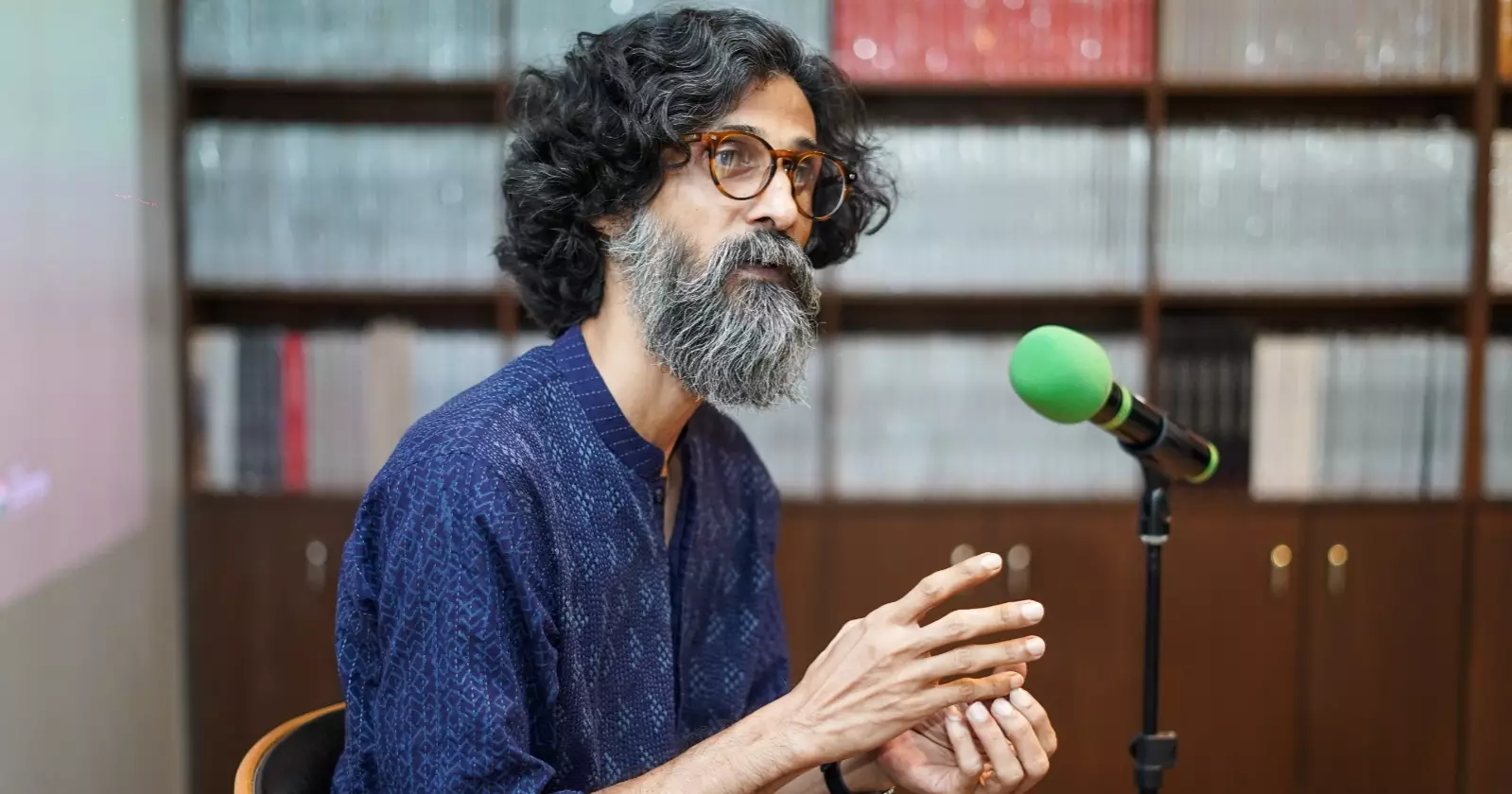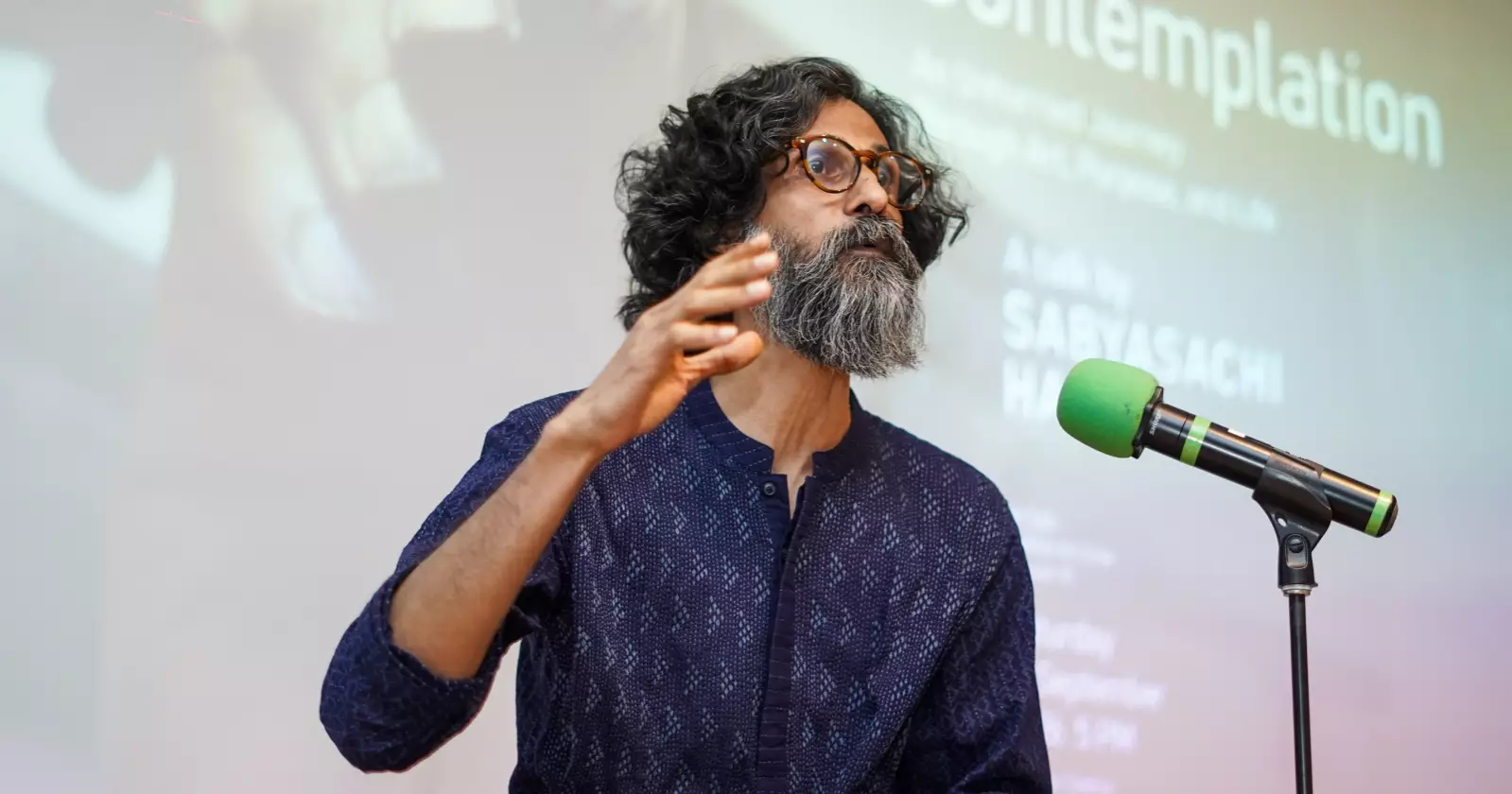
For artist Sabyasachi Hazra, art has never been confined to a canvas or a gallery; it has grown alongside his memories, friendships, struggles and everyday encounters. Life has been an unhurried journey for him.
At an intimate Art Talk in Dhaka on Saturday, Hazra revisited that journey, recalling his ancestral home, the communist literature that entered his life as a teenager, his early work with little magazines and the friendships that shaped his understanding of art and design.
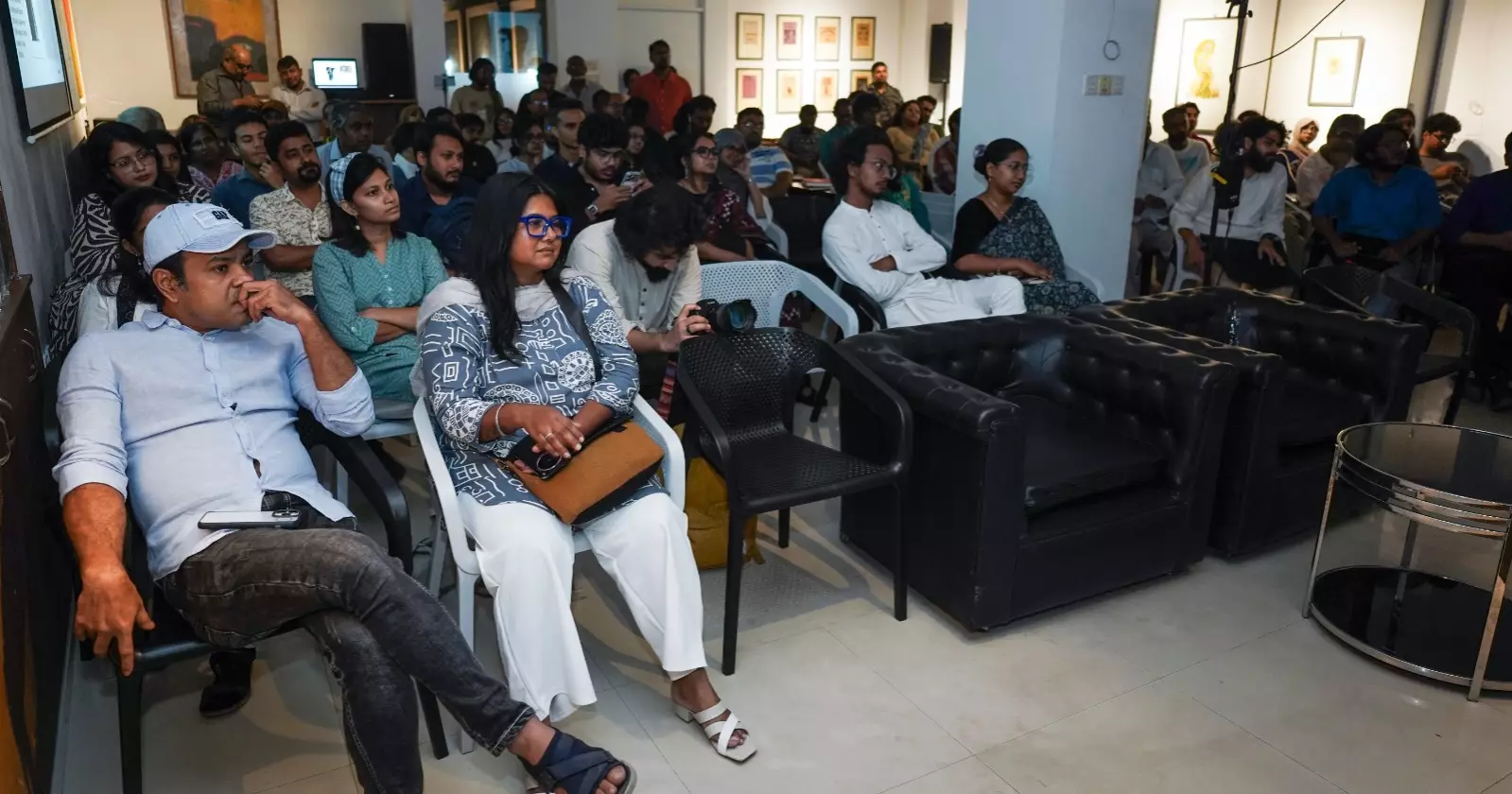
Hazra was speaking at ‘Contemplation: An Unhurried Journey Through Art, Purpose, and Life’, the 12th session of Cosmos Art Echo, organised by Gallery Cosmos and Cosmos Atelier71 at Cosmos Centre in Malibagh. Gallery Cosmos Artistic Director Sourav Chowdhury moderated the session.
Sabyasachi Hazra began by recalling his childhood in Khulna and his ancestral home at Itna village in Lohagara, Narail, where he spent his first six years. He then screened an 11-minute documentary, Hazrabari, centred on the ancestral home and his family history.
“My grandmother, whom I never saw, was shot dead in this very Hazrabari in 1971 during the Liberation War,” Hazra said. “Although I never met her, I can still feel her presence whenever I return to the house.”
His teenage years brought politics and books into his life. An elder involved in communist politics introduced him to numerous books, while he also began designing political posters and writing on walls.
“Growing up was connected with Narail, Khulna was where I had a deep love, and with Dhaka it was an ‘arranged marriage’,” he said.
After enrolling at the Institute of Fine Arts of Dhaka University and moving into Jagannath Hall, Dhaka gradually became central to his artistic life. Aziz Super Market, with its bookshops and little magazines, became one of his favourite places.
“I learnt a lot while making little magazines, especially that adversity brings out the best in people,” Hazra said, adding that he had designed around 250 little magazine covers.
His interests also extended to cinema and theatre. He recalled attending screenings organised by the Short Film Forum and later engaging with Moviyana Film Society, the Russian Cultural Centre and Goethe-Institut.
“I used to see that those who studied at Fine Arts either sang, or did theatre, acted or recited. I could not do any of those things. But theatre attracted me, and I worked with Prachyanat,” he said.
Through his elder brother, who studied at BUET, Hazra became connected with students whose experiments with composition influenced his own understanding of visual design.
“Design has never seemed less important to me than an artwork,” he said.
On artist’s block, Hazra said he did not consider it something he could afford to dwell on.
“I feel that the time in my life is limited. If it takes time just to overcome this block, where will I find that time?” he said, adding that art, cinema, music and theatre often provide subjects for his work.
“I have learnt the most from my surroundings, my friends and people younger than me, through conversations with them. Perhaps I learnt only 10 percent from textbooks,” he said.
Book-cover design has been a major part of Hazra’s professional practice. Since 2000, he has specialised in the field and built a portfolio of nearly 4,000 published works, collaborating with authors, researchers and publishing houses across Bangladesh.
He recalled learning from artists and designers including Khaled Chowdhury, Purnendu Pattrea, Kazi Hasan Habib, Qayyum Chowdhury and Kamrul Hassan. His collaborators have included Dhruva Esh, Iftekhar Mahmud, Syed Manzoorul Islam, Anisuzzaman, Joy Goswami, Syed Shamsul Haq, Nirmalendu Goon and Humayun Ahmed, among others.
“Dhruva Esh is the only writer who, to this day, has never seen a book cover I designed for him before its publication,” Hazra said.
His work has also included posters for theatre, films, cultural festivals and social advocacy initiatives, including Syed Jamil Ahmed’s 4.48 Montrash and Ami Birangona Bolchi, as well as Mayer Mukh, Agunjatra and the web production Gulmohor.
Bangla letters and typography have emerged as another major strand of his practice. His books include Chitralipi (2015), Rong Tulite Chopchap (2018), In the Quest of Bangla Typography (2022) and Bangla Namer Desher Galpo (Ed., 2023).
His typography research also led to Bornomala, which brings together eight selected Bangla primers published between 1849 and 1948, tracing changes in lettering, editing and printing techniques.
Hazra also discussed installation projects created on different walls of Dhaka University and remembered creative companions including artist Kalidas Karmakar, musician Rahul Anand, filmmakers Animesh Aich and Mezbhaur Rahman Sumon, artist Kanak Aditya and Shibu Kumar Shil of Meghdol.
“One thing that was common among all of us was that none of us ever thought we would become popular,” he said.
His paintings span different media and often engage with sociopolitical issues and women’s narratives. He also discussed abstract and mythological works from his Fine Arts years.
Towards the end, Hazra brought out personal objects from his bag, including a handmade horse figurine, a self-made pen, a small mould received from an aunt during childhood and a nakshi kantha handkerchief, expressing a wish that such objects and their memories would survive.
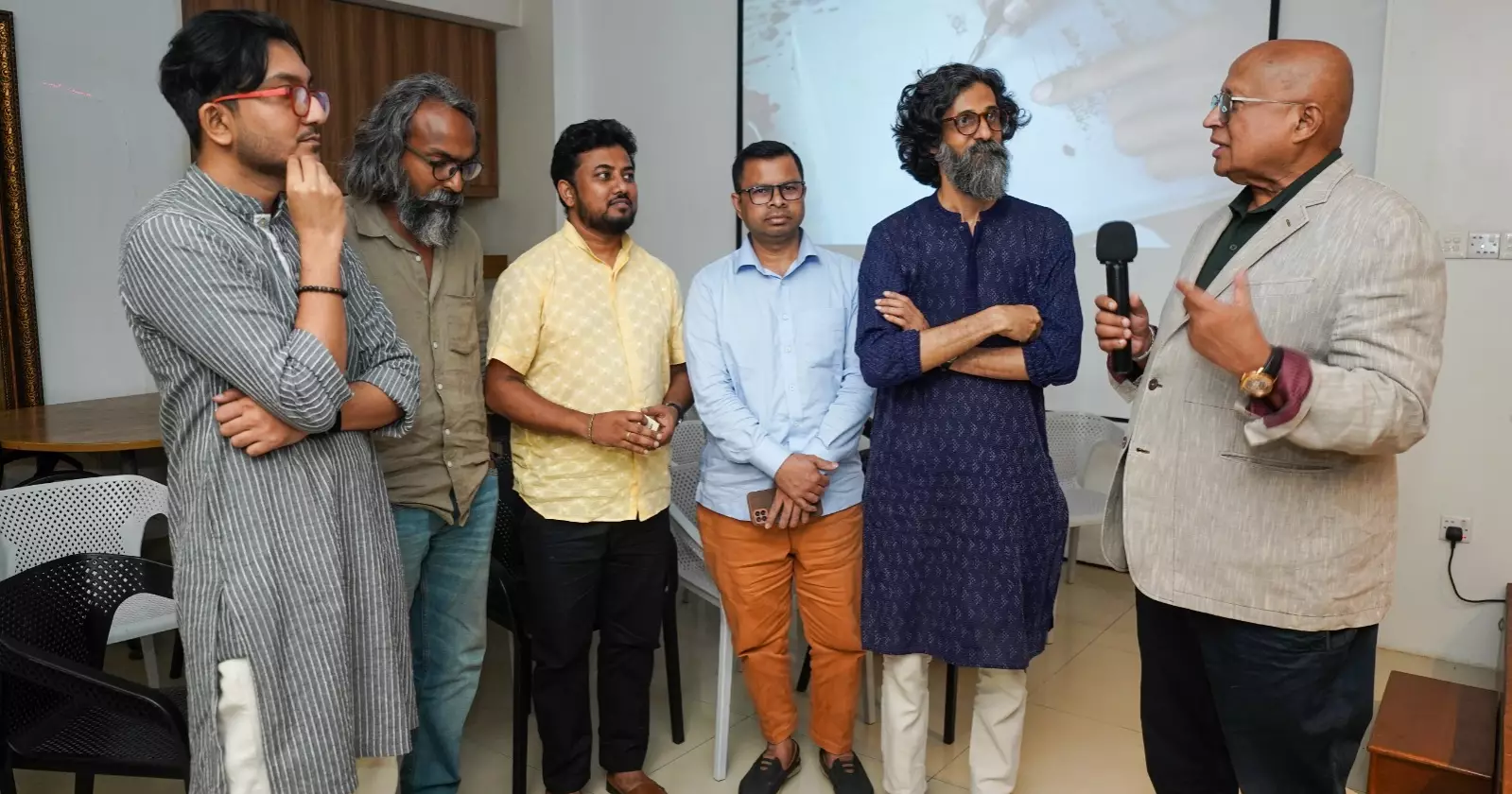
At the end of the event, Gallery Cosmos Founder Enayetullah Khan also spoke about art’s role in difficult times.
“People often tell me that, given the direction the world is heading, perhaps art is the only thing that can save the world,” he said. “During Covid-19, people asked me how I spent that time. I spent it well because I was surrounded by art.”
Khan said artists have an important role in helping people navigate pain and struggle. At the end of the programme, he presented Hazra with a copy of the recently published second edition of his book 'The Bangladesh Sundarban'.
Cosmos Art Echo is one of the flagship events of Gallery Cosmos and Cosmos Atelier71.