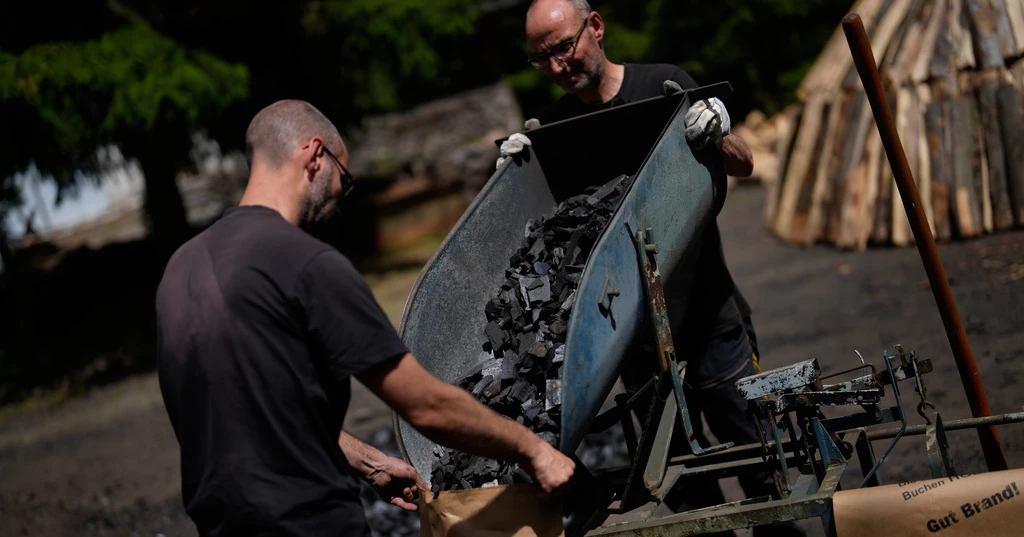
Immo Feldmer carefully tipped smoldering charcoal into a tall mound of earth, continuing an ancient tradition of charcoal making that has survived for centuries in Germany’s Harz Mountains.
Inside the mound, beech wood is tightly stacked and left to smolder for weeks until it is transformed into charcoal — a craft that has been practiced in the Harz region of eastern Germany for hundreds of years.
“We are making charcoal in traditional earthen kilns, just as it was done here in the Harz Mountains over 1,000 years ago,” Feldmer told The Associated Press in a recent interview as he stood among the mounds in the Harz forest near the small town of Hasselfelde.
Feldmer and his brother Sascha took over the Harzköhlerei Stemberghaus charcoal-making business from their father. They also employ a small number of workers because the smoldering wood inside the mounds must be monitored and carefully tended day and night to prevent it from catching fire and turning into useless ash.
Once covered with earth, the beech wood burns from top to bottom through carefully placed air holes. Beech is particularly suitable because of its high density and the intense heat it produces when converted into charcoal.
After the process is complete, the charcoal is cleared of soil and allowed to cool before being packed into 10-kilogram (22-pound) bags for sale.
Charcoal production was once essential to mining in the Harz Mountains. Valuable metals such as silver, lead, copper and zinc were extracted from hard rock by crushing the ore and smelting it in furnaces at extremely high temperatures — heat that could only be achieved with charcoal.
Over the centuries, hundreds of families in the Harz region made their living as charcoal burners.
Mining has since ended in the area, however, and only a small number of charcoal burners remain in Germany. The Feldmer brothers now mainly sell their charcoal to people who use it for barbecues at home.
“Our charcoal is, first and foremost, made from pure beech wood,” Feldmer said, noting that much of the charcoal sold in German hardware stores is imported and made from “mixed woods, scrap wood, and waste wood” to keep production costs low.
The brothers produce around 40 tons of charcoal a year, but the business alone is not enough to support them. They have therefore expanded the operation to include a museum showcasing the history of charcoal burning, a small shop and a restaurant serving local specialities, including steaks grilled over their own charcoal made from birch wood.
Although charcoal burning has largely disappeared as a traditional craft in Germany, Feldmer hopes his family can keep the practice alive for future generations.
“Of course, we hope ... that our business here will be taken over by our children, that it will continue to operate, and that the traditional craft of charcoal burning will be preserved here,” he said.