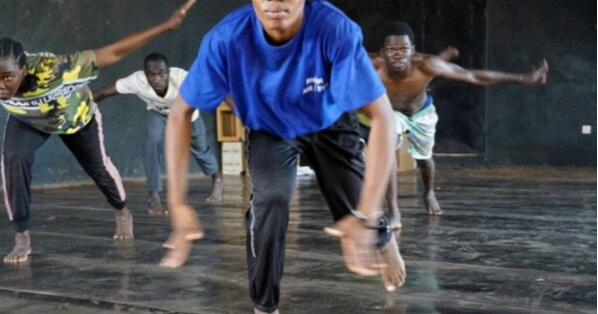
Music fills a small dance studio in Burkina Faso's western city of Bobo-Dioulasso, with vibrations traveling through the rubber-covered floor as Yaya Sanou uses his face and body movements to guide a group of deaf and non-verbal dancers.
Unable to hear the music, the dancers follow its rhythm through vibrations, touch and visual signals using a technique developed by Sanou.
Known as Vibra-Signe, the method has gained attention both in Burkina Faso and abroad through the performances of the Fientan dance company, which Sanou founded about a decade ago for deaf and hard-of-hearing dancers.
The technique combines vibrations, touch and visual cues to translate music into movements. Dancers perform barefoot so they can feel percussion through the floor, while taps, hand signs, gestures and facial expressions help them follow changes in tempo and emotion.
Fientan won a gold medal for dance creation at the 2023 Francophone Games in Kinshasa, the capital of Congo. The group has also performed its latest production, “Adepte de mon être,” or “Devoted to my being,” in Germany and Ivory Coast.
In Burkina Faso, where resources and government support for people with disabilities remain limited, the technique has helped dancers build confidence and improve their social skills.
The group's name itself reflects that message. Fientan means “without disability” in the local Dioula language.
“This teaching method is an opportunity for us and also a solution to a problem,” dancer Adama Sanou said through sign language. “It gives young people the possibility to express themselves and say what they want to say.”
Teaching and empowering deaf dancers
Yaya Sanou began dancing years ago on the streets of Bobo-Dioulasso, Burkina Faso's second-largest city. He combined traditional dances he learned at home with modern styles.
He later noticed that children at the Institut des Jeunes Sourds du Faso, a local school for deaf children and others with disabilities, had few opportunities to socialize.
Sanou decided to teach them dance and eventually developed the Vibra-Signe technique as his group attracted more children from Bobo-Dioulasso and surrounding areas.
He said learning the method can take time because dancers must become familiar with following vibrations, rhythm and body movements. But he said the results have been rewarding for both him and his students.
“With this project, we give these young people the possibility to express themselves and to say what they want to say,” he said.
Limited support for deaf children
There is no recent official data on the number of deaf and hard-of-hearing people in Burkina Faso. The country's 2019 census recorded about 46,500 people aged 2 and older who had significant difficulty hearing or could not hear at all.
Burkina Faso, a country of about 24 million people, has introduced education programs and other measures aimed at improving the lives of people with disabilities.
However, rights advocates and experts say there are still shortages of teachers, sign-language interpreters and other support services.
American Sign Language is taught in schools, but it does not necessarily match the local languages used by families at home. Many deaf children also do not learn sign language until they start school, sometimes as late as age 10.
A study by Burkina Faso's Institute of Social Sciences found that 58% of respondents had a negative perception of deafness, with some viewing it as a “curse” or “spiritual punishment.”
Disability advocate Philo Camara said Vibra-Signe could help promote inclusion for children with disabilities and could potentially be adapted for use in education and other programs.
Dance offers a new path
At Fientan's studio in Bobo-Dioulasso, dancers have developed their own ways of communicating and identifying themselves.
Souleymane Barro, a 24-year-old deaf dancer, uses a sign that combines the letters “B” and “S” from his name.
“As a deaf person, it is difficult to get ahead,” Barro said. “But I am working to become a professional and teach the younger ones to dance.”
Some dancers have also faced opposition from their families because of traditional attitudes.
“When I suggested it to my father, he did not like it at first but I kept dancing,” said another dancer named Sanou, who is not related to Yaya Sanou.
During a recent rehearsal, children gathered around to watch the dancers. The music played continuously as Sanou guided them with his hands, face and body. The dancers carefully watched him and repeated his movements.
Ouaramata Sanou, 26, once watched the group from the sidelines. Joining the dancers, she said, has transformed her life.
“Before, I watched people doing things, dancing, and I did nothing,” she said. “But now I dance, and I can travel.”