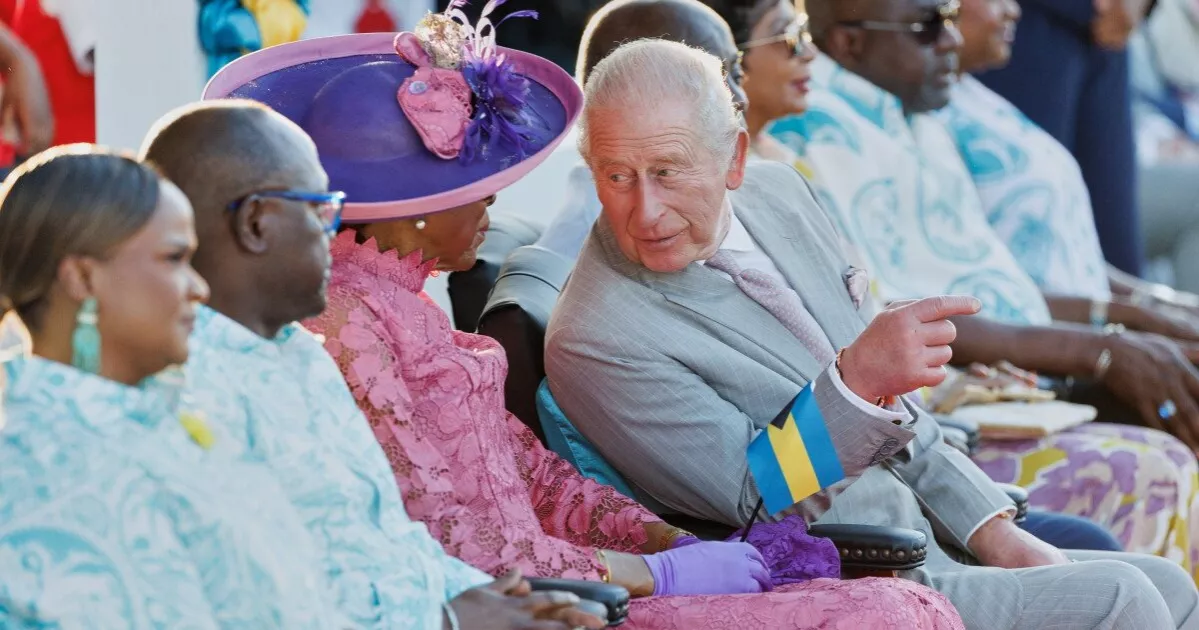
King Charles III is facing renewed pressure to address Britain’s historical role in slavery as he visits the Bahamas, Guyana and Antigua and Barbuda over the next nine days.
The British monarchy continues to face demands for an apology and reparations for the enslavement of millions of Africans who were transported to the Caribbean and North America to work for the benefit of slave owners and the British Empire.
Palace officials have indicated that Charles will repeat his previous remarks describing slavery as an “atrocity that forever stains our history,” but he is not expected to issue a formal apology.
Speaking at a youth rally in Nassau, the Bahamian capital, on Tuesday, the king said acknowledging the suffering and injustices of the past was the right thing to do.
However, Brooke Newman, a Virginia Commonwealth University history professor and author of The Crown’s Silence: The Hidden History of the British Monarchy and Slavery in the Americas, said such statements would do little to address the concerns of slavery’s descendants.
She argued that the approach failed to encourage dialogue and left affected communities feeling that the government and monarchy were unwilling to discuss the issue further.
Royal family’s historical links to slavery
Newman’s research traces the monarchy’s involvement in slavery from the late 16th century through the abolition of the slave trade in 1807 and the end of slavery across the British Empire in 1833.
According to her book, Queen Elizabeth I supported an expedition by sea captain John Hawkins in 1563 to capture Africans from Portuguese-controlled ports in West Africa and transport them to Spanish colonies in the Caribbean.
The queen provided Hawkins with a Royal Navy warship in exchange for a share of the profits, making her the first English monarch to benefit directly from the transatlantic slave trade, Newman wrote.
Nearly a century later, King Charles II granted the Company of Royal Adventurers into Africa, later known as the Royal African Company, exclusive trading rights along the West African coast. The company expanded its activities from trading gold, hides and ivory to enslaved Africans.
Charles II and his brother, the Duke of York, who later became King James II, invested in the company.
Growing international pressure for reparations
Calls for Britain and other countries that benefited from slavery, including the United States, Portugal and Spain, to pay reparations have intensified in recent years.
In March, the United Nations General Assembly adopted a resolution calling for reparatory justice, including a formal apology and compensation for both the period of enslavement and its continuing consequences.
The resolution highlighted lasting inequalities affecting Black communities in the Caribbean and the Americas, including reduced economic opportunities, lower incomes and shorter life expectancy. The United Kingdom abstained from the vote.
Craig Prescott, a constitutional law and monarchy expert at Royal Holloway, University of London, said Charles was unlikely to apologise because he acts on behalf of the elected government rather than independently.
He said the British government acknowledges slavery as a stain on the country's history but maintains that reparations will not be paid.
The issue is particularly sensitive because compensation could cost Britain hundreds of billions of pounds at a time when the government is under pressure to fund public services amid rising living costs.
Commonwealth relations add to the challenge
Charles must also consider how his remarks will be received across the Caribbean and the wider Commonwealth, an association of 56 independent countries, many of which were formerly part of the British Empire.
The British monarch remains head of state in 14 Commonwealth countries besides the United Kingdom.
The final four days of Charles' Caribbean tour will take place in Antigua and Barbuda, which is hosting a biennial meeting of Commonwealth leaders.
Hilary Beckles, chair of the Caribbean Community's reparations commission and vice-chancellor of the University of the West Indies, has urged the king to respond to the demands as a person rather than solely as a monarch or Commonwealth leader.
Speaking ahead of the visit last week, Beckles said the wealth Charles would pass to his children and grandchildren was partly rooted in the historical exploitation and enslavement of Africans.
Debate over Britain’s historical responsibility
Britain has faced similar criticism during previous commemorations of the abolition of slavery.
In 2007, the country marked the 200th anniversary of the abolition of the slave trade by honouring William Wilberforce and other campaigners who spent two decades persuading Parliament to outlaw the trade.
However, a commemorative service at Westminster Abbey attended by the late Queen Elizabeth II, then-Prime Minister Tony Blair and other dignitaries was disrupted by activist Toyin Agbetu, who accused the monarchy of failing to apologise.
Agbetu later criticised British leaders for celebrating the abolition of the slave trade without adequately recognising the suffering caused by slavery.
Newman said the challenge remained unresolved because brief acknowledgements of historical wrongdoing did not adequately examine its lasting consequences.
The effects of colonialism and slavery, she argued, continue to shape present-day inequalities and cannot be addressed through a few general statements.