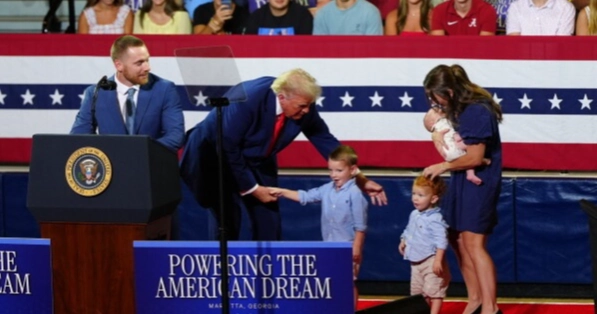
President Donald Trump on Wednesday highlighted the success of the new Trump Accounts programme, saying more than 7 million accounts have already been opened for children and describing it as a major investment in their future. However, some parents who enrolled their newborns say they are still waiting to receive the promised $1,000 government contribution.
Speaking at a rally at a Georgia high school, Trump said the accounts would help children get "a really fair shot at the American dream."
"The government is finally giving money back to our children," he told supporters.
The tax-advantaged savings accounts became available on July 4. Children under 18 are eligible to open an account, while babies born between Jan. 1, 2025, and Dec. 31, 2028 automatically qualify for a $1,000 deposit from the US Treasury to start their savings.
According to the Treasury Department, most families receive the government contribution within one or two days of opening an account. But a small number of parents have reported delays.
Once established, Trump Accounts can receive additional contributions from parents, relatives, friends and employers. Some wealthy donors have also pledged financial support. The money is invested by private firms in stock market index funds and cannot be accessed until the child turns 18. Withdrawals are limited to approved purposes such as higher education, starting a business or buying a home.
At Wednesday's rally, Georgia Republican gubernatorial candidate Rick Jackson pledged to seek matching state funding for every eligible child. He said that if lawmakers reject the proposal, he would personally contribute the additional $1,000.
Supporters say the programme will encourage more Americans to build long-term wealth through stock market investments and expand financial opportunities for future generations.
However, some families have experienced delays in receiving the initial government payment.
Masaki and Kristina McLellan of Bergen County, New Jersey, said they signed up for a Trump Account for their daughter Maya, who was born in March, after deciding the $1,000 incentive outweighed their initial concerns that the programme was politically motivated.
Masaki McLellan said he applied on July 6. After his first application was rejected, he contacted the programme's customer support and the account was activated. Although he was initially told the funds would arrive within 10 days, he was later informed it could take up to four weeks.
Kristina McLellan said she was disappointed by the delay but noted that Maya already has other long-term investments, including a college savings plan and a custodial brokerage account.
"We definitely want to give her options for her future and make sure she can choose what she wants to do," she said.
The Treasury Department described the McLellans' case as uncommon, saying only a small fraction of applicants require customer assistance.
Officials said the waiting period is comparable to routine government processing, such as issuing tax refunds. While most deposits are completed within one or two days, families are sometimes given a longer estimated processing period as a precaution.
The department said the accounts provide all families—not just wealthy households—with an opportunity to invest in their children's future. It also recently launched an initiative allowing child welfare agencies to open accounts for children in foster care.
Treasury officials said nearly one million families signed up each month before the programme officially launched, calling Trump Accounts the most successful government-backed savings initiative in US history.
Trump described the programme as one of the most significant elements of his signature tax-and-spending package, known as the "One Big Beautiful Bill."
The programme comes as Trump and fellow Republicans face increasing scrutiny over the economy ahead of the midterm elections. An AP-NORC poll conducted in June found that only 33% of US adults approved of Trump's handling of the economy, with inflation remaining a key concern despite his campaign promise to reduce living costs.
Trump Accounts resemble "baby bond" programmes introduced by several Democratic-led states and cities to reduce wealth inequality. Unlike those programmes, which often target low-income children, the Trump Accounts are open to families across all income levels.
Critics argue the initiative offers little immediate help to families raising young children and note that the Republican legislation establishing the accounts also reduced funding for programmes such as Medicaid and the Supplemental Nutrition Assistance Program, which provide assistance to many low-income families.