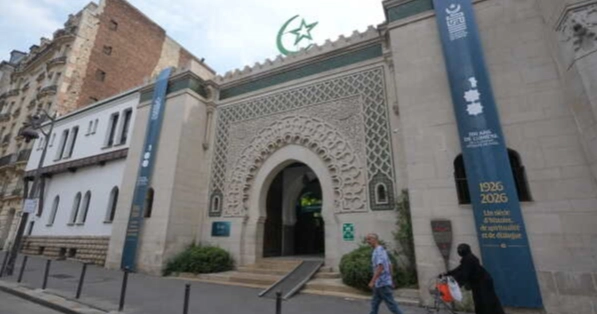
The Grand Mosque of Paris marked its 100th anniversary on Friday, with worshippers and religious leaders celebrating its history while calling for greater unity, religious tolerance and understanding in France.
Built a century ago to honour Muslim soldiers from France's former colonies who fought and died in World War I, the mosque has become one of Paris' best-known landmarks and an important place of worship for the country's Muslim community.
Chems-eddine Hafiz, rector of the Grand Mosque, described the mosque as a symbol of France's diversity and interfaith dialogue. However, he expressed concern over growing religious tensions linked to conflicts in the Middle East and the country's increasingly polarised political climate ahead of next year's presidential election.
"It is everyone's responsibility to see Muslims as part of the national community," Hafiz told The Associated Press.
People from across the Paris region attended the centenary prayers, including French-born Muslims and families with roots in Algeria, Senegal and other former French colonies.
Located in the historic Latin Quarter, the mosque is also a popular tourist attraction. Inspired by Spain's Alhambra Palace in Granada, it features an ornate prayer hall, a 33-metre-high minaret overlooking the Seine River, a traditional tea room and a hammam.
Built to honour Muslim soldiers
Hafiz said the mosque was built to recognise the sacrifices made by Muslim soldiers who fought for France during World War I, particularly those who died in battles such as Verdun.
He noted that when the mosque opened in 1926, then French President Gaston Doumergue described France's diversity as a source of national strength.
While he believes that message remains relevant today, Hafiz said prejudice against Muslims continues.
"Anti-Muslim acts are still committed, and Islam is often misunderstood," he said.
Calls for greater acceptance
Islam is the second-largest religion in France, which has Western Europe's biggest Muslim population. However, many Muslims say they still face discrimination and negative stereotypes, especially after a series of extremist attacks over the past decade.
The issue has become more prominent as campaigning begins for France's 2027 presidential election, with far-right leader Marine Le Pen and her National Rally party continuing to focus on immigration and Islam.
Volunteer Fatma Chouchane said Muslim women should be free to choose whether to wear headscarves without restrictions in schools or workplaces.
"I ask France to leave these people alone and let them make their own religious choices," she said.
Despite those concerns, Chouchane said the mosque's centenary should be a celebration of unity.
"It is a symbol. It is the Paris museum for Muslims. We must all stand together," she said.
For Ibrahima Seye, who moved to France from Senegal, the Grand Mosque was one of the first places he visited after arriving in the country.
"It's always open," he said. "It is important for the Muslim community, and many tourists also appreciate it."