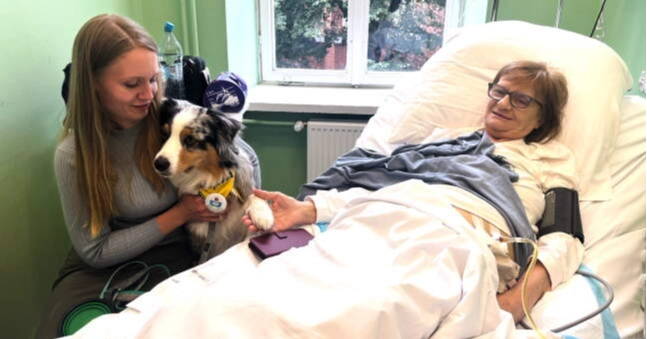
A terminally ill cancer patient's deep concern for her pet dog has helped fuel efforts in Poland to allow patients in hospices and palliative care wards to receive visits from their own pets.
Seventy-year-old Ewa Lutka-Krawczyk, who is battling gallbladder cancer, said one of her biggest worries after her diagnosis was her beloved dog Gaja, whom she adopted from a shelter three years ago. She even asked her doctor if she could live a few more years so the dog would not be left alone.
Now receiving treatment in a palliative care ward at a Warsaw hospital, Lutka-Krawczyk said Gaja has barely been eating since she was admitted.
"She is waiting for me," Lutka-Krawczyk said from her hospital bed.
Under a proposed law currently being discussed in Poland's parliament, patients in hospices and palliative care facilities would gain the legal right to receive visits from their pets. While some hospitals already allow such visits, there is currently no nationwide legal framework.
The initiative is being led by Dr. Tomasz Dzierżanowski, director of the Palliative Medicine Clinic at the Medical University of Warsaw. He believes that contact with a beloved pet can ease emotional suffering and reduce feelings of loneliness among seriously ill patients.
According to Dzierżanowski, society is facing what he describes as an "epidemic of loneliness," making emotional support more important than ever for people nearing the end of life.
"We make sure no patient dies alone," he said, adding that while family and friends provide the best support, many patients no longer have close companions nearby.
He noted that older patients often outlive friends and relatives, while some younger patients struggle with isolation despite living in a digitally connected world.
The doctor said his campaign was inspired by a cancer patient named Waldemar, who worried less about his own illness than about the fate of his two cats. Dzierżanowski arranged for the cats to visit him in the hospital, and the emotional reunion left a lasting impression on everyone who witnessed it.
The experience convinced him that hospitals should formally recognize the importance of pet visits for terminally ill patients.
Lutka-Krawczyk may soon be reunited with Gaja, as Dzierżanowski already allows pet visits in his clinic when circumstances permit.
Katarzyna Piekarska, the lawmaker who introduced the proposal in parliament, said pets are already visiting some hospitals in practice, making it necessary to establish clear legal rules.
In addition to family pets, therapy dogs are also welcomed at the clinic. During a recent visit, an Australian shepherd named Kluska brought comfort and distraction to patients, many of whom smiled, petted the dog and enjoyed watching her perform tricks.
One patient, 58-year-old Wojciech Zelik, who is being treated for a tumour, said interacting with the dog lifted his spirits.
Handlers of therapy animals say the benefits extend beyond patients. Nurses, cooks and other hospital staff also experience reduced stress through contact with the animals.
Medical student and therapy dog handler Małgorzata Brzozowska said visits from patients' own pets may provide even greater comfort, helping not only patients and their families but also the animals themselves.
She said pets often seem calmer when they can see and understand where their owners are, rather than being left wondering why they have suddenly disappeared.