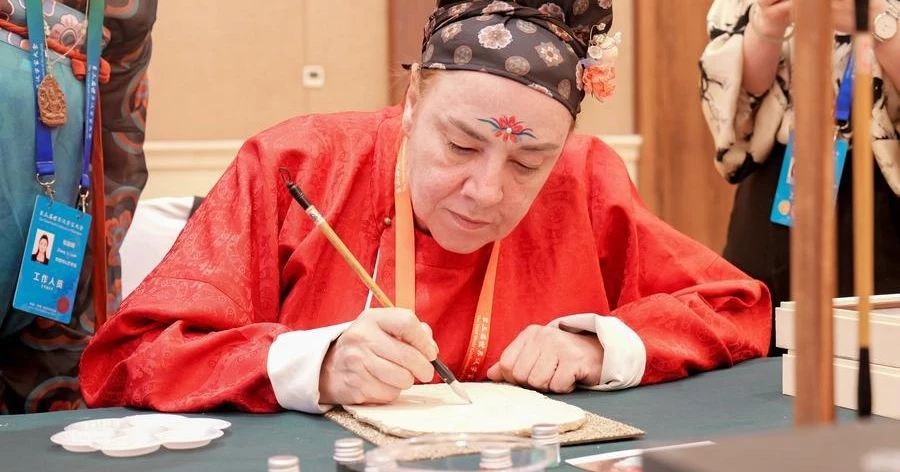
More than 300 scholars, researchers and cultural figures from around 70 countries gathered in northwest China's ancient Silk Road city of Dunhuang this week to discuss how Chinese culture and ideas can help address some of the world's growing challenges.
The Third World Conference of Sinologists, which concluded on Thursday, focused on the theme "Pooling Wisdom of Civilizations to Jointly Address Challenges of Our Times."
Participants said increasing global conflicts, economic inequality and declining trust among nations have sparked renewed international interest in Chinese culture, philosophy and approaches to development.
Among the attendees was German traditional Chinese medicine (TCM) practitioner Joel Mikael Walker, who has spent more than a decade studying in China. Speaking at the conference, he said Chinese philosophy had changed his understanding of the world.
Walker said concepts such as yin and yang taught him that differences and conflicts do not always have to lead to confrontation and can instead be resolved through dialogue and balance.
Many speakers noted that sinology, traditionally the study of Chinese language and culture, is increasingly moving beyond academic research and becoming part of everyday cultural exchanges between China and the rest of the world.
The choice of Dunhuang as the venue carried special significance. Located on the ancient Silk Road, the city served for centuries as a meeting point for trade and cultural exchange between East and West. It is also home to the world-famous Mogao Grottoes, which contain hundreds of ancient caves, sculptures and murals dating back more than 1,600 years.
Former Ethiopian President Mulatu Teshome Wirtu said the Silk Road was not only a route for trading goods but also a channel for sharing ideas and cultures among different civilizations.
Several participants pointed to a growing curiosity about China among younger generations, particularly in Europe and other Western countries.
Ingar Solty said many young people are becoming interested in Chinese lifestyles, wellness practices and cultural traditions. Similar views were expressed by Sebastien Joseph Roland Perimony, who said more young Europeans now see China as a country associated with innovation, development and stability.
Speakers also argued that Chinese philosophical traditions, shaped by thinkers such as Confucius and Lao Tzu, offer ideas that remain relevant in today's world, including harmony, respect, humility and coexistence.
Mohamed Rasheed said these values could help address growing tensions and divisions across the globe.Wirtu said China's development model, which combines economic growth with social and cultural progress, could provide useful lessons for other developing countries seeking modernization.
Meanwhile, Sira Abed Rego said international dialogue and cultural exchange are becoming increasingly important as geopolitical tensions and conflicts continue to rise.
She said China has contributed to global cooperation by promoting multilateralism, mutual respect and trust among nations, adding that efforts to study languages, translate cultures and promote understanding help reduce barriers and support peace.
Participants agreed that greater exchanges among civilizations and cultures remain essential to addressing shared global challenges and building a more peaceful future.