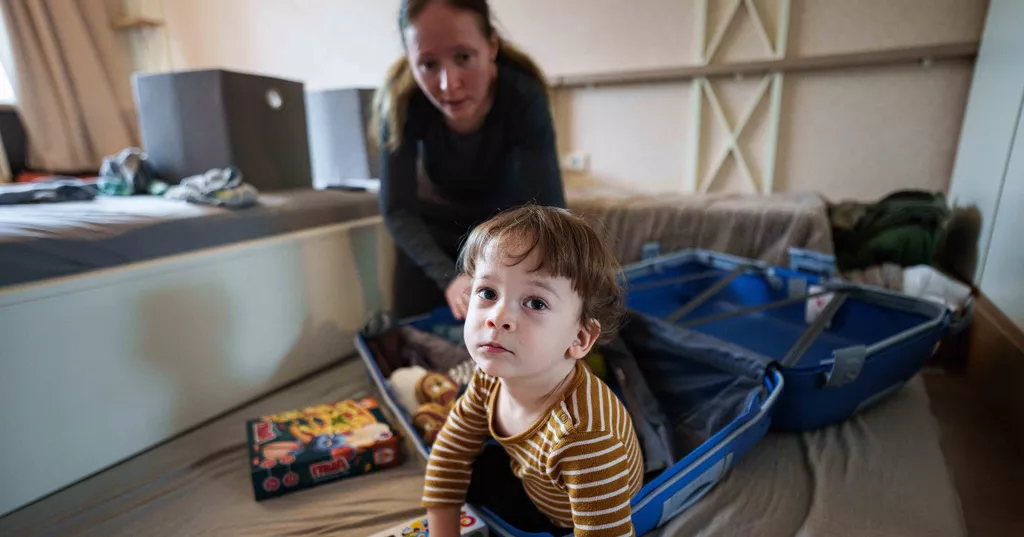
Matvii Yermolenko is only two years old, but he already knows the words for air raid sirens and air defence systems. As winter approaches, his mother has decided to take him out of Kyiv.
"There is sadness, but even stronger is the understanding of what I have to do — leave," said Matvii's mother, Kateryna Tsvihun, adding that they plan to return in spring. "I cannot live without Kyiv and Ukraine. I am rooted here, my child is Ukrainian, and my husband is fighting for this."
Across Ukraine, people are preparing for what many fear could be the most difficult winter since Russia launched its full-scale invasion. Last winter, interruptions to heating services left thousands of Kyiv residents shivering in freezing apartments. Now, officials and analysts warn that the country's heavily damaged energy infrastructure is becoming increasingly vulnerable to Russian attacks, posing another major challenge to its resilience.
With no immediate end to the war in sight, many Ukrainians are focused on surviving the coming months.
Kyiv is already facing mounting pressure. Since August 22, the capital has experienced air raid threats every day, frequently followed by daytime drone strikes and missile attacks at night. Some residents have opted to spend the winter in other parts of Ukraine or abroad. Although the exact number of people leaving the capital is unknown, developments in the rental market suggest that some are relocating.
"In September, we saw that the number of flats available to rent was increasing in Kyiv, whilst it was decreasing in a number of western cities," said Liudmyla Kiriukhina, head of the statistics department at Ukrainian real estate platform LUN. "This could have indicated that tenants were moving from the capital to the west of the country."
Using its growing capabilities in jet-powered drones and ballistic missiles, Russia has widened its range of targets in Kyiv to include petrol stations, data centres, warehouses, large retail outlets and bridges essential for civilian transport across the Dnieper River, which divides the city.
Power cuts have disrupted subway services, the capital's main transport system, while water supply interruptions have become increasingly frequent. Some residents have also voiced dissatisfaction with local authorities' preparations for winter.
However, relocating requires money, leaving many Ukrainians with little choice but to remain in the capital. They are stocking up on portable power banks, water containers and gas-powered cooking stoves to prepare for possible disruptions.
Some families leave to protect their children
Kateryna Tsvihun, 41, said last winter had been particularly difficult. She did not want her young son to face another season of power cuts, especially with the possibility of losing heating as well.
She discussed her decision to leave with her husband, who has been serving in the military since 2022, and decided to spend the winter elsewhere.
Unable to find a suitable place within Ukraine, she eventually found an option in Albania through a Facebook group for mothers interested in travelling.
"The birth of a child is the ultimate game-changer," she said. "Before, no matter how scared I was, I stayed in Kyiv and did not even think about leaving."
Russia recently struck an area near a metro station where she and Matvii regularly go for walks.
"It's a bit scary to stay," she said. "But it's still our home, so we will come back this spring."
Before leaving, she handed over her portable power station, power banks and rechargeable lamps to relatives who would remain in Kyiv. She purchased a large light-blue suitcase for the journey, packing mainly essential items along with a few small toys for Matvii.
"I see it as an opportunity to exhale, because the tiredness and pressure have been piling up over these years of war, the lonely waiting for my husband, and the attacks," she said.
Officials warn Russia wants to undermine Kyiv's morale
Ukraine's Energy Ministry said Wednesday that Russian forces were continuing to target power generation facilities and substations.
"Attacks on the energy sector are not stopping," the ministry said in a statement.
"The situation in Kyiv is especially difficult right now: People and businesses are facing many hours of electricity and water outages," President Volodymyr Zelenskyy said.
He added that repeated attacks and continuous air raid alerts were slowing repair work and making it increasingly difficult to restore damaged infrastructure.
"This winter could be just as hard, or even harder than the last one," said Andrii Tkachov, acting head of the Kyiv City Military Administration.
"The enemy will keep striking critical infrastructure and trying to disrupt residents' heating and water supply."
According to Tkachov, Moscow aims to trigger a crisis and heighten humanitarian and social tensions in Kyiv, Ukraine's most populous city and the headquarters of its main state institutions.
"The enemy understands that attacks on Kyiv will affect the morale of the entire country. The main goal is to break Kyiv," he said. "But, as we say, Kyiv rests on three pillars: air defense, our utility and energy workers, and the self-organization of its residents."
Data from LUN showed that active rental listings in Kyiv had increased by 87% as of November 1 compared with August 1.
During September, the number of apartments offered for rent increased in Kyiv but declined in several western Ukrainian cities, including Uzhhorod, Lviv, Chernivtsi and Ivano-Frankivsk.
LUN said the trend could indicate that tenants were moving from the capital to western parts of the country, although further time and analysis would be needed to establish a clearer picture.
For many, leaving is not an option
For some Kyiv residents, however, financial constraints make relocation impossible.
Kateryna Tymoshenko, 39, took her two children to a rally on October 17 demanding the resignation of Kyiv Mayor Vitalii Klitschko.
The demonstration, organised by civic groups, activists and veterans, accused the city administration of inadequate winter preparations, insufficient shelters, corruption and misuse of public funds. Klitschko has dismissed the criticism, describing the rally as part of an effort to discredit him.
"His direct call was to leave. … I don't have the money to leave," Tymoshenko said, referring to the mayor's appeal earlier in October.
She had considered relocating to central or western Ukraine, but rising demand had pushed up rental prices, making affordable accommodation difficult to find. With her husband serving at the front, she has also had to shoulder the responsibility of preparing the family for winter on her own.
"I expect it to be worse than it was, precisely because of the psychological state," she said. "I hope there will at least be heating and sewage."
She added that even people accustomed to difficult conditions, including herself, might eventually consider leaving if basic services failed.
Tymoshenko has stocked up on power banks, and her family has already moved into an apartment on the ground floor.
"Everything depends on our partners," she said.
Despite the resilience of Ukrainians, she said she was prepared to endure the hardships for as long as possible. However, she stressed that the country lacked sufficient financial resources and military equipment.
"But we have no money, we have no weapons, we have no Patriots (anti-missile batteries). So we are forced to explain, to beg, to plead."
"Well, this is the life we have," she said. "We didn't choose it."