
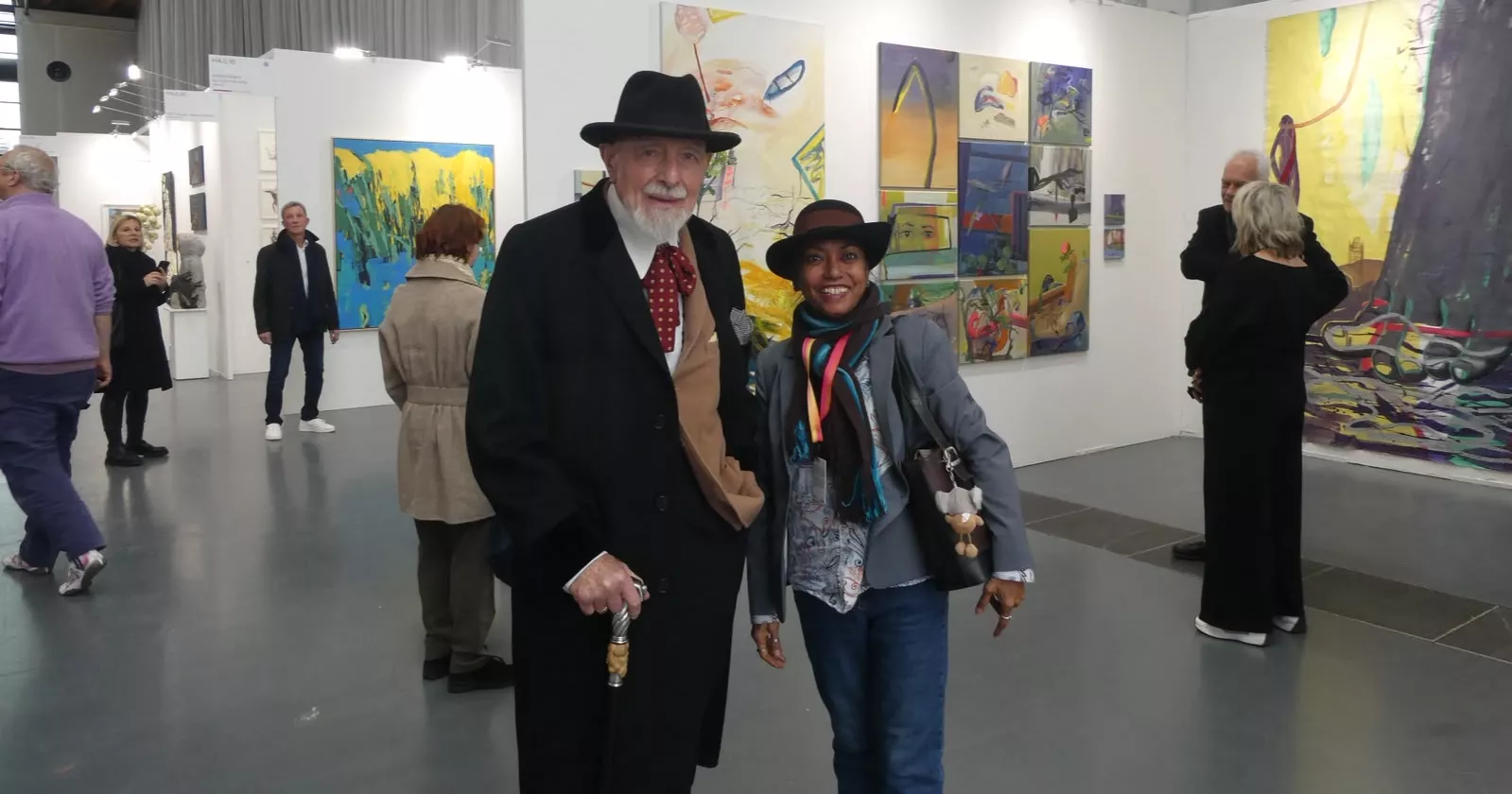
For three decades, Murshida Arzu Alpana has held her ground among Berlin's most exacting painters. Her work was selected for Reinhard Fuchs's Women in Art, a survey of masterpieces by 512 women artists across history. And this Friday, Dhaka gets a rare chance to stand in front of the work that crossing has produced.
Plenty of Bangladeshi artists are loved at home; far fewer are taken seriously abroad, on terms they don't set themselves. Alpana is one of the few — trained in Dhaka, Santiniketan and Berlin, she earned a place inside the German art establishment by its own measures, and remained, unmistakably, ours.
Born in Dhaka in 1961, she finished first in her class at the Institute of Fine Arts, University of Dhaka, then took her master's at Visva-Bharati in Santiniketan under K.G. Subramanyan. The harder step came in 1993, when she arrived in Berlin on a DAAD scholarship and became a Meisterschülerin — a master student — of Karl Horst Hödicke at the University of the Arts, inside the lineage that shaped German Neo-Expressionism. Very few artists from anywhere pass through that door, and almost none from Bangladesh.
The recognitions that followed were not local courtesies. She was received at the Royal Over-Seas League's Centenary Reception at St James's Palace in the presence of Queen Elizabeth II, named an artist of "Distinguished Talent" by Australia, and in 2020 awarded the Falkenrot Prize from Künstlerhaus Bethanien, one of Berlin's most respected contemporary art institutions. Her paintings hang in the permanent collections of Deutsche Bank, the Bangladesh National Museum and galleries across Europe.
The prizes matter less than where she earns them. She shows year after year at Art Karlsruhe and Berlin Art Week, the fairs that decide who counts in European contemporary art. This past winter Der Tagesspiegel reviewed her solo exhibition "Existence & Non-Existence," describing canvases that vibrate between surrealism and neo-expressionism — houses that float, animals loose in the city. A Bangladeshi painter reviewed by the German press, on its own terms, is a quiet and unusual thing.
Colour comes first in her work, laid in deliberate tension and pushed almost past what the eye expects. Her figures have pared down over the years to monumental heads that hold feeling rather than likeness — displacement, longing, the isolation of someone at home in two places and settled in neither. That in-betweenness is her subject, not her limitation.
On Friday, 3 July, Alpana's paintings go on view at a private showing in Dhaka — a chance to see what an artist does when she meets the wider art world at its own level, and stays.
Sabreena Leya is an art enthusiast.