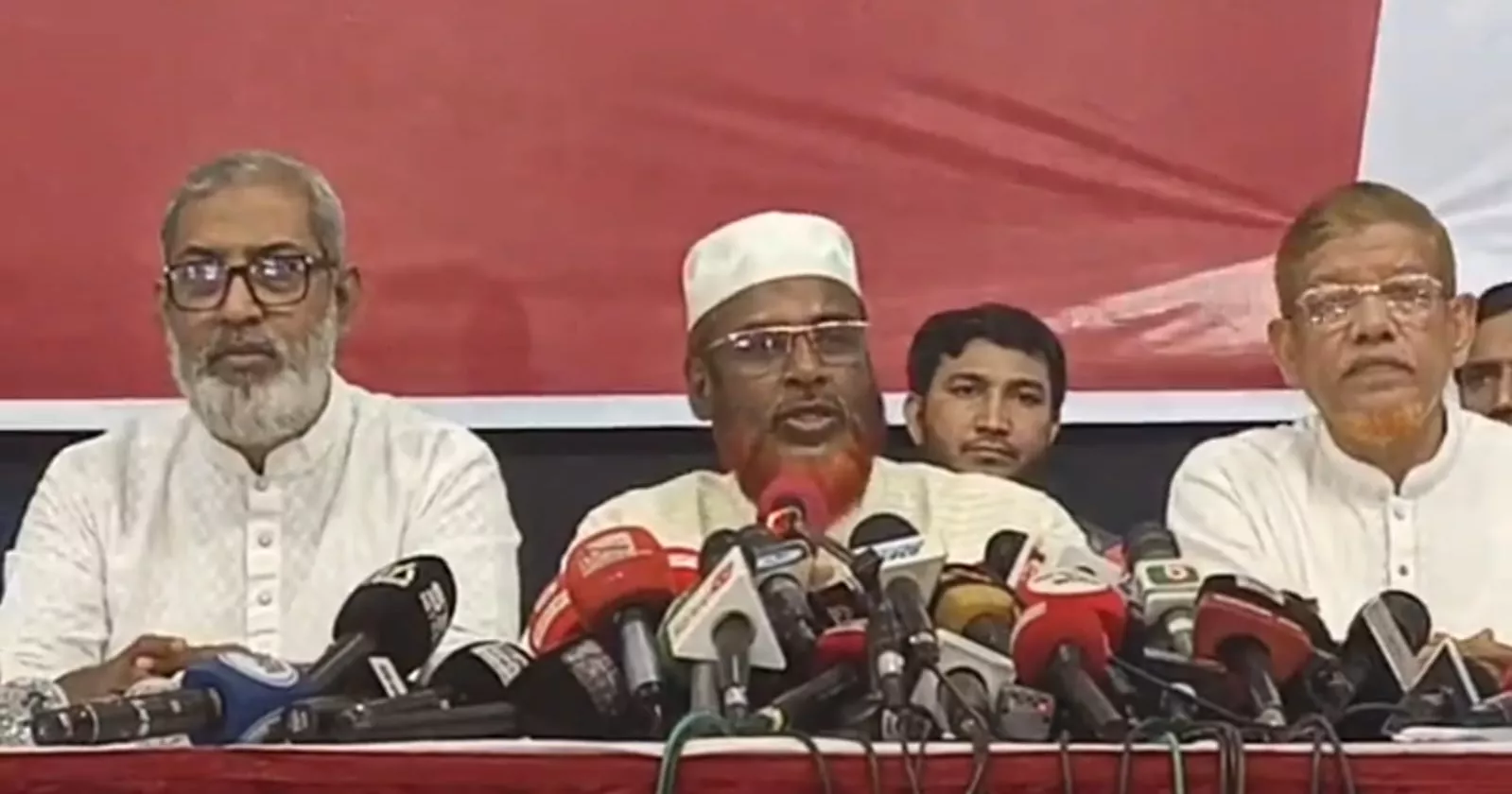
Jamaat led 11-party alliance on Sunday rejected the government's initiative to amend the Constitution through a special parliamentary committee, demanding implementation of the constitutional reform process approved in the February referendum.
“We have decided that we do not support any initiative for constitutional amendment in principle. We want constitutional reform,” Jamaat Secretary General Mia Golam Parwar on behalf of the alliance said at a press conference held at the Jatiya Press Club in the city.
The alliance said the parliamentary committee cannot replace the Constitution Reform Council envisaged under the July National Charter implementation framework, arguing that the people's direct mandate must be respected.
The alliance's position comes as the parliamentary special committee invited political parties that signed the July Charter to hold discussions.
The 12-member committee, headed by Home Minister Salahuddin Ahmed, was formed in July after opposition parties refused to nominate members, with the government saying it would later seek their views on the reform process.
Parwar said the 11-party alliance had rejected the committee because the February 12 referendum had endorsed not only constitutional reform proposals but also a specific mechanism for implementing them.
“The people's mandate cannot be replaced by a parliamentary majority. Nor can any special committee be a substitute for the sovereign will of the people,” he said.
He argued that elected MPs from the 11-party alliance had taken oath both as members of parliament and as members of the proposed Constitution Reform Council, while BNP lawmakers took oath only as MPs.
The alliance maintains that Parliament and the proposed reform council have different legal identities and sources of authority, describing Parliament's constitutional amendment power as delegated power and the people's authority to reshape the constitutional order as ‘constituent power.’
Parwar also questioned the government's reliance on Article 142 of the Constitution, saying Parliament's amendment power was not unlimited.
He referred to the Supreme Court's rulings concerning the Fifth, Seventh, Eighth, 13th and 16th constitutional amendments as evidence that parliamentary amendment powers have constitutional limits.
The alliance also cited the basic structure doctrine, arguing that fundamental features of the Constitution cannot be altered merely through a two-thirds parliamentary majority.
Parwar said the alliance wanted the elected representatives to complete the required oaths and activate the Constitution Reform Council rather than proceed through the parliamentary special committee.
“We officially reject the initiative of the special committee on constitutional amendment,” he said, adding that there was still time for Parliament to activate the reform council in accordance with the referendum verdict.
11-party alliance coordinator Hamidur Rahman Azad said the alliance had held a top-level meeting before deciding to reject the government's invitation for discussions.
He said the alliance had participated in the July Charter process and signed the document, but would not participate in what it considers an alternative process for constitutional reform.
Parwar also challenged the government's argument that the Constitution Reform Council lacked a legal basis, referring to Article 152's definition of ‘law’, which includes an Act, ordinance, order, rule, regulation, notification and other legal instruments having the force of law.
The parliamentary special committee, meanwhile, has said it intends to consult political parties, constitutional experts, lawyers, members of the judiciary, intellectuals, editors and other stakeholders before finalising its recommendations.