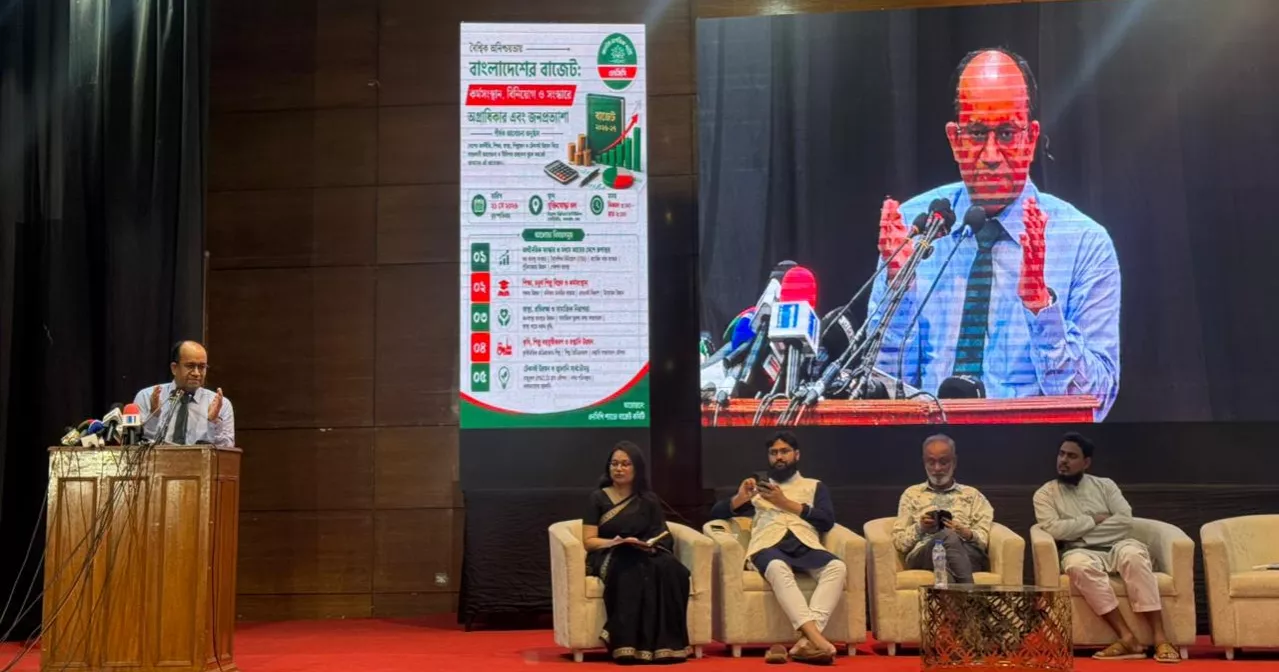
Economists and policy analysts on Thursday called for a fundamental departure from the routine budget-making process, urging the government to craft a genuinely people-oriented budget backed by comprehensive tax reforms, digitised revenue collection and
a faceless tax administration system.
They made the call at a discussion titled "Bangladesh's Budget Amid Global Uncertainty: Priorities in Employment, Investment and Reform, and an Equitable, Prosperous Bangladesh" organised by the National Citizen Party's (NCP) Shadow Budget Committee at Kakrail, Dhaka.
Opening the event, NCP Member Secretary Akhter Hossen criticised the budgets of the previous Awami League era as little more than paper documents serving a corporate clique that siphoned public money abroad. "Our expectation from the government is simple, this budget
must not be a looters' budget. It must be for ordinary people."
He noted that while education, health and marginalised communities are mentioned every year as budget priorities, the final document invariably mirrors the preceding year's allocations with cosmetic changes.
NCP Shadow Budget Committee Chief Atik Mujahid said the committee consulted workers in Ashulia, small traders at Kawran Bazar and Chittagong's Khatun Bazar, SME owners, university students and government officials before formulating its recommendations.
"People don't want charity from the government, they want fairness," he said. "They want a tax system they can trust, assurance that their investments are protected, and accountability in how public money is spent."
Former Chairman, Sonali Bank PLC Mohammad Muslim Chowdhury warned of serious structural problems in financing the upcoming budget, pointing to the country's chronically low tax-to-GDP ratio. "If the government borrows from the domestic market, private sector borrowing costs will rise and investment will suffer. Printing money is not an option either, given persistently high inflation."
He recommended consolidating over 100 social safety net programmes across 20 ministries under a single digital umbrella, which he said could reduce administrative costs and expand beneficiary coverage by 30 to 40 percent.
He also called for closure or liquidation of insolvent banks and a fully faceless, digital tax collection system.
Centre for Policy Dialogue (CPD) Additional Research Director Towfiqul Islam Khan flagged a troubling fiscal reality: in FY2023-24, the government's current expenditure exceeded total revenue by Tk 40,000 crore, forcing a 25 percent cut in development spending in critical sectors like health and education. Private sector credit growth has since fallen to just 4 percent.
He pointed out that despite legal requirements under the Public Finance and Budget Management Act 2009, including quarterly budget progress reports and submission of revised budgets by March, successive governments have routinely flouted these provisions. "Quarterly progress reports have disappeared from the website altogether. That is a transparency failure."
To plug tax evasion, he proposed linking National ID cards with bank accounts, land registration and vehicle registration data within an integrated digital tax framework, and called for separating NBR's policy and collection functions to eliminate conflicts of interest.
Development economist Dr Khan Zahirul Islam of the University of British Columbia, Canada, described the banking sector, the lifeline of any economy, as effectively "destroyed."
He cited non-performing loans worth Tk 6.30 lakh crore against a proposed annual budget of Tk 9.30 lakh crore. "Had this money not been looted, imagine where our budget implementation would stand." he said, adding that the S Alam Group alone is alleged to have laundered Tk
1.90 lakh crore, equivalent to the entire Annual Development Programme allocation.
Zahirul also questioned the government's recent amendment to the Bank Resolution Act, which he said reopens the door for former owners implicated in banking irregularities to reclaim control of their institutions.
NCP Chief Coordinator Nasiruddin Patwary, who chaired the session, stressed that without meaningful tax reform, public trust in the state would erode irreversibly.
"The poor pay taxes while the wealthy loot the system," he said, warning that any further delay in NBR reform would deepen the disconnect between citizens and the state.
The session was moderated by NCP Dhaka Metropolitan North Member Secretary (Acting) Sadia Farzana Dina.