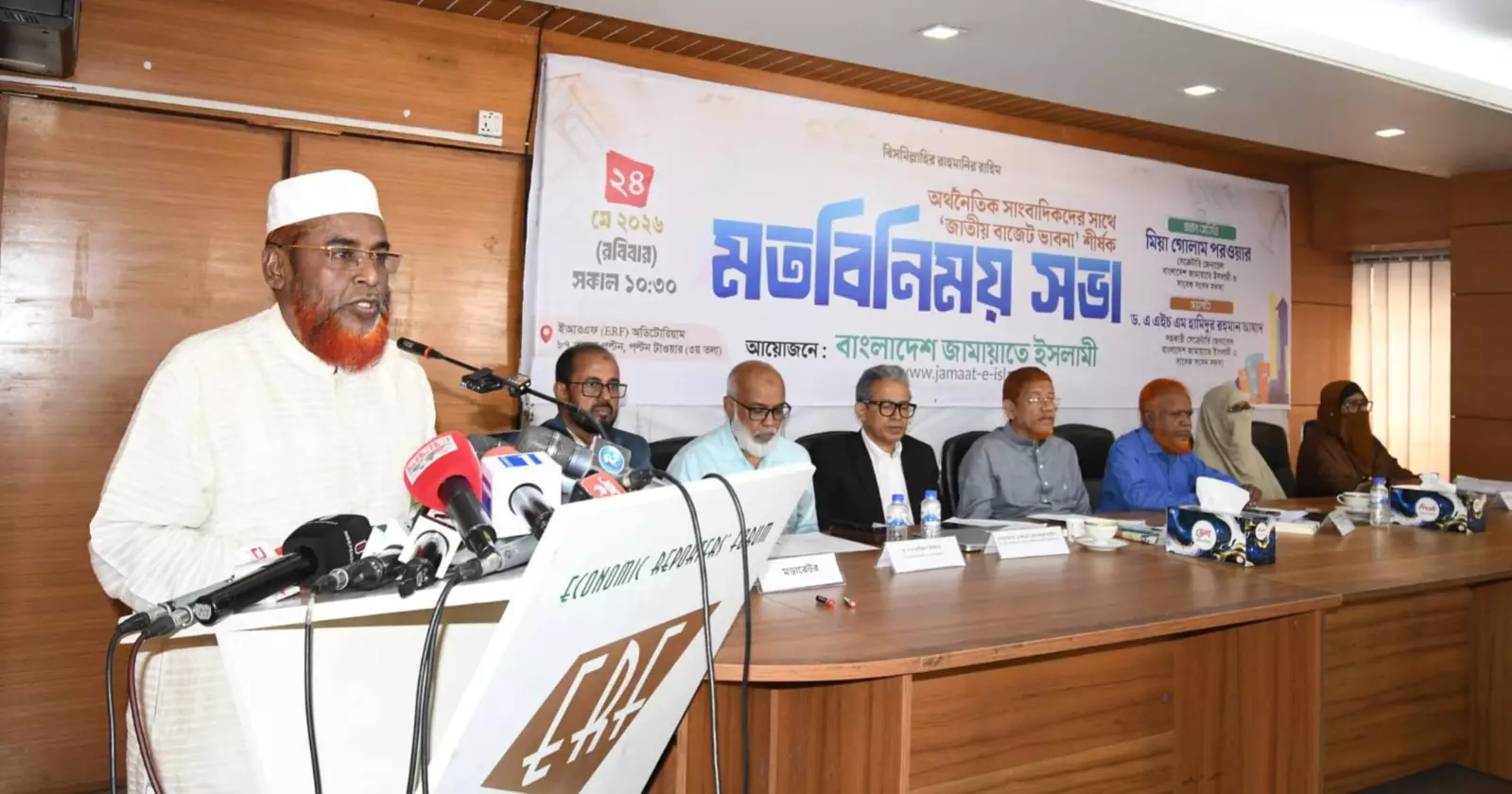
Speakers at a view-exchange meeting on Sunday urged the government to channel the newly announced Tk 60,000 crore stimulus package into capital-starved ready industries that are unable to start production, rather than sinking funds into chronically sick sectors.
The observation was made at a pre-budget discussion with economic journalists organized by Bangladesh Jamaat-e-Islami at the Economic Reporters’ Forum (ERF) auditorium in the capital's Purana Paltan.
Professor Dr. Waresul Karim, Dean of the School of Business and Economics at North South University, presented the keynote paper, detailing Jamaat's fiscal vision to restructure Bangladesh's socio-economic landscape.
Referring to Bangladesh Bank’s recently announced Tk 60,000 crore recovery blueprint for 2026, Dr. Karim argued that utilizing the funds under the proposed structure would not yield fruitful job creation. Instead, he noted, it would be far more viable to finance operational and ready-to-produce industries that are currently stalled due to immediate capital shortfalls.
The keynote speaker strongly urged the government to reduce its heavy reliance on indirect taxes like Value Added Tax (VAT), which currently accounts for 78.2 percent of total revenue collection in the budget. "Because of this structure, the poor and the ultra-poor are forced to pay the same rate of indirect tax as the wealthy, which is aggressively widening income inequality in society," Dr. Karim added.
Jamaat Secretary General Mia Golam Parwar attended the function as the chief guest, while the party's Assistant Secretary General and former MP, AHM Hamidur Rahman Azad, presided over the meeting.
In his speech, Mia Golam Parwar said, "As an opposition party, we want to constructively help the government strengthen the economy and reinforce the nation's financial drivers."
He informed that Jamaat has already organized seven to eight pre-budget seminars, and the compiled recommendations from these sessions will be formally placed before parliament through the party's parliamentary group.
"While it is difficult for an opposition party to alter decisions made by a ruling party that governs through a parliamentary majority, the nation has a right to know what kind of budget we envision in line with public aspirations. That is why we want to play an active role in the budget discourse," Parwar added.
In his presidential address, AHM Hamidur Rahman Azad noted that the upcoming national budget will be placed by the first elected government following the July mass uprising.
"Consequently, the people of the country expect to see the reflections and aspirations of the July uprising mirrored in this fiscal blueprint," he said, urging the government to move away from debt dependency and avoid burdening citizens with extra taxes to deliver a self-reliant, discrimination-free budget.
Nurul Islam Bulbul, Ameer of Jamaat's Dhaka City South unit, criticized the conventional budget-making process. "The way bureaucrats formulate the budget reflects only their own narrow perspectives, leaving no room for participation from the public or political parties. We must break away from this traditional mindset," he said.
He further cautioned that unless institutional corruption is aggressively contained, a larger budget will only foster higher levels of graft and wastage, ultimately choking real development. Retired Senior Secretary Dr. AKM Kabirul Islam and Jamaat women MP Professor Nurunnisa Siddiqa and Sabikun Nahar also spoke in the event.
Among others, Center for Policy Dialogue (CPD) Additional Research Director Towfiqul Islam Khan, Executive Editor of Daily Naya Digonta Masumur Rahman Khali, Outlook Bangla Editor-in-Chief Lutfun Kabir Saadi, Bangladesh Post Acting Editor Sadrul Hasan, former ERF President Refayet Ullah Mirdha and Former Vice president of ERF Shalahuddin Bablu spoke in the discussion.