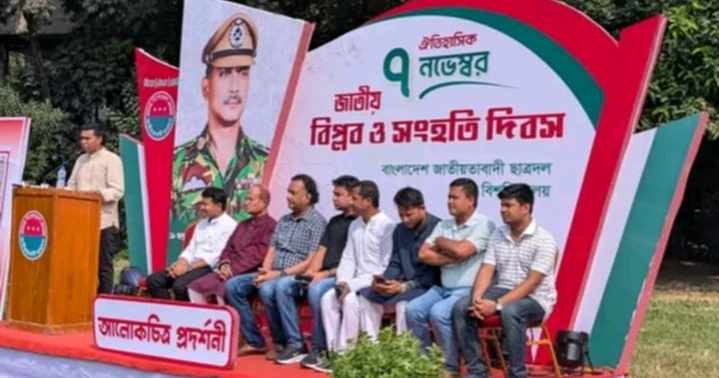
The Dhaka University unit of Jatiyatabadi Chhatra Dal (JCD), ruling party BNP's student front, began a two-day photo exhibition at the university's Teacher-Student Centre (TSC) on Saturday afternoon to mark National Revolution and Solidarity Day. The exhibition will continue until Sunday.
BNP Joint Secretary Habib-un-Nabi Khan Sohel, Dhaka University Vice-Chancellor Prof Dr ABM Obaidul Islam and JCD leaders attended the inaugural ceremony.
Speaking at the event, Habib-un-Nabi Khan Sohel said November 7 is a symbol of inspiration and consciousness. He said the spirit of the day closely resonated with that of Dhaka University, as both stood against injustice and upheld truth and justice.
Referring to the dreams with which the freedom fighters liberated the country, he said, "They dreamed of a Bangladesh free from oppression, poverty and suffering, where freedom of expression would be ensured. But everything changed after the Liberation War. The leader (Mujib) returned from abroad, and a series of different events followed. The dreams of the martyrs were shattered. Oppression, repression and injustice prevailed across the country. What a terrible situation it was! People were suffering from hunger, while people and dogs were seen living side by side near dustbins. These were real incidents that took place in Bangladesh. Meanwhile, the leader was feeding his daughter-in-law rice pudding with a golden spoon from a golden bowl at his son's wedding."
The BNP leader further said attempts had been made after independence to make Bangladesh dependent on another country. However, he said, Bangladesh, which had been liberated through the sacrifices of its martyrs, had its own strength and distinct identity.
He said the events of November 7 took place against the backdrop of a determination not to allow Bangladesh to become subservient to any other country.
Referring to the mass uprising of 2024, Habib-un-Nabi Khan Sohel said Bangladesh had been deliberately made dependent on another country over the past 17 years, undermining its own strength and capabilities.
"Bangladesh had no power of its own. Once, we saw the then foreign minister saying that he had told the head of state of India during a visit to the country to keep Sheikh Hasina in power for a few more days. How shameless does a foreign minister have to be to make such a statement!" he said.
He further said Bangladesh would not be allowed to become dependent on any country in the future. The people of Bangladesh would determine the country's future, and they would not accept any attempt to decide it from another country.
DU Vice-Chancellor Prof Dr ABM Obaidul Islam said Bangladesh would not have retained its independence and sovereignty had November 7 not taken place.
"The country might otherwise have become known as a province of another country. At that time, safeguarding the country's independence and sovereignty had become difficult. From November 3 to 7, the country went through an extremely difficult period amid domestic and foreign hegemonic influences, counter-coups and political instability," he said.
Referring to the role of Ziaur Rahman, the vice-chancellor said multiparty democracy was established and press freedom was restored under his leadership.
He also said Ziaur Rahman had played a role in creating opportunities for different political parties, including Jamaat-e-Islami and the Awami League, to engage in politics.
Meanwhile, Dhaka University observed the day through separate programmes.
A discussion meeting was held at the TSC auditorium on Saturday morning, attended by university teachers, students, officials, employees and alumni.
Besides, the national flag was hoisted at the Vice-Chancellor's residence, all residential halls and important university buildings.
Milad mahfils and special prayers were organised at the Central Mosque, mosques in residential halls, hostels and residential areas, while special prayers were also held at other places of worship.
The university also decided to organise an essay competition involving students during November.