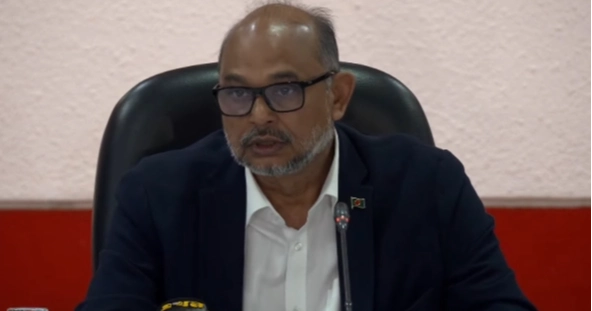
The government is developing a new economic model to navigate the current financial crisis, with a target of elevating Bangladesh to a one-trillion-dollar economy by 2034, focusing on investment growth, administrative reform, industrial revival and long-term agricultural transformation.
“Our philosophy is 'Bangladesh for All', the new economic framework is being built to ensure the benefits of growth reach every segment of society," said Professor Rashed Al Mahmud Titumir, adviser to the Prime Minister on finance and planning, while addressing a roundtable titled ‘Budget 2026-27 in a Moment of Crisis’ at the CIRDAP International Conference Centre in the city on Saturday.
Govt sets 5 energy security milestones to break import dependence: Titumir
Titumir stressed that ensuring an investment-friendly environment was crucial to placing the economy on a sustainable footing, calling for reduced bureaucratic complexity, equal opportunities for domestic and export-oriented industries, business-friendly policies and administrative reforms.
He added that the government was working on a restructuring package worth around Tk 60,000 crore to revive long-dormant industrial units, while simultaneously prioritising job creation and expansion of the productive sector.
On agriculture, the adviser said the sector must be steered toward long-term development rather than relying solely on subsidies, emphasising the need to improve water resource management, modernise farming systems and strengthen the rural economy.
He also underscored the need to improve the effectiveness of spending in health and education, saying service quality, accessibility and grassroots-level delivery of public services must be ensured alongside increased allocations.
Apex Footwear Managing Director Nasim Manzur called for tax structure reforms to attract fresh investment and boost private sector growth, proposing a reduction of the corporate tax rate from 27.5 percent to 20 percent.
He also urged policy stability, modernisation of tax administration and improvement of airport warehousing facilities.
Researcher and rights activist Maha Mirza demanded higher budgetary allocation for agriculture, arguing that greater investment is needed to strengthen food security and the rural economy.
She stressed agricultural mechanisation, storage infrastructure and union-level agri-facility development.
Speakers at the roundtable said the upcoming budget must be pragmatic and reform-oriented amid high inflation, investment stagnation, employment pressure and global economic uncertainty.
They emphasised modernising tax administration, boosting productive investment, ensuring financial sector good governance and maintaining long-term policy stability.
Among others, the discussion featured Policy Exchange Bangladesh Chairman M Masrur Reaz, former Finance Secretary Muslim Chowdhury, BKMEA President Mohammad Hatem, ICMAB President Kausar Alam and North South University School of Business and Economics Dean Dr AKM Wareseul Karim.