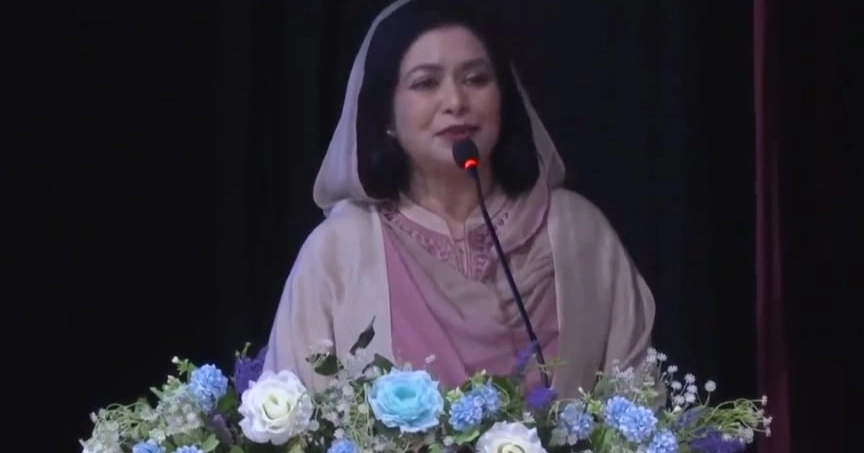
Ziaur Rahman Foundation Vice President and cardiologist Dr Zubaida Rahman on Thursday called for building a humane and effective healthcare system to ensure that no villager dies for lack of medical treatment and no pregnant woman or newborn loses life due to inadequate healthcare.
"We want a future Bangladesh where no sick villager dies because of lack of treatment, no pregnant woman dies without receiving proper medical care, and no newborn leaves its mother's lap because of inadequate healthcare," she said.
"We want to build a healthcare system that will set an example for the world because everyone's health matters," she said at a programme as the chief guest at the Holy Family Red Crescent Medical College auditorium in the capita, where meritorious students were honoured for their academic achievements.
Congratulating the award recipients, she also praised students who managed to pursue cultural activities alongside their hard academic schedules.
"If you continue to nurture your talents this way, it will be highly commendable. Culture is what we are; civilisation is what we have. Culture is the foundation of civilisation," she said.
Describing the students as some of the country's brightest minds, Dr Zubaida said they had earned the opportunity to study medicine through merit and urged them to combine excellence with compassion.
Expressing hope that many students would pursue higher education and advanced medical training abroad, she urged them to return and serve the people of Bangladesh.
Citing healthcare statistics, she said Bangladesh currently has only 0.83 physicians per 1,000 people, meaning one doctor often has to serve between 1,200 and 1,800 patients, with the situation being even worse in rural areas.
"This situation can change if we commit ourselves to serving the country from our student life," she said.
She noted that 70 to 75 percent of doctors work in urban areas while 78 percent of the country's population lives in rural and remote regions.
Dr Zubaida also said the nurse-to-population ratio in Bangladesh is only 0.549 per 1,000 people, compared to the World Health Organization's benchmark of 1.48 nurses per 1,000 people.
She added that the WHO recommends 2.28 doctors per 1,000 people while in Bangladesh there is only one government doctor for every 6,500 people. "That is why healthcare remains one of the major causes of poverty."
She expressed confidence that through merit, hard work, perseverance and patriotism the students would build the healthcare system the country aspires to have.
"Our villagers are often deprived of timely treatment because of the shortage of doctors. But if you dedicate yourselves to serving the people, this challenge can certainly be overcome," she said.