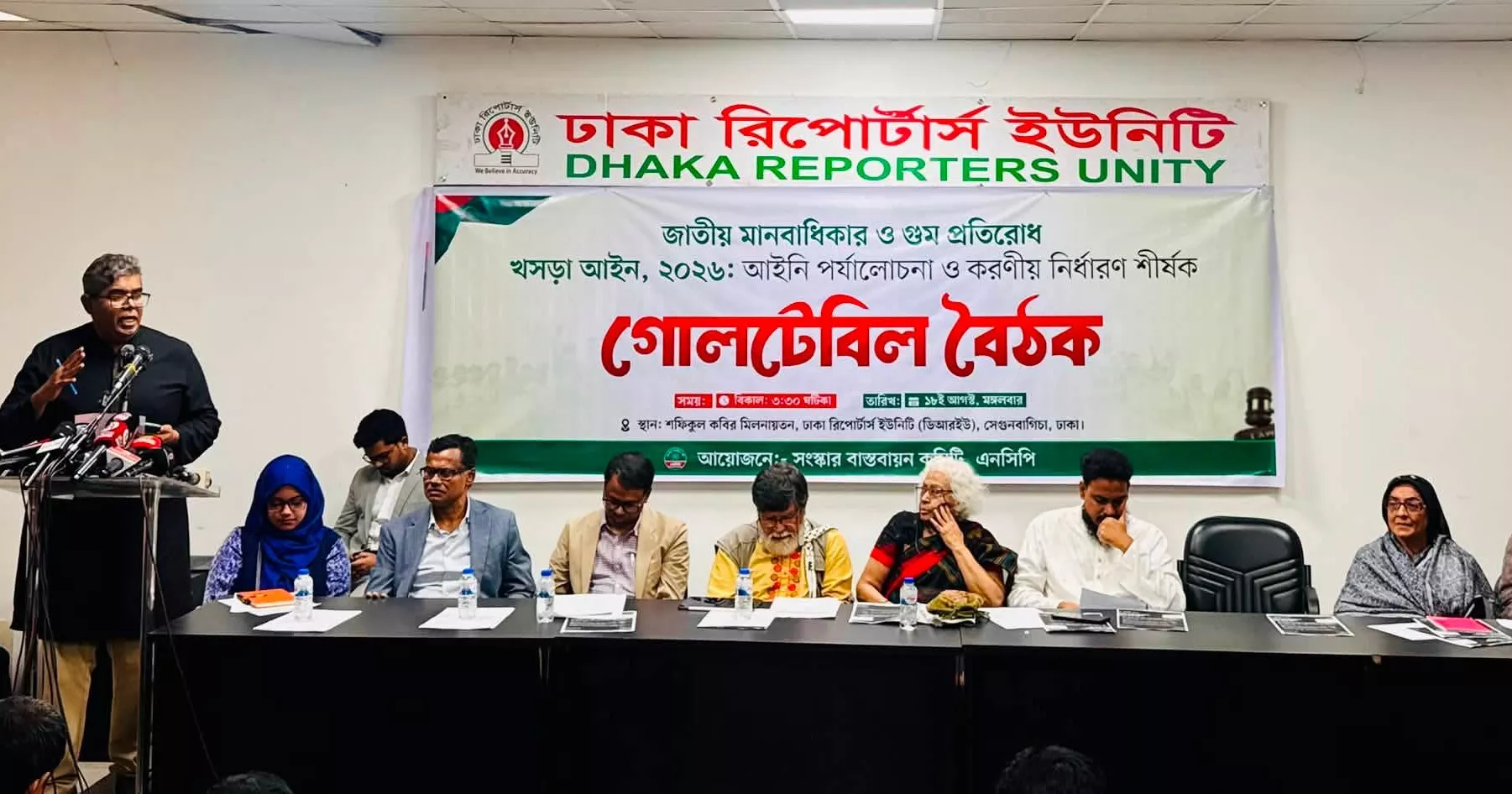
Political parties, human rights activists and lawyers have criticised the government over the draft laws on the National Human Rights Commission (NHRC) and prevention of enforced disappearances, calling for an end to political appointments and stronger institutional independence.
They also demanded that allegations of enforced disappearance be investigated by an independent and impartial body instead of law enforcement agencies.
They made the remarks at a roundtable titled “National Human Rights and Prevention of Enforced Disappearance Draft Laws, 2026: Legal Review and Way Forward” organised by the National Citizen Party (NCP) at the Shafiqul Kabir Milon Auditorium of Dhaka Reporters Unity on Tuesday afternoon.
Former member of the NHRC and the Commission of Inquiry on Enforced Disappearances Dr Nabila Idris presented the keynote paper at the event.
NCP Member Secretary Akhter Hossain said six months have passed since the government assumed office, but some decisions taken by the previous government have been cancelled, forcing stakeholders to discuss the same issues again.
“If the ordinances on the National Human Rights Commission and prevention of enforced disappearances had been passed in the first session of parliament, there would have been no need for such discussions,” he said.
He said people in Bangladesh carry a deep trauma over enforced disappearances, with many people having disappeared and some later returning to testify about how they had been detained.
“Many others have never returned after being disappeared. Yet the victims and their families have not received proper justice,” he said.
Akhter alleged that the draft NHRC law has curtailed the commission’s investigative powers, requiring it to wait for investigation reports from the concerned agencies when human rights violations occur.
He also criticised the proposed appointment process for the chairperson of the commission, saying it could allow the government to appoint a person of its choice.
Regarding the draft law on prevention of enforced disappearances, he said assigning investigation to agencies that themselves could face allegations of enforced disappearance would make impartial investigations difficult.
“There is a risk that incidents of enforced disappearance could be covered up in the name of investigation,” he said.
He further said provisions allowing punishment for false complaints could intimidate families of victims and discourage them from reporting disappearances.
Photographer, writer and human rights activist Shahidul Alam said he had hoped Bangladesh would become a different country after the fall of the previous government.
“I still have that hope,” he said.
He said large amounts of money had been taken out of the country and the country would have to overcome the consequences.
“Politicians have come to power through our votes. They will decide how the country is run. But the country cannot be run according to the security forces,” he said.
Political scientist and analyst Prof Dilara Chowdhury said state-building becomes difficult in the absence of national ideological consensus.
“We have not yet found the leadership needed for state-building,” she said.
She also criticised political debates over issues such as who is a collaborator while people continue to face shortages of electricity and gas.
She alleged that the BNP had been moving away from its commitments made during the July movement.
Former member of the Constitutional Reform Commission and Supreme Court senior advocate Dr Sharif Bhuiyan said the NHRC and a law on enforced disappearances were necessary to hold the government accountable.
“The ability of these institutions to work independently depends on their appointment process. There can be no politicisation in appointments,” he said.
He said the government should not be allowed to interfere with these institutions either before or after appointments.
Former member of the Judicial Reform Commission Barrister Tanim Hossain Shawon said the main purpose of the enforced disappearance law should be to prevent members of law enforcement agencies from committing such offences.
But, he said, the draft law had weakened this provision.
“The original proposal was that an independent commission would investigate enforced disappearances. We recommended assigning this responsibility to the Human Rights Commission. But the law now says the police will investigate. Then what is the point of enacting the law?” he asked.
General Secretary of Amar Bangladesh Party (AB Party) Mohammad Asaduzzaman Bhuiyan Fuad questioned why politicians in Bangladesh repeatedly fail to change their traditional practices.
He alleged that enforced disappearances and extrajudicial killings had historical precedents in Bangladesh and criticised successive governments for failing to break away from such practices.
Fahim Mashrur, convener of the Referendum Implementation Citizens’ Forum, alleged that the government had already “thrown the July Charter into the dustbin”.
He said that if the charter was implemented with notes of dissent, it would no longer remain the July Charter in its original form.
“If reforms are not carried out, those appointed to the Human Rights Commission will be politically affiliated people. The question is how much service can be expected from them,” he said.
Sarwar Tushar, deputy head of the NCP’s Reform Implementation Committee, criticised the BNP-led political approach to the government and alleged that the party had failed to deliver on its commitments.
He also criticised the police for allegedly continuing practices from the previous regime and alleged that political appointments were being made in key positions.
“The BNP may play its main game during the formation of a caretaker government,” he alleged, adding that the party was advancing its political plans through appointments to institutions.
NCP central organiser Advocate Arman Hossain moderated the roundtable.