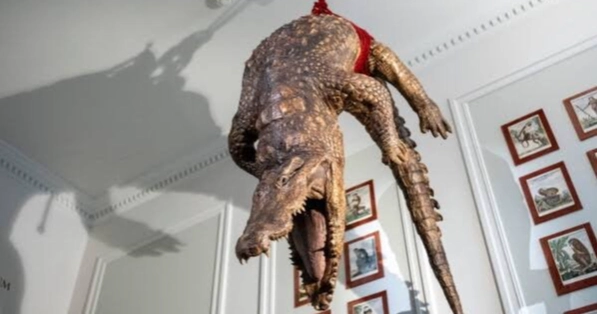
A giant crocodile with its jaws wide open greets visitors entering Amsterdam's newly opened Art Zoo museum, staring down from above as if ready to attack.
The 12-foot-long preserved reptile is among hundreds of taxidermied animals displayed throughout the museum, alongside carefully arranged bone collections, illuminated tulips in glass jars and cabinets filled with unusual fish.
Although the museum is not designed around Halloween, its unusual and somewhat eerie displays make it an attraction for visitors seeking something different during the spooky season.
"It was a little creepy," said Tomáš Vaško, a Slovak resident of Amsterdam, after visiting the museum on a gloomy October day.
The museum was established by Dutch artists Jaap Sinke and Ferry van Tongeren, who took inspiration from the historical "wunderkammer" tradition. These curiosity cabinets were assembled by wealthy Europeans during the 16th and 17th centuries to exhibit unusual objects from nature.
"We enjoy telling stories through animals," van Tongeren told The Associated Press. "We like to create drama and give the animals an attitude, unlike traditional taxidermists, who mainly try to reproduce nature."
Inside the museum, a cheetah appears to lounge in an alcove while a cassowary stands nearby. Elsewhere, a Japanese giant spider crab spreads its six-foot-long legs above a doorway, beside the skeletal remains of a mastodon reaching almost to the ceiling.
Unlike traditional natural history museums, where animals are displayed in lifelike poses, Art Zoo presents them in dramatic and imaginative arrangements.
The artists gained international recognition in 2015 when British artist Damien Hirst, known for his work involving preserved animals, purchased their entire exhibition at an art show in London.
The museum is housed in a 17th-century canal-side building, where visitors move through exhibition rooms surrounded by dark metal cages. Interestingly, it is the human visitors who are kept behind bars, while the preserved animals appear to roam freely.
"We really like the concept of having all the people in a cage and then all the animals free," van Tongeren said. "In that way, the whole building becomes one artwork."
The artists said none of the animals in their collection were captured from the wild. According to Sinke, all the specimens came from zoos where the animals died of natural causes. He added that obtaining the necessary documentation can be complicated, which is why they mainly source specimens from Europe, allowing them to trace their backgrounds.
Sinke and van Tongeren also describe their artistic collaboration as a trio, considering naturalist Charles Darwin their third contributor. They developed the museum around the idea of bringing back Darwin's sense of wonder.
A wall display featuring a series of sideways-facing busts of Darwin pays tribute to the scientist who developed the first scientific theory of evolution. The artists also find irony in celebrating Darwin inside a building that previously housed a Biblical Museum.
Not every creature on display is genuine. Beneath the suspended crocodile, visitors can see a collection of Jenny Hanivers — modified ray carcasses that 16th-century sailors transformed into bizarre-looking creatures and falsely presented as sea monsters to deceive collectors.
With their distorted faces and staring eyes, the strange figures appear to watch visitors as they move through the museum's cage-like exhibition rooms.