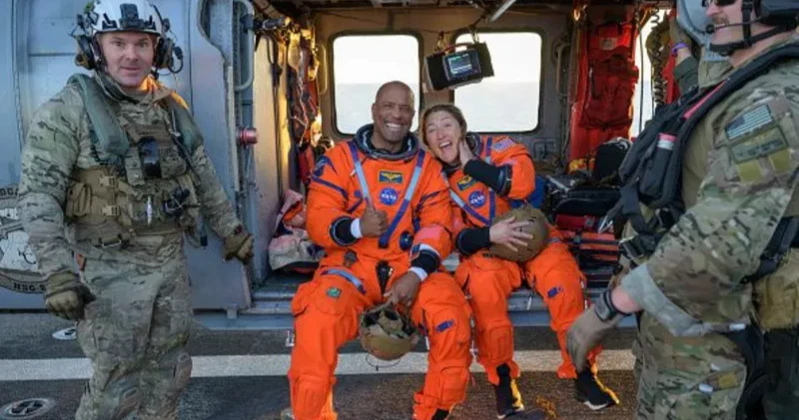
Four astronauts have completed a historic mission, travelling farther into space than any humans before during a 10-day journey to the Moon and back.
The NASA-led Artemis II mission followed every stage of the journey, from launch to a tense return to Earth, capturing global attention.
Before liftoff, astronauts said they usually remain calm on launch day. But for many watching, the moment was overwhelming. As the rocket blasted off from Kennedy Space Center, the intense brightness, deafening sound and powerful force created an unforgettable scene. At the top of the 98-metre rocket were four astronauts heading toward the Moon.
The crew — Reid Wiseman, Victor Glover, Christina Koch and Jeremy Hansen — soon shared their first view of Earth from space. “Earth, you look beautiful,” Glover said, as the spacecraft began its roughly 250,000-mile journey. He told me he'd spoken to his wife and three children about the possibility that he might not come back.
Reid Wiseman also said he'd had very honest conversations with his two daughters about the dangers involved with this endeavour. He'd brought them up as a single dad after his wife died six years ago. As the crew neared their destination, with the Moon growing ever larger in their spacecraft's window, new features became visible on the lunar surface.
They named a crater a bright spot visible from Earth after Reid's late wife Carroll. The crew, all in tears, came together to hug their commander and friend. And back in Houston, there wasn't a dry eye at mission control and that includes the BBC team.
As they adjusted to microgravity, live video showed how limited their space was. The astronauts lived, worked, ate and slept inside a capsule about the size of a minibus, with no privacy as millions followed their mission in real time.
Even basic facilities drew attention. Their specially designed toilet system, which cost millions of dollars, faced some technical issues, forcing the crew to use backup methods for certain needs.
At Johnson Space Center, engineers and flight controllers closely monitored the spacecraft’s systems, including navigation and life support. The mission was a test flight, marking the first time humans travelled on this rocket and spacecraft, making safety a top concern.
Ahead of launch, astronauts spoke openly with their families about the risks. Hansen discussed the possibility he might not return, while Wiseman had similar honest conversations with his children.
The mission went on to break the distance record set by the Apollo 13 mission, eventually reaching about 252,756 miles from Earth. Along the way, the astronauts captured thousands of images and described the Moon’s surface as it passed beneath them.
The mission also highlighted NASA’s future plans, including a return to the Moon with a landing expected later this decade and long-term goals of sending humans to Mars. Officials say the aim is to build on past achievements rather than repeat them.
The most dangerous part of the mission came during re-entry. As the capsule returned to Earth, it faced extreme heat and lost communication for several minutes, creating tense moments in mission control.
Relief came when contact was restored and the spacecraft was seen descending under parachutes before safely splashing down in the Pacific Ocean.
Cheers erupted at mission control as the astronauts were confirmed safe, marking the successful end of a high-risk test flight.
The crew described the journey as life-changing and said the bond they formed would last a lifetime. What began as a mission by four astronauts ended with them returning as widely recognised figures, having taken millions of people along on a remarkable journey beyond Earth.