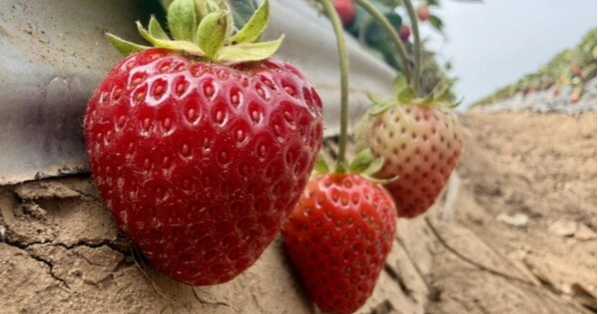
Experienced strawberry farmer Rod Koda is harvesting fruit from his California fields well beyond the usual growing season, thanks to a promising technique that uses steam to improve soil health.
Koda said plots treated with steam before planting produced nearly twice as many organic strawberries this year as other fields on his farm. The green fields near the Pacific Coast are part of a project exploring alternatives to chemical fumigants used to control soil-borne diseases and weeds.
“It's a very noticeable difference,” Koda said.
Steam has been used in greenhouses for decades, but California researchers are working to adapt the technology for open fields where strawberries, one of the state's major crops, are grown. The effort aims to help organic farmers increase production while reducing the use of chemicals that environmental groups say can threaten the health of farmworkers and people living near agricultural fields.
Rick Tomlinson, president of the California Strawberry Commission, said researchers have been studying steam treatment for more than a decade. They are now working to make the process faster and more practical for large farms.
The industry is also exploring other alternatives to chemical fumigants, including removing oxygen from the soil to control diseases and developing strawberry varieties with greater resistance to them, he said.
“Fundamentally, there's this disease in the soil and if you don't have some solution, you're just rolling the dice and one of the years you're going to end up bankrupt,” Tomlinson said, warning that soil-borne diseases can destroy an entire field.
California produces about nine out of every 10 strawberries grown in the United States. The crop covers around 35,000 acres (14,000 hectares) in the state and ranked among its top 10 agricultural commodities in 2025.
Farmers have traditionally relied on chemical fumigants because strawberries grow close to the ground and their soft flesh makes them vulnerable to diseases.
Jenny Broome, a University of California, Santa Cruz researcher involved in the project, said machines can inject steam into the soil before planting to kill harmful organisms and weeds, potentially improving crop yields.
Four California growers took part in trials last autumn, Broome said. On Koda's farm, steam-treated fields produced more strawberries and experienced less damage from fusarium wilt, a fungal disease.
The technique could also be useful for growing lettuce, carrots and other high-yield crops, she said. However, making the process affordable remains a challenge. Researchers are working to improve the machines so they can treat larger areas of farmland in less time.
“We're going back to the future, where we're looking back at an older technology but we're finding more ways to engineer more efficiently and use it,” Broome said.
David Andrews, chief science officer at the Environmental Working Group, welcomed efforts to find alternatives to traditional soil fumigants. He said farmworkers and their families have faced exposure to the chemicals, while technological improvements and growing health concerns have increased interest in other methods.
“The economics are shifting,” Andrews said.