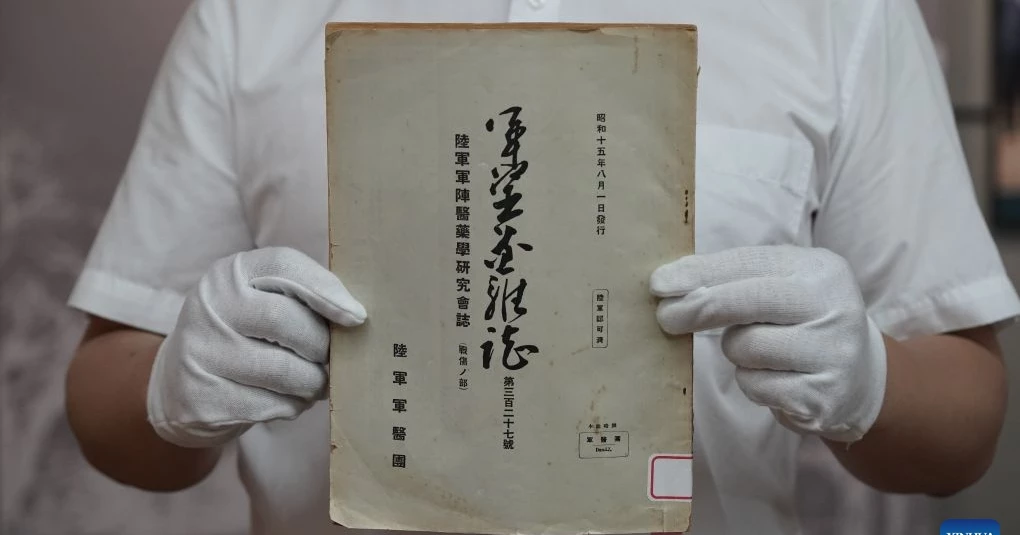
A museum in northeastern China has released new details about human experiments allegedly carried out by the Imperial Japanese Army during World War II, including cases in which animal blood was transfused into prisoners.
According to the Exhibition Hall of Evidences of Crimes Committed by Unit 731 of the Imperial Japanese Army in Harbin, historical records show that Japanese military doctors conducted experiments on 23 prisoners of war in 1938 using blood taken from horses, sheep, dogs, rabbits and chickens.
Researchers at the museum said the information comes from a report written by Japanese military surgeon Tsutomu Saito. The report, which examined the use of animal blood transfusions for severe blood loss, was later published in a Japanese military medical journal in August 1940 after being presented at a military medical conference earlier that year.
Museum researcher Jin Shicheng said the Imperial Japanese Army was exploring various methods of supplying blood to wounded soldiers on the battlefield. These included preserved blood, serum, dried blood and blood taken from corpses. As part of those efforts, researchers experimented with directly transfusing fresh animal blood into humans.
According to the archived report, victims in experiments involving massive blood loss had between 1,200 and 2,500 millilitres of blood removed. Records described severe physical reactions, including unconsciousness, breathing difficulties and symptoms resembling suffocation.
After receiving animal blood transfusions, some victims reportedly developed high fever, chills, bloody urine and other serious reactions.
Another museum researcher, Tan Tian, said Japanese military personnel also carried out experiments involving direct injection of animal serum into human arteries. According to the records, victims’ necks were cut open and blood flow in the carotid artery was restricted before the serum was injected for observation.
Researchers said chicken blood was also injected into victims so that doctors could monitor how long the blood cells remained in the human body through microscopic examinations conducted over several days.
Jin said the publication of these studies in publicly available medical journals suggests that knowledge of such human experiments was widespread within parts of Japan’s medical community at the time.
The museum noted that the same journal contained numerous articles written by senior members of Unit 731, including Shiro Ishii and Masaji Kitano, covering bacteriological warfare and human experimentation.
Japanese media outlet [Kyodo News](https://english.kyodonews.net/?utm_source=chatgpt.com) reported on the findings last week, describing the experiments as a clear violation of medical ethics.
Responding to questions on the issue, Chinese Foreign Ministry spokesperson Guo Jiakun said those responsible for large-scale human experimentation and germ warfare during the war should be remembered as a source of lasting shame.
During World War II, Japan established a network of biological warfare facilities across Asia. Unit 731, based in Harbin, served as a secret center for biological weapons research and human experimentation, according to Chinese historical records.