NASA's newest space telescope was launched into orbit on Tuesday, embarking on a mission to survey the entire sky in an unprecedented way. This ambitious project aims to analyze hundreds of millions of galaxies and their collective cosmic glow, tracing back to the universe's earliest moments.
The Spherex observatory was carried into space by a SpaceX rocket from California, entering a polar orbit around Earth. Alongside it, four small satellites were deployed to study the sun. After separating from the rocket’s upper stage, Spherex drifted into space with Earth’s blue surface visible behind it.
With a budget of $488 million, the Spherex mission seeks to deepen our understanding of galaxy formation and evolution over billions of years, as well as the rapid expansion of the universe in its infancy. Within our own Milky Way, the telescope will search for water and other life-essential compounds in the icy clouds where new solar systems take shape.
Weighing 1,110 pounds (500 kilograms) and shaped like a cone, Spherex is equipped with infrared sensors designed to capture a wide field of view. Over two years, it will complete four full-sky surveys from its orbit 400 miles (650 kilometers) above Earth. Unlike NASA’s Hubble and Webb telescopes, which focus on detailed images of galaxies, Spherex will measure the total cosmic light emitted over time, including from the earliest galaxies formed after the Big Bang.
NASA powers down two instruments on twin Voyager spacecraft to save power
“This cosmological glow encapsulates all the light ever emitted,” explained Jamie Bock, the mission’s chief scientist from the California Institute of Technology. By studying this glow, scientists aim to uncover previously unnoticed light sources and gain insights into the origins of galaxies.
While the telescope won’t directly observe the Big Bang, it will capture its aftermath, offering valuable data on the universe’s early evolution. Its infrared sensors can detect 102 colors beyond human vision, creating the most detailed and colorful cosmic map ever produced.
"It's like viewing the universe through rainbow-colored glasses," said Beth Fabinsky, deputy project manager at NASA’s Jet Propulsion Laboratory. To keep its infrared detectors at ultra-low temperatures—minus 350 degrees Fahrenheit (minus 210 degrees Celsius)—Spherex is uniquely designed with three aluminum-honeycomb cones nested inside one another, resembling a large protective collar.
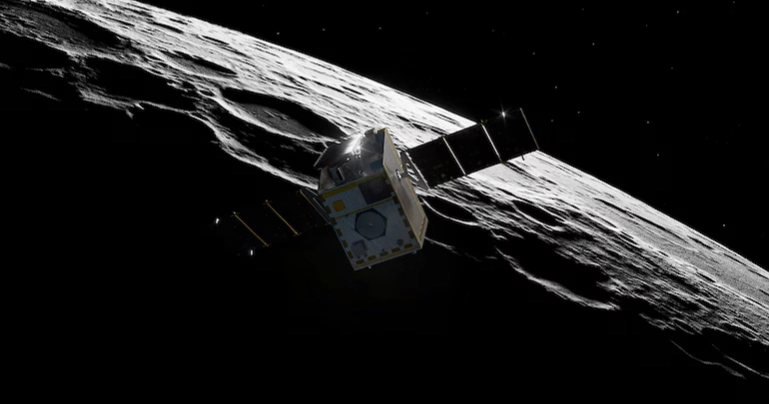
In addition to launching Spherex, the SpaceX Falcon rocket also deployed four NASA satellites, known as Punch, into their own orbit. These satellites will study the sun’s outer atmosphere and solar wind.
Private lunar lander Blue Ghost aces moon touchdown with special delivery for NASA
The launch had been delayed for two weeks due to technical issues, but the mission is now underway, set to expand our understanding of the universe like never before.