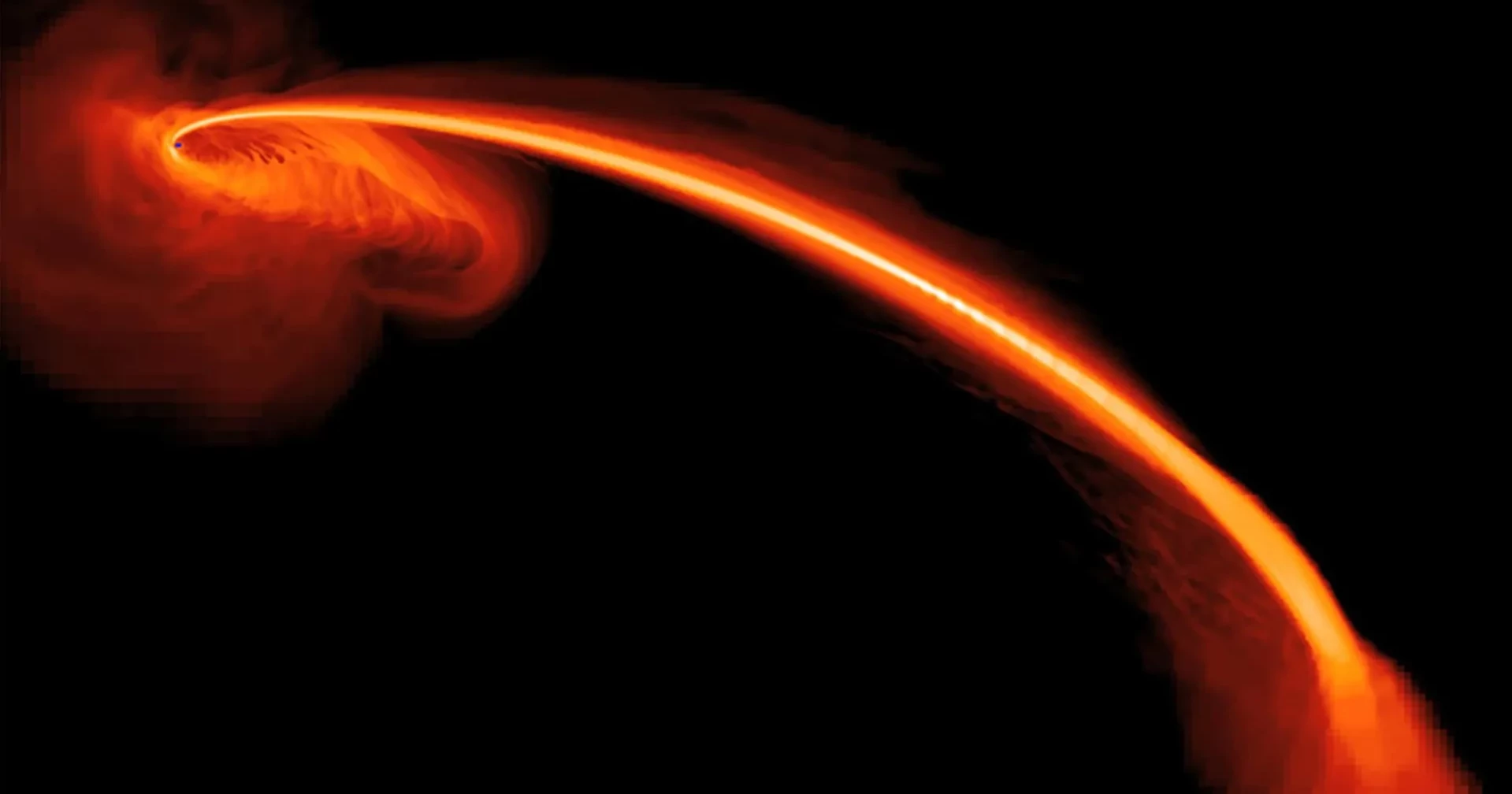
Rapidly spinning stars may explain fading flares from black hole encounters
UNB, New York: The rapid rotation of a star before its first close encounter with a black hole may explain why some recurring bursts of light from such encounters gradually become weaker, according to a new study by astrophysicists at Syracuse University.
The study, published in The Astrophysical Journal, examines rare events known as repeating partial tidal disruption events (rpTDEs), in which a star survives a close encounter with a black hole but loses part of its mass.
The surviving core remains in orbit and returns for further close encounters, shedding more material each time and producing fresh bursts of light.
Astronomers have identified around 10 such repeating systems, four of which have shown progressively weaker flares. Previous theoretical models, however, struggled to explain the fading pattern.
In a normal tidal disruption event, a black hole's powerful gravity completely tears a nearby star apart. The resulting debris falls toward the black hole and releases energy in the form of light.
In a partial disruption, the star survives because it does not pass close enough to be completely destroyed. The amount of material stripped during each encounter depends partly on the star's internal structure.
The researchers found that the star's rotation plays an important role. Previous work showed that the black hole's tidal forces can cause a surviving star to spin faster after each encounter.
As the star spins faster, the material stripped from it can return to the black hole more quickly. This can keep the peak rate of material falling back relatively stable, even when the amount of stripped material declines, resulting in flares of similar brightness.
The new study suggests that this changes if the star was already rotating rapidly before its first encounter.
In that case, subsequent encounters cannot significantly increase its rotation rate. The stripped material therefore takes roughly the same amount of time to return to the black hole. As less material is removed during successive encounters, the peak fallback rate declines, causing each flare to become progressively fainter.
The researchers believe the star's rapid initial rotation could be explained by the Hills mechanism, in which a binary star system is disrupted by a supermassive black hole.
Under this scenario, two closely orbiting stars approach a black hole. The black hole's gravity tears the binary apart, sending one star away while capturing the other in a tight orbit.
Before the disruption, the stars may have been tidally locked, meaning they rotated at the same rate as they orbited each other. A very close binary would therefore produce a rapidly spinning star, which could later be captured by the black hole.
Lead researcher Ananya Bandopadhyay and her colleagues said the mechanism could explain both the star's rapid rotation and its unusually short orbit around the black hole.
The findings may also shed light on some stars orbiting Sagittarius A*, the supermassive black hole at the centre of the Milky Way, where the Hills mechanism may have played a role in placing some stars into their current orbits.
Source: Science Daily