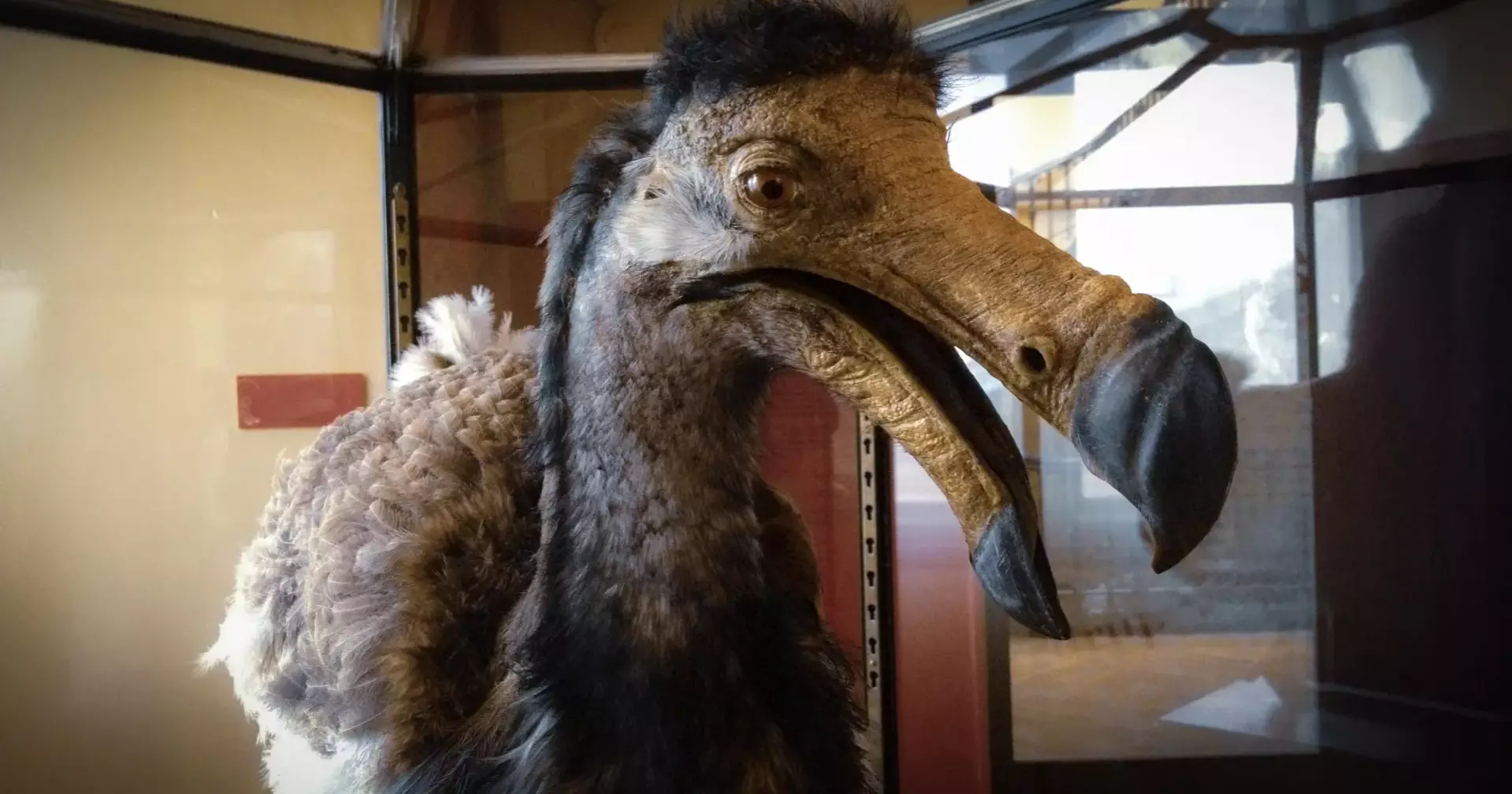
New research into the extinct dodo bird has revealed previously unknown clues about its sensory abilities, suggesting that the species may have had a stronger sense of smell, greater sensitivity to touch and a more flexible pattern of daily activity than its closest living relatives.
Scientists used high-resolution CT scans and digital reconstructions of dodo skulls to examine the spaces where the birds' brains once existed. Their findings indicate that the dodo may have been active not only during daylight but also around dawn and dusk.
The research also suggests that the dodo relied more heavily on its sense of smell than modern pigeons and doves. Its large upper beak, meanwhile, appears to have been particularly well adapted for detecting tactile information from its surroundings.
Together, the findings provide fresh insight into how the flightless bird may have searched for food and explored its environment on the island of Mauritius before becoming extinct in the late 17th century.
“The dodo is one of the world's most recognizable extinct animals, yet surprisingly little is known about how it actually lived,” said Peter Andrew Hosner, associate professor and curator of birds at the Natural History Museum Denmark and a co-author of the study published in the Zoological Journal of the Linnean Society.
Researchers examined CT data from three dodo skulls, including the only two complete specimens known to exist. One is housed at the Natural History Museum Denmark and the other at the Oxford University Museum of Natural History.
The Copenhagen skull, which has long been displayed at the Danish museum, was given new scientific attention as preparations continue for a new museum building and permanent galleries scheduled to open in 2027.
High-resolution CT scanning allowed scientists to create detailed three-dimensional models of the skulls without damaging the rare specimens. They then digitally reconstructed the internal cavities that once contained the birds' brains.
Because developing brains leave impressions on the surrounding skull bones, those structures can provide clues about how extinct animals processed information and interacted with their surroundings.
“Studying extinct animals is a bit like detective work,” said Christy Anna Hipsley, associate professor at the Natural History Museum Denmark and another co-author. She said the preserved impressions inside the skulls allow scientists to reconstruct aspects of how the dodo sensed and experienced its environment.
The researchers compared the reconstructed brain cavities of the dodos with those of modern pigeons and doves, their closest living relatives. The comparison revealed several anatomical differences that could help explain the dodo's distinctive sensory capabilities.
Scientists cautioned, however, that anatomy alone cannot establish exactly how the bird behaved. The findings instead offer evidence-based clues about its possible feeding habits, movement and interaction with the island ecosystem.
The study also challenges the popular image of the dodo as a clumsy or unintelligent bird whose extinction was inevitable. The researchers found no evidence suggesting that the dodo had inferior cognitive abilities compared with living pigeons and doves.
Instead, they say the bird developed a unique combination of sensory adaptations over millions of years in the isolated environment of Mauritius.
Hosner said the research does not resolve all the mysteries surrounding the dodo, but it provides a stronger scientific basis for understanding the bird's biology and ecology.
The study, he said, helps replace long-standing myths about the extinct species with a more accurate picture of how the dodo may have lived before disappearing from the Earth.
Source: Science Daily