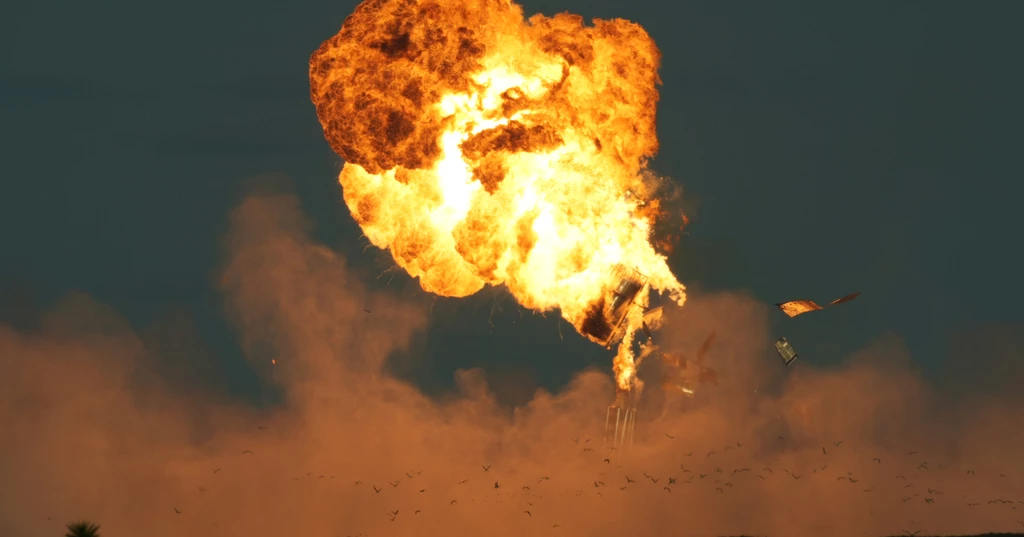
SpaceX's effort to recover both stages of its Starship rocket at the launch pad suffered a setback on Friday when the booster fell into the Gulf of Mexico and exploded. However, the spacecraft successfully reached orbit in what marked its most ambitious test so far.
Rather than returning to its Texas launch pad after liftoff, the first-stage booster was diverted to an offshore location. Despite losing the booster, the spacecraft continued its journey and is scheduled to return to the launch site on Saturday, provided no further problems arise. The mission could continue for up to 22 hours.
The flight marks the first attempt to bring Starship back to its launch pad from orbit, where mechanical arms attached to the launch tower are expected to catch it in midair. The booster explosion prevented the company from achieving its planned double recovery.
SpaceX initially aimed to retrieve both sections of the rocket for future reuse, a feat never accomplished anywhere in the world. Company owner Elon Musk believes full reusability could enable the rapid and regular launch schedules needed to establish bases on the moon and eventually send humans to Mars.
Shortly after entering orbit, Starship deployed 26 of SpaceX's most advanced Starlink satellites. The spacecraft is expected to complete 15 orbits around Earth at an altitude of approximately 170 miles (275 kilometres) before attempting its return to the launch site on Saturday.
SpaceX had previously completed three successful booster catches at its sprawling Starbase facility near the US-Mexico border, making Friday's failure particularly unexpected.
"Well, that certainly isn't the news that we had hoped to hear for today," SpaceX launch commentator Kate Tice said, noting that the outcome was consistent with the company's extensive safety procedures to protect the launch pad. The company did not immediately explain the cause of the failure.
Friday's mission was the first attempt to catch the upgraded 236-foot (72-metre) booster, designed as the production model for future lunar and Mars missions. It also marked the company's first effort to recover the 171-foot (52-metre) spacecraft itself.
Together, the two stages form the world's largest and most powerful rocket, standing an impressive 407 feet (124 metres) tall.
The spacecraft components of the previous 14 Starship flights ended up in the ocean, either through planned splashdowns or accidental destruction in fiery debris.
During the first full-scale test flight in 2023, several engines failed to ignite, prompting the activation of the rocket's self-destruct system as it began tumbling.
The previous test in September was the first Starship mission to reach orbit, although SpaceX made no attempt to recover either rocket stage.
The company plans to begin launching Starships from Florida within the next few months and from Louisiana in the coming years.
Expanding launch infrastructure alongside complete rocket reusability could dramatically increase the frequency of space missions, SpaceX Vice President of Launch Kiko Dontchev said at a NASA technology summit last week at Florida's Kennedy Space Center.
"That's how you go from zero launches to 10 to 100 to 1,000 to 10,000 to 100,000," he said.
SpaceX's smaller Falcon rockets will continue operating from Cape Canaveral, transporting astronauts to the International Space Station for NASA, while launches from California will carry Starlink satellites. Other satellites will also continue using Falcon rockets for the time being, although Musk ultimately wants Starship to replace the Falcon fleet.
"Falcon rockets are still not fully reusable. We still throw that second stage away every single flight. Starship, we're going to catch both the first stage and second stage," Dontchev said before Friday's launch.
NASA is providing SpaceX with billions of dollars to develop Starships capable of carrying Artemis astronauts to the moon. Jeff Bezos' Blue Origin is another major competitor in the programme.
NASA plans to decide a year before the Artemis IV lunar landing mission whether astronauts will reach the lunar surface aboard Musk's Starship or Bezos' Blue Moon. The mission would mark the first astronaut landing on the moon in more than half a century.
Under next summer's Artemis III mission, astronauts will practise docking their capsule with Blue Moon and subsequently Starship while orbiting Earth. The exercise will help prepare for a crewed lunar landing as early as 2028.
"We are looking forward to some of that on-orbit Starlink capability on Artemis III," NASA Administrator Jared Isaacman said in a post on X after Starship reached orbit.