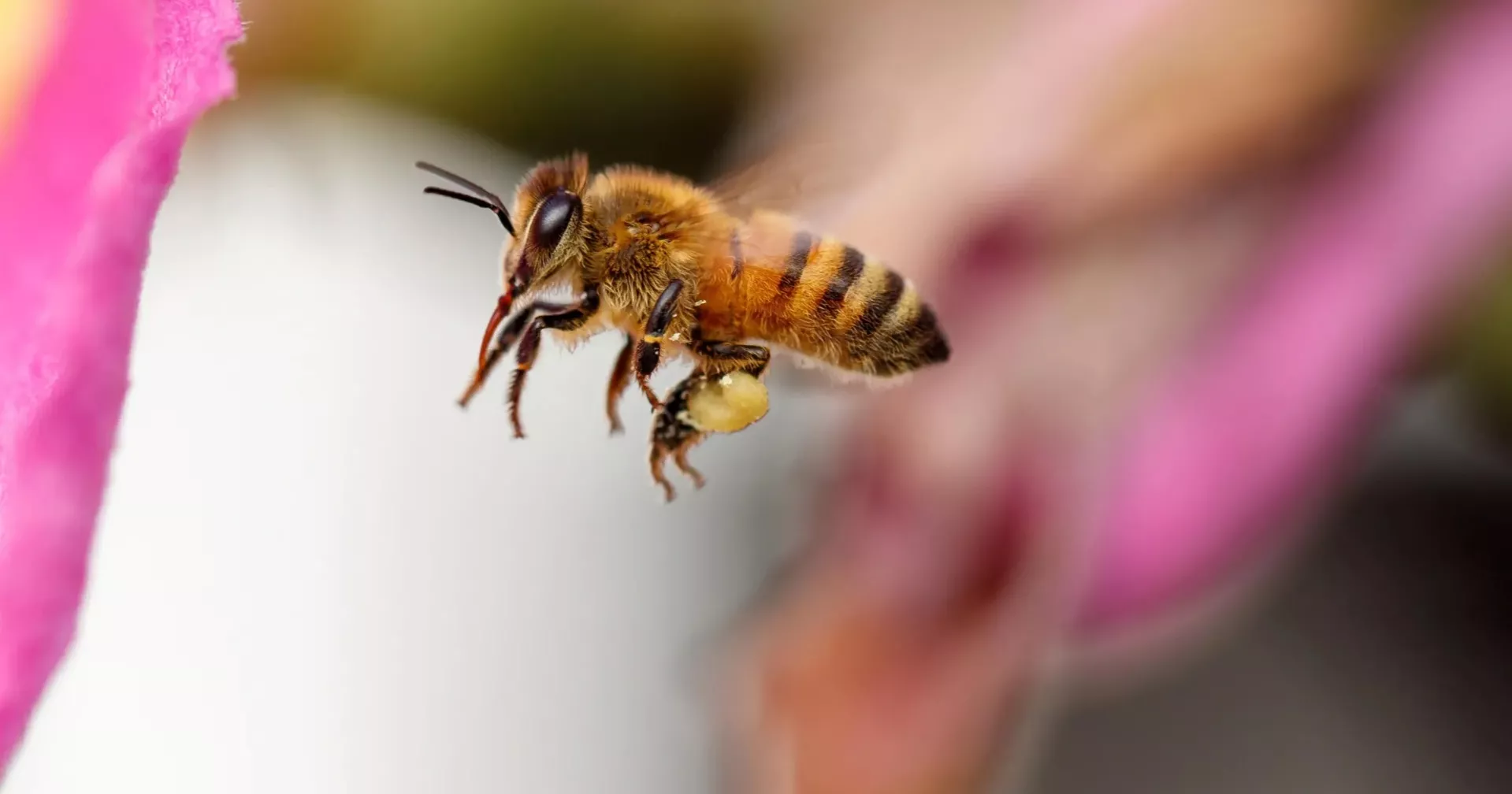
Honey bees are much more skilled at navigation than previously believed, with new research showing that individual bees follow their own preferred flight routes and repeat them with impressive precision using landmarks in the environment.
Researchers at the University of Freiburg tracked honey bees flying between their hive and a food source about 120 metres away and found that each bee consistently used nearly the same path on every trip.
The study was led by Andrew Straw, whose team used a drone-based tracking system to observe the insects in a natural agricultural setting.
To monitor the bees, researchers attached tiny reflective markers to them and used a technology called Fast Lock-On (FLO) Tracking. The system enabled the drone to identify and follow individual bees within milliseconds, allowing scientists to record highly detailed three-dimensional flight paths.
The findings showed that each bee preferred a specific route and was able to follow it with exceptional accuracy while travelling both to and from the food source.
“Our recordings show that each bee has its own preferred route and flies it very precisely,” Straw said, adding that the behaviour is so distinct that “each bee has its own personality.”
The research team analysed 255 flight paths near the Kaiserstuhl region. The study area included hedges, a cornfield and a large tree located between the hive and the feeding site, forcing bees to take indirect routes.
Scientists found that bees often flew only a few centimetres away from their previous paths, demonstrating a surprisingly high level of consistency.
The most accurate navigation occurred near noticeable landmarks, particularly the tree. In contrast, bees showed greater variation when flying over the cornfield, where the landscape offered fewer visual references.
According to the researchers, the findings suggest that honey bees rely heavily on visual landmarks to guide their journeys and improve navigation accuracy.
The study also offers new insights into the famous “waggle dance,” the method honey bees use to communicate the location of food sources to other members of the colony.
Previous studies showed that the directional information shared through the waggle dance is not always highly accurate and can vary by about 30 degrees for food sources located around 100 metres away.
However, the new research indicates that this imprecision is not due to poor navigation skills.
Researchers found that bees travelling to locations they already know can stay extremely close to their established routes, deviating by only a few degrees even in areas where flight paths vary the most.
The findings suggest that honey bees possess much stronger navigational abilities than their dance communication alone would indicate, making them among nature’s most precise insect navigators.
Source: Science Daily