
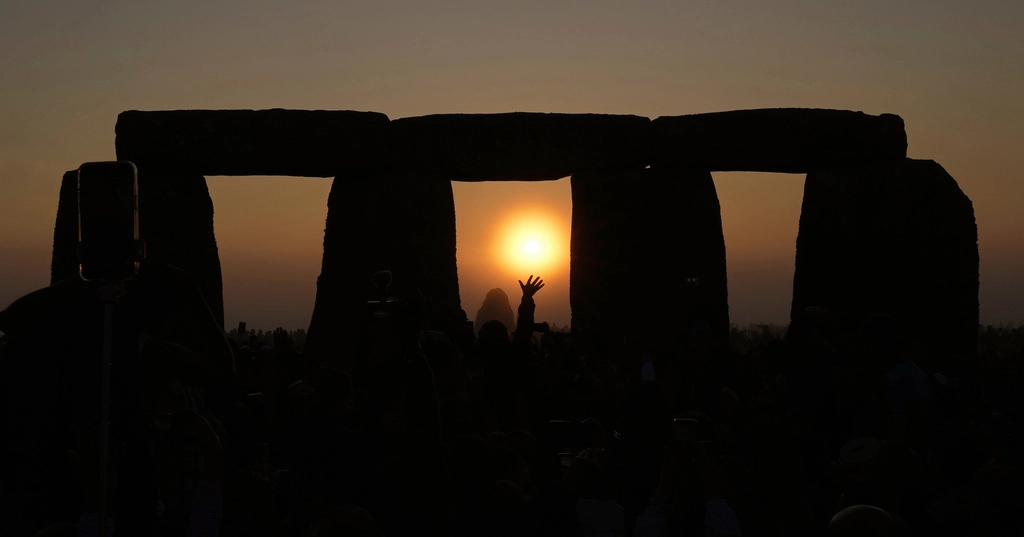
People across the Northern Hemisphere are experiencing the longest day of the year on Sunday as the summer solstice marks the beginning of astronomical summer.
The event also signals the start of winter in the Southern Hemisphere, where Sunday is the shortest day and longest night of the year.
The term "solstice" originates from the Latin words sol, meaning sun, and stitium, meaning pause or stop. The summer solstice occurs when the sun reaches its highest and longest path across the sky before beginning its gradual retreat, causing daylight hours to shorten each day until late December.
For centuries, cultures around the world have marked the solstice with celebrations and monuments, including Sweden's midsummer festivities and the ancient stone circle of Stonehenge, which was designed to align with the sun's position during the solstices.
The phenomenon is caused by the Earth's tilted axis as it orbits the sun. Because the planet is tilted, sunlight and warmth are distributed unevenly between the Northern and Southern hemispheres throughout most of the year.
The solstices occur when the Earth is tilted at its maximum angle either toward or away from the sun, resulting in the greatest differences in the length of day and night.
During the Northern Hemisphere's summer solstice, the upper half of the Earth is tilted toward the sun, producing the longest day and shortest night of the year. The summer solstice typically falls between June 20 and 22.
Conversely, the Northern Hemisphere's winter solstice occurs between December 20 and 23, when the region is tilted furthest away from the sun, leading to the year's shortest day and longest night.
The solstice differs from the equinox, which occurs when the Earth's tilt is neither toward nor away from the sun. During an equinox, both hemispheres receive nearly equal amounts of sunlight, resulting in day and night lasting almost the same length.
The word "equinox" is derived from Latin terms meaning "equal" and "night." The Northern Hemisphere experiences the autumnal equinox between September 21 and 24 and the vernal, or spring, equinox between March 19 and 21.
Scientists also distinguish between astronomical and meteorological seasons.
Astronomical seasons are based on the Earth's position in relation to the sun, while meteorological seasons are determined by annual temperature patterns and divide the year into three-month periods. Under the meteorological calendar, summer begins on June 1, autumn on September 1, winter on December 1 and spring on March 1.