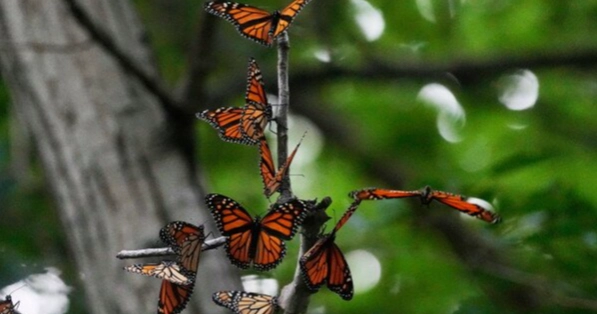
Scientists are using miniature tracking devices to learn more about the long-distance migration of monarch butterflies across North America, hoping to identify important resting and feeding sites before habitat loss threatens them further.
Rebeca Quiñonez-Piñón, a senior scientist at the National Wildlife Federation, has been fascinated since childhood by where monarch butterflies stop to feed and rest during their seasonal journeys. She is now working with other researchers to attach tiny tracking devices to hundreds of butterflies to identify these critical locations.
Every year, large groups of orange-and-black monarch butterflies travel approximately 3,000 miles (4,800 kilometres), from areas as far north as southern Canada to central Mexico. They spend the winter in forests of oyamel fir trees within a protected biosphere reserve that is also a UNESCO World Heritage site.
Despite decades of research, scientists have struggled to determine the butterflies' exact migration routes, daily travel distances and overnight resting places. Solar-powered radio transmitters attached to nearly 1,750 monarchs this year are helping researchers gain new insights.
The findings could support conservation efforts as monarch populations face growing threats from habitat destruction, pesticide use and climate change.
Quiñonez-Piñón said the well-known butterfly provides an opportunity to raise awareness about the wider threats facing insects and their essential contribution to plant life and ecosystems.
She stressed that protecting pollinators is necessary to maintain healthy ecosystems and ensure the availability of food sources for humans.
People can also follow individual butterflies' journeys through a free mobile application called Project Monarch Science.
Tracking butterflies through Texas and beyond
Quiñonez-Piñón is leading a research project that combines real-time migration tracking with community-based scientific contributions to identify important stopover locations in Texas. The National Wildlife Federation recently joined an international research team involving scientists from three countries.
Although not all monarch butterflies migrate, a significant portion of those living east of the Rocky Mountains travel through a narrow passage known as the "Texas funnel" during their autumn and spring migrations.
In autumn, they head south towards Mexico. During spring, they travel north to reproduce and lay eggs before completing their life cycle.
Their routes across Texas can change from year to year depending on the availability of water, nectar and suitable trees for overnight shelter.
Since tracking began last year, researchers have recorded several previously undocumented migration connections. One butterfly from Utah, west of the Rocky Mountains, was found joining eastern monarchs in central Mexico.
Other butterflies travelled south along the Eastern Seaboard before crossing the Gulf of Mexico and continuing through Mexico, revealing migration connections that scientists had not previously documented on such a scale.
Emma Pelton, senior conservation biologist at the Xerces Society for Invertebrate Conservation, said the findings were revealing migration patterns and connections between butterfly populations that researchers had previously only suspected.
She said the research team was encouraged by the progress made during its first year, particularly because earlier tracking devices were considered too large or heavy for the insects.
Since this year's migration began, approximately 175 tagged butterflies have been detected in Mexico.
Only selected butterflies receive tracking devices
The newly developed tracking devices cost around $200 each and weigh approximately as much as a drop of water. They were developed by Cellular Tracking Technologies.
According to Quiñonez-Piñón, properly trained researchers can attach the devices without harming the butterflies when the procedure is carried out correctly.
However, not every monarch is suitable for tracking. To avoid placing excessive weight on the insects, researchers generally select butterflies weighing more than 400 milligrams, roughly the weight of a standard pill.
David La Puma, vice president of global market development at Cellular Tracking Technologies and coordinator of the Project Monarch Collaboration, said researchers and community scientists also consider wing length when selecting butterflies for the devices.
The tagging process requires careful handling. Researchers typically catch butterflies using nets and place them in cool conditions to calm them before attaching the transmitters.
Each butterfly is positioned on a specially designed board, with its legs and antennae protected. Researchers then apply adhesive to its abdomen using a cotton swab before gently attaching the tracking device. Once the procedure is complete, the butterfly is released.
New tracking technology offers opportunities but has limitations
Louie Yang, an insect ecologist at the University of California, Davis, who was not involved in the research, described the technology as remarkable because it allows scientists to observe migration routes and estimate how quickly butterflies travel across different regions.
However, he cautioned that the system does not provide the exact location of an individual butterfly. Instead, it records the location of a receiver that detects its signal.
A detection also does not necessarily confirm that the butterfly is still alive.
Yang said additional research would be necessary to determine whether the tracking devices influence the insects' natural behaviour.
Climate change and pesticides threaten monarch populations
Monarch butterflies generally live between two and six weeks. However, those that migrate to Mexico can survive for up to nine months, travelling south, spending the winter there and returning north to reproduce during spring.
Their extraordinary migration has also made them a symbol of international migration and the challenges faced by migrants.
Since the mid-1990s, eastern monarch populations have declined by more than 80%, while western populations have fallen by approximately 95%.
Pesticides pose a significant threat to milkweed, the plant on which monarch butterflies lay their eggs and the only food source for their caterpillars.
Human-driven climate change, largely caused by burning coal, oil and gas, is another major threat throughout the year, said Tierra Curry, senior scientist and endangered species codirector at the Center for Biological Diversity.
She explained that prolonged high temperatures in northern regions can disrupt the environmental signals that trigger migration. If temperatures suddenly fall below freezing, butterflies may struggle to complete their journey to Mexico.
Curry also warned that delayed migration reduces the likelihood of butterflies reaching their wintering grounds safely.
Extended droughts can further reduce the availability of water and nectar-producing flowers. Collisions with cars and trucks also kill large numbers of butterflies.
In California, forests used by western monarchs as winter habitats are also being cleared for development.
Late last year, the Trump administration postponed a decision on granting federal protection to monarch butterflies. Several conservation organisations subsequently filed a lawsuit, prompting a court to order the government to make a final decision by 2030.
Despite these challenges, conservationists are continuing efforts to protect the declining populations.
In Texas, protective nets installed along some highways are encouraging butterflies to fly higher and reducing the risk of vehicle collisions, particularly at night when they descend to rest in trees.
Other initiatives include large-scale planting of milkweed and other pollinator-friendly plants in gardens, along roadsides and near transport corridors.
According to Curry, several studies have found that these conservation measures are helping increase local butterfly populations.