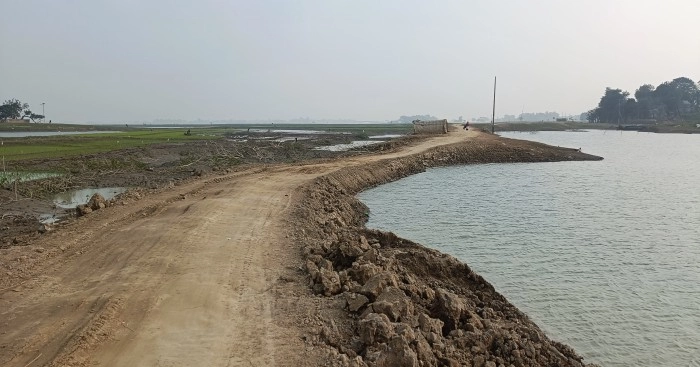
Anxious days are returning for farmers in the haor areas of Sunamganj as work on crop protection dams remains sluggish, even three weeks after the official deadline for starting construction passed.
Although construction has begun in some haors, the overall pace has been slow, fuelling frustration among farmers who depend on the timely completion of embankments to protect their Boro crops from early floods.
Many fear that continued delays could leave vast tracts of farmland vulnerable during the coming monsoon.
According to the Water Development Board, several factors have hindered timely implementation.
Delays in the recession of water from the haors and complications in forming Project Implementation Committee (PIC) have stalled work in multiple upazilas, including Tahirpur, Derai and Shalla.
Fertiliser crunch threatens Kushtia’s onion boom despite high prices
Officials also pointed out that administrative activities were disrupted earlier as officials remained busy with election-related duties.
Despite these setbacks, officials said construction would gain momentum within a few days and that all projects are scheduled for completion by February 28.
Mamun Hawlader, Executive Engineer of the Sunamganj Water Development Board, said that under the KABITA (Kajer Binimoye Taka) policy, a total of 705 projects have been approved for the construction of crop protection dams across 12 upazilas in the 2025–2026 fiscal year.
An allocation of Tk 137 crore has been made to build approximately 500.5 kilometres of embankments.
Although the construction work was formally inaugurated on December 15, progress has been limited.
As of January 6, work had started on only about 400 projects, with overall progress standing at just 15 per cent.
Bumper harvest, plunging prices; Chandpur’s potato market in crisis
Officials said the remaining projects would begin within a week.
A visit to several haor areas revealed that work has yet to begin on most approved projects, while some Project Implementation Committees are still waiting for official work orders.
The slow pace has drawn criticism from the Haor Bachao Andolan.
Leaders of the organisation recently held a press conference expressing concern that, despite the official start date, construction has not commenced in most upazilas.
They also alleged irregularities in the formation of PICs, unnecessary projects and additional allocations, raising doubts over whether the work can be completed within the stipulated timeframe.
Bijon Sen Roy, general secretary of the central committee of the Haor Bachao Andolon, said, “We are very worried about the dam work this time. The progress is very disappointing. If action is not taken now, it could spell bad news for the people of the haor.”
In response, Executive Engineer Mamun Hawlader assured that monitoring has been intensified and that dam construction will be completed on schedule.
According to the Department of Bangladesh Haor and Wetlands Development, Bangladesh has a total of 373 haors as of 2026.
These haors are spread across seven districts in the north-eastern and north-central regions, covering approximately 858,460 hectares.
As haor waters recede, Sunnamganj farmers sow hope in every field
Of them, 95 haors are located in Sunamganj district alone, spanning about 268,531 hectares.
As the agricultural season advances, farmers across Sunamganj continue to watch the embankment work closely, hoping that construction will accelerate before rising waters put their livelihoods at risk.